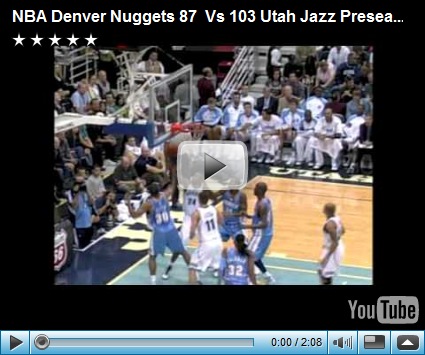
Do any of you remember last year’s pre-season game that was supposed to be the worst ever, but ended up being pretty exciting (for fans, as it went to Overtime, with the good guys winning by a point)? Well, those same two teams faced off last night and here are the highlights (via YouTube – until the NBA pulls this video down). Enjoy, and remember, C.J. Miles for MIP !!!
Friday, October 2, 2009
2009-2010 Pre-season Game 1 Highlights: Denver at Utah
Notice 2
Some articles to expect (when they’re done!):
- A full explanation of my newer revisions for my previously posted new stats. (original post – super duper long; 1st revision)
- Analysis of the revolving door at back-up PG over the years for the Jazz
- X-O’s analysis of the evolution of the Forward oriented offense (from Dick Motta), over time and multiple rules changes to the game
- 2009-2010 Season Preview
- Hardcore stat analysis of our current team
- Some nostalgia pieces
- My opinion on the whole Bynum/Kareem issue
Notice
Hello all. No doubt some have noticed a general lack of posting of late. Last off-season I had loads of free time, and enthusiasm, for posting. This off-season things have been a little less super when it comes to free time. (Or some would say, time management) I kept trying to make goals for me to reach per month, then per week, and so forth. These were goals that I was unable to keep when mixing my busy schedule, my so-called career and balancing my family life with the whole ‘blogging’ thing. I’m quite active on twitter, and do stop into a few basketball websites frequently enough to share my views on things. (mostly slcdunk.com and dimemag.com)
I missed blogging about the NBA Draft; the HOF ceremonies; about all the international competitions; and this season there’s not going to be a massive 20+ Pre-Season Preview – like there was last season. I do still enjoy blogging, and still have a lot of posts in me to get out. So I’m not going to be closing the doors – but I will be making myself available for outsourcing. (here’s something I wrote for @Nat77 on her amazing blog; and something I wrote for DimeMag on Jerry Sloan getting in the Hall – if you want to see what kind of stuff I’m capable of)
There’s some unfinished business for both the Jazz and for me – so don’t count us entirely out yet. But for the mean time, expect a few more posts at this location, and hopefully many more on other websites. (hey ESPN, gimme a job – here’s a free sample for Insider: “Kobe Kobe Lakers Slurp Slurp Adande Sportsguy Phil Jackson Jordan Kobe LeBron!”)
If you know how to put my blog in a google reader type of thing, or subscribe to my updates then feel free to do so. Probably the best way to stay connected to my infrequent postings. If you are on twitter I think you should follow me as I generally stop in there every day and talk sports – and announce when I post something too. Follow me @AllThatAmar
Friday, July 31, 2009
Dear Blog reader
Thank you for your support over all these months, all of you, even the people who come here looking for e-mail addresses to use in Nigerian Spam Scams, the 83 people who do not yet have closure on Blue Edward’s paternity case, and of course, the people who are redirected here when searching the ‘net to see if Jeff Hornacek made any all-NBA defense teams. (Btw, the answer is no) I’ve tried to be fair, and write interesting posts for everyone to enjoy. Some deal with stats, others with looking back upon NBA records, or old players or whatever. That said, even when you try you just can’t support 100% of the readership 100% of the time.
So, to the 5 people who visit my blog under 640x480 resolution and the 11 people who visit my blog under 800x600 resolution, I’m really sorry. My blog will not be able to support your continued readership at this point in time. I can only hope that in the year of our Obama-lord 2009 that the only way you are visiting my site (let alone any other) under those pre-millennial resolutions would be if your computer happens to be running in safe mode. I’m flattered, I really am, but if you are in Safe mode, please try to get your computer fixed. The basketball commentary can wait for another time.
If those are the best resolutions your computer can do, it may be time to spend the $500 bucks to buy a new minimum spec desktop that’ll at least take you to 1024x768 and 1 gig of RAM.
And yes, the vast majority of the random / non-repeat reader of my blog comes here to find out more info on Blue Edwards/Kimberly Van de Perre. (That and pictures of CeCe Boozer)
Thank you,
and now we will resume our regularly unscheduled blogging.
Tuesday, July 28, 2009
Deron Williams / Ronnie Brewer 6th best Backcourt in NBA ?
There are some really good tandems out there in the NBA right now. Kobe Bryant and Derek Fisher, Tony Parker and Emanuel Ginobili along with Rajon Rondo and Ray Allen obviously comprise championship caliber backcourts. Mike Bibby paired up with Joe Johnson causes all kinds of trouble for defenders – similarly Steve Nash and Jason Richardson can flat out make defenders look silly. Even hypothetically amazing backcourts will assemble this season, like in Portland with Andre Miller and Brandon Roy, and down in Orlando with Jameer Nelson and Vince Carter. These are all great backcourts in paper, but just where does Deron Williams and Ronnie Brewer rank among them? Justin DeFeo, of Sir Charles in Charge, states that the Jazz tandem is clearly a Top 10 backcourt in the league – 6th specifically – and one where both players “compliment each other well,” (DeFeo, 2009, ¶13). He continues to say that:
Offense:
Deron dominates the ball on offense. Some teams have some sort of ball-sharing provision between the PG and the SG (like how Brandon Roy basically had to do everything himself in Portland). This has never been the case in Utah, not in Stockton’s time, and not now. Deron has a very solid handle on the ball and is able to maneuver himself into the lane with or without help from screens. Williams does this not with simple blinding speed, or a series of picks from teammates, he uses power and finesse to go from point A to point B, going over any and all terrain in the process. He has all the moves, and can get into the lane whenever he wants. (Essentially, he’s a swashbuckler with a basketball in his hands) He’s not just a PG who will bring the ball up the floor, hang out at the three point line, and pass the ball to someone to start a play. Deron’s penetration allows for defenders to shift their attention from the man they are guarding to Deron Williams (who is a scoring threat in the lane). This shifted attention allows for guys who move well without the ball to find open spots (often in their defender’s blindspots) and be in scoring position. If Deron Williams is daring swashbuckler who can move with a quickness and body control that belie his physique then Ronnie Brewer is the stealthy assassin who moves in the shadows, unaccounted for, with muscles tensed up for a finishing strike. It happens again, and again and again. Ideally, a drive and dish PG would be paired with a guy who had a reliable outside shot – but at best, a three pointer is a 40% success rate, while dunks are, generally speaking, much, much more effective.
Deron is a capable three point shooter – though his percentage has been a roller coaster his entire NBA career (42%, then 32%, then 40%, then 31%), and if he’s the only one of the two with an outside shot you can clearly see a deficiency in that department for this backcourt tandem. (By comparison, LA, Orlando, Atlanta and a few other teams on DeFeo’s list are replete with guys who can absolutely bomb from outside)
This group is just as adept in halfcourt sets as they are on the break. Utah produces a lot of deflections and Brewer starts as many breaks (with his natural quickness and 6’11 wingspan) as he is capable of finishing (with his 42” vertical). Deron hardly ever makes the wrong decision on who to pass to, and the two (naturally) hook up for Alley-Oops more frequently than any Utah tandem since Mark Jackson played here. Offensively, the two are nearly a match made in heaven.
Defense:
If Deron is the leader on Offense, Ronnie is the leader on Defense. Brewer starts the game off checking the other teams’ best scoring wing – regardless if he is a shooter or slasher or whatever. Ronnie gets the call until AK gets off the bench. If the last few playoffs are an indication – few players play better man defense (without fouling) on Kobe Bryant than Brewer does. In no way am I suggesting that Brewer shuts Kobe down, I’m just saying that he plays good man defense. Many times I’ve seen Kobe take shots that absolutely could not have been defended better without the aid of being allowed to do Bruce Bowen style fouling, and still make them over Ronnie. Kobe just makes amazing shots – and he’s had quite a few against Brewer. Brewer is more than just a speed bump on defense. His long arms, quickness and penchant for playing the passing lanes made him one of the league leaders in steals last season. He’s long enough, with good enough hops that I would expect him to get more ‘from behind’ LeBron style blocks this season though. While Brewer is a physical freak, his defensive instincts lead the way – and that’s usually towards pressuring the other team into making a mistake.
Deron does not get all the flashy steals that Brewer does, but he is quick enough on defense to stay with faster ball handlers, and just big and physical enough to discourage them from driving too much. (Just look at how the, honestly, best PG in the NBA, Chris Paul, is so taken out of his game whenever he plays Deron. CP3 owns everyone, and he is rightfully the best PG in the league right now. Deron is just the perfect storm on defense to give him trouble, and good enough on offense to tire him out there) If the first foundation for team defense is to slow down the other team’s ball handler / forward progression, then it’s obvious that Deron Williams is a very solid defender.
Together they comprise a physical, long defensive backcourt. Brewer is 6’7 with the previously mentioned 6’11 wingspan and the quickness of a man much smaller than he. Deron is a 6’3 point guard who was a wrestler in high school and deceptively quick. (check out his draft combine scores, you’ll be surprised) If anything, I think that they are better on defense than they are on offense!
What do the Stats Say:
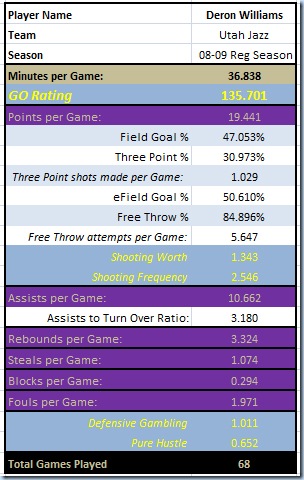
I’m a stats junkie. So this is important to me. Also, I guess I’m debuting my new stats format. If you want to know about what some of these things are, you can always read my treatise on my own created stats. If you don’t want to, just wait for the analysis that will appear below.
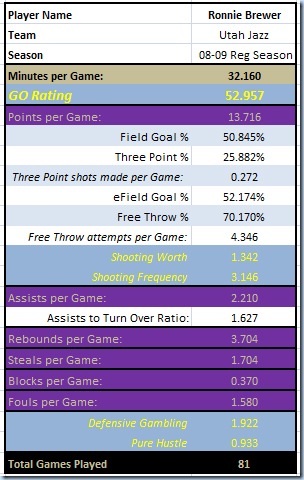
First of all, for those of you following along at home, I have changed the GO Rating, and expect a new post about the New formula shortly. What you need to know about it is what these scores mean. The GO Rating incorporates all possible statistically tracked outcomes on offense, hence the full name of “Gestalt Offense”. The GO Rating is in light blue, all the things in the light blue cell background are my own invented stats. I think they better round out what you see. Anyway . . . what is a good GO Rating? I depends on what you are looking for. If you are a point guard it’s hard to be upset if you get a rating in the 130’s. Magic Johnson’s regular season career totals calculate to a GO Rating of 138.784. Allen Iverson’s GO Rating for the same category (career regular season stats) is 134.883. Deron gets 135.701 for his work last season – though shortened by injury, arguably his best season ever. As a further point of reference, Gary Payton’s career GO Rating is 88.882, that’s almost 50 points lower than Deron. Brewer’s rating is much lower, but that’s due to a few major factors. Firstly, wing players who do not take many shots (see shooting frequency, the higher the number the more time it takes to get a shot off) hardly ever do well. Scottie Pippen’s GO Rating for his career regular season stats stands at only 71.431. As solid as Pip was offensively, Brewer is nearly there in his 3rd season in the NBA. That’s not too shabby.
Again, the stats don’t lie when they show how poorly they are as a team when it comes to three point shooting. They make up for it with stellar eField Goal percentages (which I think are more important than just FG% and 3PT%). They both shoot better than average, when it comes to their shooting worth (average being 1.2). Offensively they are very competent getting to the line a combined 10 times a game and averaging over 30 points between the two, while dishing the ball with a good Assists to Turn over ratio. Offensively they put up quite solid stats, and I feel like they are even better defensively. Of course, defensive stats are pretty much useless, so take these with a grain of salt. (if you want more on that rant, read my treatise, linked above)
These guys don’t usually get called for fouls, so that’s pretty good. What is even better is that both of them come out on the positive side of their defensive gambling – Brewer especially makes very smart gambles on defense: effectively getting 2 steals for each fouls he commits. If he was to gamble defensively at that rate he would foul out with nearly 8 steals a game. (For those watching him closely know that he got 6 steals in a recent USA Select team scrimmage) Deron still manages over a steal per game as well, and his primary duty is to man up on his guy, and not actually go for steals. Neither of them block worth a damn – though Brewer should get more in my opinion. Both of their pure hustle ratings clearly fall below that of the Dream Team members, but exist within an acceptable range for starters in today’s NBA. These defensive statistics are not overwhelming – but I don’t put much stock in defensive stats at all. The best defense causes no effect on an individual’s boxscore; if you defend a guy so well that he takes shot he can’t make then you get nothing, except the satisfaction of playing good defense. These two guys are good defensive players – but Brewer gambles more and gets more steals – and it shows.
Conclusion:
Some statistics are worth more than others, and I’d put my money on the offensive ones actually relating to actually being good at playing. That said, Deron and Ronnie are a better defensive tandem than offensively, where their weaknesses are more exposed. (Weaknesses being that neither of them shot over 35% from three last year; as a unit they do not produce much from deep per game; they both do not jack up shots frequently (jacking up shots gives you a better Shooting Frequency and GO Rating for some reason); and so forth) Other guard tandems will score more points per game, and probably get to the free throw line more times per game. There will always be a better offensive tandem around. Collectively Ronnie and Deron make up a better defensive force, and have the talent and ability to get better (they are both closer to 20 than 30 – guys like Kobe, Fish, Vince, Nash, J-Kidd and others are getting up there and aren’t going to be as good in the next few seasons). They can be a Top 5 starting backcourt in the NBA, but they just aren’t quite there yet. I agree with DeFeo’s rankings and thank him for posting this in the first place!
P.S. Thanks to J.E.Skeets for the Ball Don’t Lie link directing me to DeFeo’s post!
YouTube Tuesdays: Penetrating thoughts . . .
The best guards are the ones who can go where they want to go with the ball, despite what the other team is throwing at them. Essentially, the best guards can penetrate through the heart of the defense in order to better threaten for a score (or easy scoring opportunity for a teammate). Of course, not all guards/wing players are built the same. Though, you do have your archetypes . . .
| The Blur: These guys have existed in the NBA since the Cenozoic era. They are short in stature, keep their dribble low, and rely upon blinding speed to get from Point A to Point B. Examples of this include Nate “Tiny” Archibald, Michael Adams, Muggsy Bogues and Avery Johnson. Modern incarnations may be a little bit taller (like the actually 6’0 Chris Paul), or a little bit stronger (like Nate Robinson). These guys all have amazing handles and often go deep into the lane and score amongst the trees. Probably the best examples of this type of player would be Isiah Thomas or Allen Iverson. | |
| Mr.Quick first step: These players rely less upon their top speed, and more on their quick trigger muscles. They utilize a series of triple threat moves (ball fakes, jab steps, etc), or nothing at all, to unnerve their defender. With a drop of a hat (or more often, with the batting of an eyelid) these players explode into decisive motion while their defender fails to react. Another, obvious, component of having a quick first step is having a long stride. Taller guards who have both quickness and length display this form of penetration beautifully. Naturally, Michael Jordan possessed both attributes and mastered the quick first step. Behold! Today some of the best at this were guys who grew up and emulated Jordan’s move in their individual periods of basketball development: Vince Carter (think Toronto version), Tracy McGrady (think Orlando version) and yes, Kobe Bryant. | |
| The Pure Athlete: These guys aren’t top speed demons like Chris Paul, nor do they have all that it takes to be Quick first step artists . . . but they do possess some combination of the two, have ridiculous length and hops. It’s not that they have all the tools needed to get into the lane at any cost, but more of what they can do when they are in the lane that counts. Dr.J fits the bill here, same with guys like Dominique Wilkins and today’s versions: Andre Iguodala, Ronnie Brewer and Jason Richardson. After reviewing these types of players on YouTube I’ve come to the decision that everyone should watch this Top 10 video featuring just Scottie Pippen highlights … not just because he proves my point, but because of the crazy music in the background. | |
| The Guy with all the Moves: Obviously at some stage, players can fit into more than one of these categories. Yes, a young Vince Carter had a great first step, but let’s not forget that he was among the top 5 most athletic players in the history of the sport as well; so a player like Vince could easily be placed in the quick step *or* pure athlete category. This is not what I mean when I say “guy with all the moves” though; while Vince is nice here, he’s not a true acrobat who drives the lane like an elusive running back: juking, spinning, side-stepping, hesitating his way to the goal line. Some NBA players have mastered this form of penetration which allows them to use practiced talent and a learned skill to take them where others rely on purely physical abilities to go. Guys with all the moves do have to have speed, quickness and athletic ability as well, but these players string together a sequence of moves almost effortlessly – the only physical force these guys rely upon is momentum. (Like these kids in Russia displaying some of their parcour prowess: this video gets crazy at the 2:19 mark – watch at least 60 seconds of this video from that mark onwards, watch longer if you want to see this kid free run away from a dog in some guy’s private property.) Additionally, these players have the over-all best handles in the game that allows them to use their Running back/Parcour movement skills while still holding onto the ball. Guys with all the moves eventually get from Point A to Point B, even if it takes a Point C, D and E to get there first. You may be familiar with their go-to move . . . the Crossover. Examples of guys who have all the moves include Earl “The Pearl” Monroe, “Pistol” Pete Maravich, Dwyane Wade, Kobe Bryant and Ball Don’t Lie’s Bedlam ‘09 Tournament winner: Deron Williams. | |
While this post was mostly to categorize the different types of ways guards get into the lane, I kind of wanted to touch on how bigger guys get there (and the chance to post a few more links to videos).
| The Freight Train: For the majority of these guard type movement skills, strength is an afterthought. Pure Athletes and some guys with all the moves do need strength to finish the plays they start. But they are a far cry for how forwards and centers start, follow through, and finish plays with strength. Some of these hulks take the concept of momentum to a whole new level as they plow through the lane, dispassionately going through anyone in their way. Not only are these guys big, but they are all also great at running the floor – regardless of their size. We’ve all seen that Charles Barkley clip where he has a full head of steam and goes coast to coast for a two hander where his momentum swings him around the entire basket support system. (1:56 in this 10 minute video) This is a prime example of the Freight Train. Other players we can easily include in this category are Karl Malone, Amaré Stoudemire and, of course, LeBron James. |
| The Black Tornado (only one player ever): Someone like Vince, Jordan, T-Mac or Wade may defy the laws of gravity. That’s nice. They are able to bend the rules of the natural world to pull off extraordinary moves. Other guys are forces of nature altogether. You don’t need to bend any rules when you make the rules. Shaquille O’Neal took pity on our world, and self-banned this move which he called “The Black Tornado” – a move that he himself agreed was “illegal.” Take cover below! |
It is only natural that players of different sizes, speeds, talents and ability would evolve different ways of getting into the lane. Penetration is usually the initiation of good things on offense, as players create advantageous passing angles, draw in defenders, or just plan dunk it on people themselves. Take notice of this, and enjoy these categories as you watch the upcoming season!
EDIT: I completely forgot this category:
| The guy who does not look pretty dribbling, but makes amazing passes: Sometimes God gives you seemingly conflicting gifts. For one, you could be 6’9 and a great passer. Unfortunately for you, you are so tall that in order for you to dribble the ball effectively, yet not actually leave it wide open to get stolen from you, you have a really ugly dribble. Not every big guy who dribbles does it poorly, Lamar Odom has a very nice looking dribble and has a great handle with the ball. Magic Johnson also had a great handle on the ball, but he really had to pound the heck out of the ball to make sure it got back up to him fast enough that the guys who defended him (big time steals guys like Isiah Thomas, Alvin Robertson, Mo Cheeks, John Stockton, etc) did not pick his pocket each time down the floor. It was far from the prettiest dribble in the half-court set. The modern player who immediately comes to mind when I think of guys who pass well, but don’t look like they can dribble at all is Andrei Kirilenko. This is a guy who has played point guard internationally and in the 2nd round of the NBA Playoffs – yet Jazz fans cringe whenever he drives to the basket. We don’t trust his dribbling skills at all – yet he does some really amazing things with the ball on occasion (not unlike Magic) with passes: through defenders legs (can’t find the vid of him doing this to Bosh); behind the back passes; no look passes (0:26); over the shoulder on a fast break (0:43); spinning through the lane (2:11); on the run in traffic with no eye-contact with any of your teammates passes; passes through his OWN legs; and so forth. Very good passer, and very creative player – he just looks like he’s murdering a goose when he dribbles. (really, the video to the left is a mixtape which starts out with him dribbling off his foot, and his goose killing continues at the 0:20 mark!) |
Sunday, July 26, 2009
Rethinking Go Rating
I find that some tweaks are in order . . . so I’m re-working some of the numbers. This has caused a delay in the big tables of Go Ratings (that we’ll use for frames of reference down the line).
- I’m rethinking the issue of using 77% (numerically, .770) as the baseline for Free Throws. Over the last 20 years the league average has not been 77%, and it normalizes more towards 75% (.750). As a result I’m probably going to change the formula accordingly.
- Similarly, I think that my baseline for Assist:Turnovers really hurts non-passing specialists too much. Not everyone in the league is an awesome ball handler . . . yet they are still capable of making good enough passes to keep the defense honest. The point of Go was to see how much pressure a single player put on the defense. Turnovers are already another step of the equation as it is. Putting the base line from 1.48 down towards 1.25 isn’t going to shake things up too much. Good passers will still be good – but now more forwards will not be HURT for attempting to pass out of the post.
- The number for Offensive Rebounds (0.2673) was taken from the current league average, though this is like the FT% number . . . and does not stand through the test of time. Heck, the “proper” number for the 1984-1985 season was closer to 30%, which would cause havoc with today’s style of play. This number needs more work to find balance.
- Lastly, with Shooting I don’t think the last part of the equation should be “total points / 10”, that’s not good enough as points is a total crapshoot sometimes – obviously the guys who shoot the ball more or play more minutes will look better because of this.
So . . . hold tight stat-a-roos, I’m going back to the work book to figure this one out.
USA Basketball scrimmage pictures! Woo!
Here are some of the (jazz related) pictures from the scrimmage featuring Kyle Korver, Paul Mil$ap and Ronnie Brewer (and coach Ty Corbin too!). All the pictures were photographed by Andrew D. Bernstien for NBAE/Getty Images.
| Here is the team picture (L to R): Bottom row is Paul Millsap; Top row is Kyle Korver, Ronnie Brewer and Tyrone Corbin. | |
| Kyle is on offense, and at half court here. Great job Kyle! | |
| Here Millsap watches Anthony Randolph throw it down | |
| Kyle jokes with Thad Young and business casual friday guy. | |
| Here Kyle defends Ronnie Brewer, uh-oh, Kyle is on you . . . you better look to pass! | |
| Brewer and Millsap take a breather | |
| Durant talks while Brewer mentally constructs new ways to defend him | |
| What does this picture have to do with the Jazz? Oh yeah, Kyle is in it waaaay in the back. Great job Kyle! Keep it up! | |
| Brewer makes airspace to dunk on Durant | |
| Kevin Love dunks on Millsap | |
| Here the two are going for the same rebound . . . but obviously looking at two different things. I wonder who got the rebound . . . | |
| Brewer skies in for two more! | |
| Okay Amar, now really! What does this have to do with the Jazz? Ah yes, Korver is behind Westbrook (foreground) in the center of the picture, in stealth mode. | |
| And Tyrone is over near a cheerleader on the right hand side. | |
| It was business as usual after the game for Kyle, who seems to be moving into the Kevin Costner period of his career. | |
| Thad Young is trapped behind the basket and Millsap is looking for a pass -- ‘Sap, that pass isn’t going to come, Young is going to shoot this. It was that kind of camp for Millsap – it seems. | |
| Let’s finish this with some OJ going up and over some Korver defense! You can do it! Go JAZZ! |
Saturday, July 18, 2009
These aren’t John Hollinger’s dad’s statistics
Okay, I love direct observational research as much as the other guy, but as someone firmly rooted in the sciences (aka. wasting my life in college and beyond), I love quantifiable results. As a result, I find that statistics are vital towards observing, categorizing and understanding the environment that we inhabit (and share with other organisms). Stats are awesome, and I love them (I got 98% in stats in university) . Though, I know that stats can be manipulated and abused – furthermore, statistics do not fully explain the entire situation, nor do sufficient statistics exist that can approach a full knowledge of a hybrid (not just numerical) system.
We can attempt to use statistics to better understand basketball – and as a fan, and non-paid analyst, I’m not alone in this point of view (just check out the Wages of Wins sometime). That said, the statistics that we currently have in basketball are not complete. No current stats exist to fully describe all possible positive actions on the court (e.g. there’s no stat for a defender breaking / slipping a screen and staying on his man, despite the set play run by the offense). Also, some stats that would be useful are just not recorded in the NBA (e.g. in the Adriatic league their stats also include things like how many times a player has their shot blocked, or how many times a player draws a foul – don’t you want to know how many times Dirk gets stuffed, or how many fouls Shaq drew per game during his peak?).
Right now there aren’t enough stats to fully map out good play, and some of the stats that we do have appear to mean more than they actually do! A steal means that a defender has disrupted the offense to the point that a turnover has occurred – many guards and swingmen get steals. The bigman analog has always been blocks, but the most important part of the steal (aka, the change of actual possession of the ball) is lost in a block. Often a blocked shot prevents a made basket, but does not always give possession back to the defending side. In effect, a blocked shot that still gives the ball back to the offense is no better than a defender causing a deflection of a pass where the ball goes out of bounds – and the offensive team retains possession.
Deflections are the most important stat that continues to not be officially counted by the NBA; on one hand it would be difficult to adjudicate (when is it a block? when is it a deflection?), but on the other hand, deflections often lead to other stats. The guy who picks up a ball that’s deflected out of the hand of the ball carrier is rewarded with a steal – but the guy who got the ball out of the ball carrier’s hand (the deflector) doesn’t get credited for causing the play. I think that’s kind of unfair.
In fact the guy who defends well frequently gets jobbed out of a good stat. For years I’ve seen a solid defensive play in the paint by a center (straight up single coverage that results in his man taking a shot – and missing) be recorded as a GREAT defensive board by the power forward (who wasn’t defending anyone, he just happened to get the rebound off of someone else's good defense). I’ve seen this happen on all levels of play. If anything, it prove the limitations of stats, and the limitations of the stats to accurately reward defense.
It’s no secret that defense is way harder to grade by using stats alone. Firstly, there are not enough defensive stats (like the guy who can navigate through a number screens and gets back in time to contest/change a shot gets the same amount of stats as another play who doesn’t even go through the screens and lets his man take an open jumper), and secondly, the stats that do exist do not always mean great defense. A very quick guy like Allen Iverson spent years on the court playing in the passing lanes. This is him gambling on defense to get steals. It’s exciting when a guy does get those break away steals in the game – but it’s not sound, fundamental man defense. Really, this play is sorely discouraged in the case where there isn’t a big shot blocker in the paint to clean up any mess that an unguarded PG getting into the paint can cause.
I know – I’ve seen John Stockton make these same type of ‘Defensive Back’ style steals because he had big Mark Eaton (two time defensive player of the year – once had close to 500 blocks in a season) watching his back. Iverson had the same with Theo Ratliff and Dikembe Mutombo. Chris Paul is another player who benefits from being backed up by shot blocking force of nature Tyson Chandler. If guys like Stockton, Iverson and Paul had Mehmet Okur and Jarron Collins laying down the law in the paint behind them you can be sure that the head coach would have told them to defend their man more, and gamble on defense less.
Over the years I’ve been lucky enough to coach some basketball on the youth developmental level. We tried to go past the lack of collected stats on defense in order to quantify good play on both sides of the ball. An attempt was made to count the number of times the player defending a shooter resulted in that shooter missing. Other times we tried to record good traps on the ball carrier, or how many times the defender harassed the ball handler into turning the ball over. These types of things can be recorded but by far the best defense I’ve ever seen on any level is that where the man being defended does not ever get the ball, entry passes are denied, position is denied, and when he does get the ball – he’s in such a disadvantageous point that he cannot positively help his team when he has the ball. You know what kind of stats that guy gets – for playing the best defense? He gets nothing for it. There is no reward for him that shows up on the boxcore – and this is a failure in terms of statistics being used to categorize and enumerate good play in a game. But if he manages to tip an errantly passed ball that he forces the guy he’s defending into attempting(because he can’t shoot it where he is), the team mate who picks up the ball gets credited for a steal.
Oh yeah, that’s basically it for defense in the NBA, I talked about the fallacy that defensive boards is akin to good defense, I talked about how blocks may stop a shot, but do not give you possession of the ball all that time, and I talked about how steals can be indicative of poor defense, not good defense. (Of course, exceptions to these rules always exist – it is good defense to control a tough defensive rebound that’s contested, or to block a shot to a team mate, or to single handedly strip a guy that you are defending. But let’s not forget that these instances of good defense are counted just as much as the same stats that are products of situational defense. A ball that rolls do you on defense counts just like a ball that you fought for.)
The long and short of it is that we need more stats – especially on defense. If you’ve read this far down then you are awesome . . . because I’ve tried to make some ‘new’ stats. Some people are good enough for simple points, rebounds, assists, steals and blocks. That’s fine for a casual fantasy basketball league . . . but not good enough if you really watch the game like your life depends on it. I wish there were more stats, and more ways to reward good play – but right now the NBA does not appear to give us things like that (instead the +/- stat is thrown to us, like it means anything). Anyway, I’ve tried to make some new stats and here are five calculations that you can even do at home (studio audience of old ladies says ‘ooooohh’, already put in a receptive mood because of the deal that they got on that juicer they just purchased):
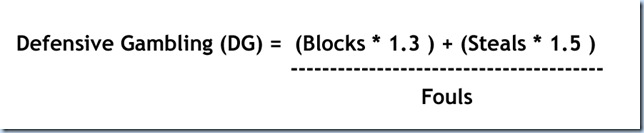
1. Defensive Gambling (DG): This stat is pretty easy – I try to recognize that some of the stats that people get on defense are related to gambling on some level. (Gambling in a passing lane, gambling by leaving your man to get a weak side shot block, gambling by trying to strip a man when the ref is right there, and so forth) We already had blocks and steals . . . but they exist in a world without accumulated risks. The risk here, of course, exists as a foul being called – another stat that we already have. The fun part is balancing the risks vs. the rewards.
The Foul is the base for this equation – as it means that you tried a risky move and you got burned. Not only do you have a penalty against you, but it directly benefits the offensive team. A steal, on the other hand, is a situation where a player takes a risk, is rewarded – and the offensive team is directly disadvantaged. When a team misses a three pointer and the opposing team gets the ball and scores a layup that is a 5 point swing. A steal does not directly mean you gain points, but you directly prevent the chance of points – it’s not a 5 point swing, but it’s a possession swing. I say that this is worth 1.5 fouls, in terms of risk/reward. A block does not guarantee such a similar swing in terms of possession (it does sometimes though), but while a steal only prevents the potential of a shot being taken, a block directly affects shots that are taken. (It’s a shame there’s no stat for shots changed, because a good shot blocker has an aura that surrounds him that changes many shots – for example when players started to scout Kirilenko his blocks went way down . . . but he was changing the same number of net shots as guys changed their shots to avoid getting blocked by him) A block, then, is not as good as a steal, but it’s still good – a block is equal to 1.3 fouls. The full equation for Defensive Gambling is as follows:
|
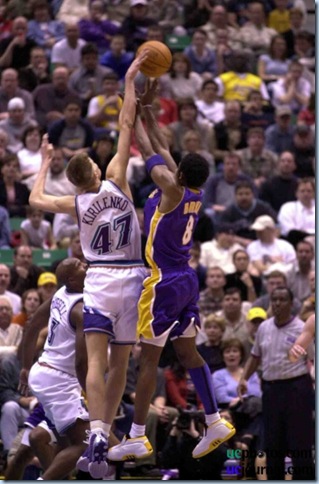
Clearly looking at things like blocks and steals on their own gives a skewed view of the world – putting it against a risk/reward system is a better frame of reference that we can use to see which players make smart gambles, and which ones do not. Andrei – for all his faults – has a good Defensive Gambling ability if you ask me.
2. Pure Hustle (PH): Pure hustle builds off of the Defensive Gambling equation, but adds more chances for risks and more chances for rewards. Here we see Blocks, Steals and Offensive Rebounds go against Turnovers and Persona Fouls. The common factor for hustle is a turn over. It’s the most benign result of hustle. Too much hustle can result in a foul – which hurts you and your team. This is why a foul is worth more. On the good side of things, hustle can result in good defense, or a second effort (or third, or fourth) on offense. We all remember Tayshawn Prince robbing Reggie Miller with a game winning block. We should all remember Bird stealing the inbounds from Isiah. And we all know that second chance shots can not only allow you to score from an advantageous position – but also result in scores themselves. This is why I think when it comes to hustle, Offensive Rebounds are worth the most, with Blocks and Steals being on equal footing with fouls.
|

3. Shooting Worth (SW): This is an easy one, because it already exists on many website by it’s other name “Points per Shot” (PPS). It’s just how many total points you get (including free throws) divided by the number of shots (FGA) you take. Sure, there’s some points that may be unrepresented by FGA (like technical fouls, or being in the bonus), but the fact that the player is involved in those free throws is a benefit that they get for being good shooters. The idea is that if you take a shot it’s worth two points, right? Well, that doesn’t always work out in the PROs, and the league average (or mean for all player data) is 1.22. [Yes, I looked at every shot in the L last year on ESPN.com] So, in effect, you have a positive Shooting Worth if you are better than average, and have a SW greater than 1.22 – of course, you can still be good at your job if you have a lower value; you’d just be below league average. That’s the crux of this statistic – it seems to display individuals who take good shots, and this stat can be used to better differentiate between guys who score a high ppg who take good shots, or the guys who shoot a lot in order to get good stats.

|
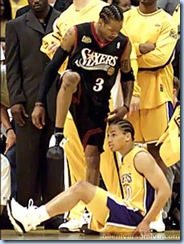
4. Shot Frequency (SF): Some websites try to find out often a player shoots and they represent it by the number of shots / value of time (usually minutes). I don’t know what 0.282 shots looks like, so that representation means little to me. I would rather look at the same data in another way, namely, how many minutes of burn does a player need before he jacks up a shot. Some guys start shooting the ball as soon as they are on the court, while others spend a lot of time on the court – but don’t shoot the ball. In effect, this stat (Shot Frequency) will be able to identify if a certain player is gun shy to a fault (some would say that John Stockton was) or a pure, unashamed jacker of shots (too many to name). In this case, the lower the number means a higher frequency of shots . . . because the number represented is the time needed on the floor between shots. To find this out we divide the total minutes played by the number of Field Goals attempted (FGA).

|
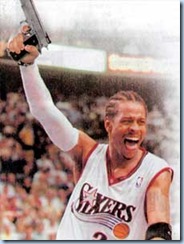
Gestalt Offense (GO): This is the biggie. I’ve fretted over this for days and days and finally am prepared to release it upon an unwitting population. It’s not perfect, and it seems to only work best with larger sample sizes (a seasons’ worth of data, or a road trip, may look fine – any singular game can break it). It really favors guards and only really works best for players who played in a modern-ish era (one where turnovers, offensive rebounds and other similar statistics were actually recorded). The basis for this was to isolate how much pressure certain players could place on the defense. What a player does on offense (when it comes to stats) can be either one of five things: he can assist on a score, he can get to the foul line, he can take a shot, he can be called for a turn over, or he can grab and offensive rebound. There are no stats for setting solid screens, or anything like the ‘hockey assist’ right now with how the stats are kept. So the statistic is already limited, but I try to do the best with the data that I have. Essentially the GO Rating is the summation of a player’s modified assists, free throw opportunities, offensive rebounding ability, penchant for scoring against their turnovers, all over the number of games a player has played:

![]() |
| Of course, it’s a lot more complicated than that . . . |

![]() |
| The first, and most straight forward, part of the equation is assists. This equation not only values assists higher than their normal value ( 2.23 > 1, after all), but it also serves to give a bonus to good passers, and penalize poor passers. (Good or poor depending on if they have a high Assist to Turnover Ratio) The first standard value here is 2.23. Where did this value come from? Well, it’s the true value of an assist when you balance it for the ratio of assisted 2PTFG vs. 3PTFG. (According to the stats on ESPN.com, where all the major stats came from, aside from archived player stats from Basketball-Reference.com) The second standard number is 1.48, this is the mean Assist to Turnover ratio for teams in the NBA. (Room for improvement exists here if I could actually find the mean Assist to Turnover ratio for the players) As it stands how good you are at passing (vs. turning it over) affects how many total points you get from this category. After all, Tim Hardaway may be able to get you 37 assists on a road trip, but those 37 assists would be better than 37 assists from Alonzo Mourning because Zo would pick up quite a few more turnovers along the way. |
![]() |
| Free throws are simple enough to understand now that we’ve gone through assists. Here we don’t look at how many free throws an individual has made, as the point of the GO rating was to see the type of pressure that an offensive player puts on the defense. Instead the focus is to see how many free throw attempts the player gets. Of course the catch is that value for FGA is modified by how good a shooter you are compared to the league average (which is 77%). A guy like José Manuel Calderón may only go to the line half the time as someone like Shaq – but Shaq is below average and Jose above average to the point that the difference in points from this category are not as large as we would think. Again, like in assists, it’s a bonus to good shooters and penalty to those who are not so hot from the line. In effect, you want your best free throw shooters at the line, their FTA are then worth more than that of guys who do not go to the line with as much confidence as they do. |

![]() |
| Rebounding is easy. I figured that in the grand scheme of things, an Offensive Rebound is worth 1.16 points. I based this on how a Turnover is 1.3 points (see below), how an assist is 2.23 points and how points are worth, well, points. This is a modifier. The second modifier is similar to previous categories. Before we looked at if the player was better than average at Assist to turnover ratio, and then how they fared in FT% against the mean. Here we see that 26.73% of the total rebounds in the NBA were offensive rebounds. If you are a better than average offensive rebounder then you get a bonus here, if you are worse, then you get a negative modifier (as seen as a number less than 1.0, but not a negative number, per se). This part of the equation really seems to get broken if used on Charles Barkley (who, if you look at just one game, would get some crazy number of points in this section because he had 11 offensive rebounds and 5 defensive ones). Thankfully this section self-neuters itself if you have zero offensive rebounds. |

![]() |
| Man, where do I begin with this one? Well, we went over Shot Frequency already. We divide 33.6 (representing 33.6 minutes of action for an elite player) by the player’s own Shot Frequency. This tells us how many shots he will put up if given Starter type of minutes. The next step is adding 1 to the Effective Field Goal Percentage (eFG%). This is so that we get a positive value with the percentage when multiplied. Why use eFG% instead of just regular FG%? Well, eFG% adds into account three point shots, and the higher degree of difficulty of shooting from that distance. (For more info on eFG% click here) This step tries to even things out a bit. The third part is how the player’s Shot Worth (also described earlier) rates compared to the league average for Shot Worth (or PPS). If you are Malone-like, you get a nice bonus here, if you are Iverson-like, you don’t get a bonus, and if you are really poor, then you get a penalty. The last part is the total points scored by the individual, divided by 10. Ten was one of the first numbers I used that seemed to make things work out when I was fiddling around. I don’t know if this last section of the Shooting section is legit or not yet, I remember when I tried this out without the last part that individuals would be getting very little from this part of the equation. At some stage you have to factor in how many points a guys scores, even if you are looking are how well they shoot. |
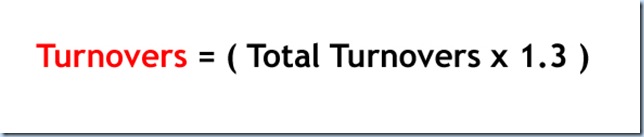
![]() |
| Uhhhh, so this is very easy to understand. I’m not going to mention anything more than that this value is subtracted from the rest of the section values in the numerator. Don’t forget to divide everything by the total number of games, ya here! |
Man, I’m super duper tired, so I’m just going to go ahead and post this. Give me feedback, tell me I’m crazy and set me straight. I think we need mores stats, and unfortunately, the lack of defensive categories means I can’t make a Defensive GO rating type of stat. I’m open to changing my formulas and re-working things. If you want I can e-mail you the spread sheet that contains the Macro that calculates these new stats. (I got really sick and tired of calculating the GO Rating by hand with pen and paper.)
I will probably make another post on the Go Rating in the future, filled with examples of players, and how they rated. So far I’ve seen that eFG%, Total Points, Assist to turnover ratio and a few other factors really seem to hinder bigmen, while giving guards and other wing players a boost. For the record, Magic Johnson’s GO Rating is 102.241, and he is the gold standard . . . some guys score higher than he does, while others politely fall into place. (Jordan is at 120, Karl Malone at 83, and so forth.)
Tuesday, July 14, 2009
Probably why you’re not going to see any Indians in the NBA anytime soon
| Okay, I love India. I love Indian food. I love Indian people. I am, ethnically, Indian. I’ve lived there a few times in my life. I even blogged about the very real full court press the NBA using to gain market share and popularity in the largest democracy by population in the world. But we (as NBA Fans) are not going to see any desis in the NBA anytime soon. For evidence I present my little cousin (KD – like Durant, but unlike him in so many ways) dunking on his driveway basket at home in SoCal. Ekdhum Motu Saffar Na Thaiyo! (aka. Epic Fail in Gujarati) |
So . . . I was right about Ronnie Price
If you aren’t on twitter, then this is news: the Jazz are going to be bringing back Ronnie Price. (also confirmed by 1320 KFAN by txt message and via Twitter and the PR department of the Utah Jazz, via Twitter) Of course, this was a mere formality after Sloan was talking about Price in post draft interviews about Eric Maynor. But really, you didn’t need that either – you just needed to listen to me all along. So, last off-season the Jazz traded Hart for Knight, and by doing so, put themselves in a position where they would end up evaluating two guys for one spot all season long – with the final prize being a contract. I’m sure it must have been a crazy year for both Ronnie Price and Brevin Knight, playing against each other all season long fighting for playing time, both in the last year of expiring contracts.
Wednesday, October 15, 2008 (an excerpt)
Things to look for this season: Brevin Knight
Posted by Amar at 1:30 PM
“. . . More playing time at PG than Ronnie Price: That doesn't mean that Price isn't going to get playing time this season -- he may very well beat out Knight as the season goes on -- but over all Knight is going to get more playing time at the PG than Price will . . . ”
Thursday, October 16, 2008 (an excerpt)
Things to look for this season: Ronnie Price
Posted by Amar at 11:58 PM
“. . . If you haven't been following Ronnie Price's career, this is pretty much his own version of Sisyphus' challenge. His entire career he's had to make a living by beating other guys out for playing time. He did it two years ago in Sacramento (beating Jason Hart out). He did it last year in Utah (again beating Jason Hart out). And he's basically going to have to do it a 3rd year in a row, having to attempt to beat out
Jason Hartthe guy they traded Jason Hart for (Brevin Knight). Brevin also being in a contract year makes this even 'better', in terms of entertainment value. They are in direct competition with each other for this season -- and the next ones too! The only way to make things a little bit harder for Price would be if his coach decides 'just for fun' (in that exaggerated East Indian accent that Russell Peters has sometimes) to stop playing him at point guard -- and have him fight for playing time against 4 shooting guards (Brewer, Korver, Miles and Almond). Sounds dumb, right? Sounds even better from Jerry's own mouth [Interview, around the 1:54 to 4:13 mark, via 1320 KFAN]. For the record though, he does compliment Price as well during that answer, and suggests that his versatility allows him to play alongside Knight for a really small, quick line-up.Basically, then, all Ronnie Price has to do is beat out Knight, and his future here in Utah will be secure, well it should be, right Mo Williams? Price has some advantages though, as he's been here last season, won the job, and played in every playoff game. Furthermore, he's a popular guy (in that younger crew with Millsap, Brewer and Miles) and the Jazz went 43-18 in games that he played in. That's winning 70.5 % of those games -- good enough for a 58 win season over 82 games. Here are three things to look out for this season from Ronnie Price:
Hustle every minute on the floor: Deron Williams plays so much point guard that there is very little time remaining for the other guys. There's going to be 8-12 minutes per game available by my estimation, and that's not nearly enough to play all three guys every game. What Price will do is hustle and play very hard in whatever time he has. Brevin Knight isn't going to jump up there and slam down alley-oops, or run back and block guys on fast breaks. Those are the types of plays that'll help get Price another contract with the Jazz -- especially if he plays within the offense and runs the team well.
Be available (and healthy) to play in 80+ games: Knight gets injured every year. He's never played over 80 games and whatever slim window of playing time exists has to be maximized by Price. Price needs to be available every game to go in and give Deron a breather. Especially in the cases where Knight is going to be injured and unavailable to play. It sounds simple, but it makes sense. One easy way to distinguish himself from his competition is be healthy. Coach is going to go with the guys on the roster who can play. Sometimes it doesn't have to be complicated. Knight averages 59 games played a season over his career. There is a window of opportunity for Price here, even if it's not wide open.
Eventually beat out Brevin Knight: I'm going to come out and say it -- there are going to be some situations all year where one of the two guys is going to get to play, and the other guy will sit. There will be situations where one guy is favored to play over the other (match-ups, etc). Also, there could be some times on the court where they both play at the same time. Out of all of those situations I think that the veteran leadership of Brevin Knight is going to be a stabilizing force for our team. I just can't bet against Ronnie Price. He's a smaller, scrappy guard who has three point range and has been in this situation before. Knight is smaller, scrappier, and much better than Jason Hart (the guy Price used to beat out each of those previous times), but I think Price has more fight in him. If Knight gets decked by Turiaf I see him on the floor for a while. Price got decked and was ready to fight. It's probably this fight that's going to win him the job sometime after the All-Star Break. . .”
| Price eventually did win out, it appears, but thanks to Brevin Knight for being there. He was instrumental in our team starting the seasons on a 5-0 run, but just did not get it going after that. It’s a shame really, because I think we all expected more out of him. Alas, he’ll be looking to play somewhere else next season.
If you don’t recall, Price did not get a chance to play massive minutes in the playoffs this season, which is in stark contrast to last season’s playoffs. But in the time that he did play, he played with energy, hustle, fire and without fear. That’s the type of player I want on the court when we’re on the wrong side of an elimination game. And that’s exactly the type of player the Jazz have in Price. |
Five reasons why you should be on Twitter
1. Inside Access: If you ever wished you could be privy to unedited communication between your favorite players, this is it. Every day I get to read about Morris Almond and his rap lyric tweets; guys like Shaquille O’Neal and Charlie Bell making fun of Chris Bosh and Charlie Villanueva’s twitter followers contest; and insane, by the minute unedited, raw reactions from the NBA family to currently developing events. (Draft Night was much better because of Kevin Love and John Hollinger tweeting all night long) If you’re content to be dicked around by ESPN’s “In$ider” fee for access then you don’t need Twitter. If you want to go deeper (for free), there’s no better option right now.
2. Connections: Years ago it would be impossible for Mr.Joe Blow Fan to be in direct communications with the PR staff of their favorite team, National TV NBA analysts, well respected reporters, Bloggers, other Fans and the players themselves. Technology has afforded us this opportunity now. While you may wait half an hour to get on sports radio, or weeks for a written fan mail reply from a star today you get responses near instantly. I don’t ride around town in a horse drawn buggy, I drive a car that is itself not entirely reliant upon non-renewable fossil fuels. I move with the times, and my life is better for it. Twitter is a movement forward.
3. Speed: My cousin is a pretty big NBA fan, and he texted me yesterday about Gortat’s contract being matched by the Orlando Magic. That was breaking news for that day, for that afternoon. It was news that was a few hours old for me, though, because of my connection with the Twitterverse. How ridiculous is that? (over 30 hours ago was when I heard about it first) If you want the news as it happens, few things are faster than twitter right now. Right now when I started typing this everything was normal, now the Tweets are piling in about Boozer going on the radio in Chicago talking about a trade, and confirmations of Detroit local radio talking about a Boozer trade that’s going down. See how crazy this is? [Edit: Detroit radio tweets are speculative rumors]
4. Participation Optional: You don’t even have to tweet to benefit from Twitter – you just subscribe to a few random people that you know/like/wish to follow, and from there you slowly add more people that you read (from @(someone) messages) and before you know it you can sit at your desk at work pressing F5 and reading some crazy conversations. But it’s not even about that passive form of entertainment because of the . . .
5. People you meet: Really, using twitter has increased my productivity in networking with other NBA fans, bloggers, players, reporters and others exponentially. More so, I’m actually getting into non-homer discussions with fans of other teams as well. This off-season I’ve learned that I probably have more in common with the people I Tweet with than some of my own extended family members. While I used to previously view them as the enemy, I know have a personal affinity for New Orleans Hornets fans that just did not exist until Twitter. (Even the ones whose blogs I used to frequent and communicate with on other websites before, like Dimemag – they were still the enemy back then!) Now we occasionally share youtube videos of cats and talk about PC RPG user created mods. (You know who you are) How totally unexpected!
Bonus Reason: it doesn’t even have to be about sports at all . . . you can just use it to follow people you already know, or other celebrities . . . I know that I really enjoy Will Wheaton’s twitter updates, they are hilarious and usually involve some sort of The Simpsons reference. Also, Twitter is the destroyer of worlds.
Wooooo! One Year Old!
Happy Birthday AllThatJazz, you’ve been online clogging up the internets for one whole year now. Sure, you really fizzled down the stretch (like the Jazz), but you were really active in the off-season. Guess what? It’s the off-season again. Oh, the things you have seen in your first year of life . . .
- Fesenko had blond hair
- The Salt Lake City media couldn’t get enough of it
- Morris Almond was killing it in the summer league
- Deron got injured
- remember that game in Philly where no one was active to play, and we won?
- Boozer got injured
- eventually everyone got injured
- The team owner died
- Utah went from 1st in the division to 3rd
- we just squeaked into the playoffs and were unceremoniously ousted by the eventual champions, the Lakers
- somehow, over the course of the season, 5 new Jazz blogs came into being
And since then so many things have changed, this season the Jazz look to a new coach and general manager to right this ship, as Deron Williams will be looking to set up all new team mates in the quest for . . . wait what? REALLY? Okay, scratch that, the Jazz will go into this next season with, pretty much, the exact same team, coach and front office and expect better results. Memo, Boozer and Korver all opted into their final years of their contract. Two low draft picks were added, Millsap is a RFA and hopefully the Jazz are healthier next season.
So that much hasn’t changed from last year to this year . . . but let’s look at some blogging highlights from the past year! (and no, there are NOT all the blog posts I did all year long, jerks!)
- Why I decided to blog, and early concerns for saturation of Jazz blogs (July 14th, 2008)
- Explaining how awesome Stockton was/is. (July 15th, 2008 a; b; April 20th, 2009)
- Deron Williams signing for the long haul (July 19, 2008)
- The Brevin Knight/Jason Hart trade (July 23, 2008)
- Not-so-Jazzy Nicknames (Part 1: August 4th, 2008; Part 2: November 12th, 2008; Part 3: December 1st, 2009)
- The Making Guard (August 21st, 2008); On a wing and a prayer (April 11th, 2009)
- The NBA's next target: India. Why India? Why not? (August 27th, 2008)
- 10 Things other Point Guards do better than Deron Williams, and why. (August 28th, 2008)
- What if: The USSR played at the Olympics? (September 2nd, 2008)
- Adrian Dantley -- better late than never (September 7th, 2008)
- Hoops-pedia: Game of Destiny (September 9th, 2008)
- The Five Epic Errors of Jerry Eugene Sloan (September 11th, 2008); The Five Epic Qualities of Jerry Eugene Sloan (October 17th, 2008)
- Tangent Alert: sports figures ARE public figures (September 22nd, 2008)
- Mehmet Okur Evolution . . . (October 1st, 2008)
- YouTube Tuesdays! Mehmet Okur Interview Drinking Game (October 15th ,2008)
- Flashback Friday: Andrei back when he was AK-47 (October 24th, 2008)
- YouTube Tuesdays! We're Number Three! (October 28th, 2008)
- Utah Jazz 2008-2009 Season Preview! (October 29th, 2008)
- Flashback Friday- Some other young Jazz players that got better after their rookie seasons or how I stopped worrying and learned to love the Long Bomb (from Morris Almond) (October 31st, 2008)
- YouTube Tuesdays! Millsap owns Kaman (November 4th, 2008)
- Where in the world is Tadija Dragicevic and Ante Tomic? (November 6th, 2008)
- 10 Things Jazz fans should be thankful for (November 27th, 2008)
- Game 6 Recap- New York 107 - Utah 99 (December 13th, 2008) <---- super late game recap
- The King is dead. Love live the King! (February 21st, 2009)
- Walking Wounded (February 21st, 2009)
- To be honest with you Diane, I'm surprised (February 21st, 2009)
- Requisite Oscars/NBA cross over post (February 23rd, 2009)
- The Jedi Voodoo Mind Trick Hype Machine (February 25th, 2009)
- ESPN, and the fans who love to hate them (February 26th, 2009) <--- a must read
- Flashback Friday- WE'RE GOING STREAKING! (March 6th, 2009)
- Contract years, Developing Talent & Front Office Subterfuge (March 6th, 2009)
- Carlos Boozer to English Dictionary -- Episode 1 (March 9th, 2009)
- Rational Jazz Blogger Roundtable 1- Playoffs, Player evaluations & Jazz fan reputations (March 10th, 2009)
- How bad are the Jazz on the road, really- (March 25th, 2009)
- . . . Of Mice and Millsap (March 26th, 2009)
- 2008-2009 Regular Season- What the heck happened- (April 11th, 2009)
- Home (aka SLC) is where the wins are (April 11th, 2009)
- Finishing weak (April 12th, 2009)
- Searching for that PPF- Perfect Power Forward (April 13th, 2009)
- You have got to be kidding me – Jeff Hornacek Mix!!! (April 20th, 2009)
- Round 1, Game 3 Postmortem- Luck (April 24th, 2009) <—Luck off, Lakers fans
- Utah Jazz 2008-2009 Season in Review (Part 1)- The Season that was (May 17th, 2009)
- Who else is sick with the Great Hype surrounding Andrew “Bust”num- (May 18th, 2009)
Hopefully this next season is better for the Jazz *and* All That Jazz (and no, I don’t mean the section of the Utah Jazz Official Website that stole my name, and is featured at the bottom of their page, seriously, that’s a total rip off job) as well. I learned a lot in this last year, and hope to use it by continuing to blog! (Be it here, or elsewhere in some other place)
Monday, May 18, 2009
Hmmmm
This may be super meta, but I’ve come to the conclusion that I wouldn’t read my blog if it wasn’t written by me. Too many words. Not enough pictures. I’m also super lazy, I have to go over all my tags and unify the format . . . I’m really avoiding doing this.
Who else is sick with the Great Hype surrounding Andrew “Bust”num?
If you’ve ever wandered onto an LA Lakers blog, message board, or listened to a nationally broadcasted game by Mike “Fellatio for the Lakers 24/7” Tirico then you’ll know, with complete certainty, that Andrew Bynum is one of the best centers in the league, and will without giving any prior notice, become the next best center in the league and join the pantheon of great bigmen. He will rightfully sit alongside Wilt, Russell and Kareem while using Ewing, Robinson and O’Neal as foot rests. The third footrest will be necessary because of how great and grand his male organ must be – as he has been photographed at the Playboy mansion (who cares) and is curiously linked to Rihanna right now. (who? exactly.)
As impressive as his potential appears, and as great as his off-court life may or may not be (I’d rather hang out at the Acharya mansion any day of the week) – I’m less than impressed with him as a player. I’m even less impressed when I actually look at his accomplishments as a player in the playoffs (aka. when it counts). Furthermore, I’m pretty much sick to death by the hype that he has received from casual fans, homer fans, and the media alike. Now, this isn’t meant to trash the hopes of the future of the Lakers at all – I strive to temper the expectations of him a little bit. For his sake, and ours.
My brother is the most rational Lakers fan I know, he is passionate, but not completely under the spell that countless others are on the internet. He’s more concerned with consistent play, rebounding and solid defense from all of the Lakers and does not have the time to worry about if Bynum is going to be the next Kareem – he’s worried about right now. If I was a Lakers fan I wouldn’t be worried about right now – you guys will trounce Denver on your way to the NBA Finals (where anything can happen). I would, on the other hand, be worried about the past – specifically Bynum’s past.
He’s 21 years old right now and was drafted as a 17 year old. What do we know about him that should really count? How about the fact that he had an injury ruined high school career (leg/knee injury), and in the NBA has had two more leg/knee injuries in his young career. He’s tall, but not nearly as super athletic and fit as freaks like Dwight Howard or Amare Stoudemire are – I don’t expect him to be physically made of the same stuff as those guys are. When you get over 7 feet tall, any injuries to your lower body seriously limit how reliable you can be, regardless of how much work one may put on their upper bodies. (You’re only as strong as your base is – look at Yao Ming, who has just a storied lower body injury history as Bynum, he misses lots of games every year, and is never 100% due to the strain his body puts on his lower body) Amare had two career ending (had this been the 80’s/90’s) knee injuries, but has come back due to a great work ethic. Bynum puts women on his shoulders during rehab. I wouldn’t be making a huge leap by suggesting that Bynum may have a career that features a number of injuries to his lower body, not unlike Yao Ming – as opposed to being virtual injury free like Dwight Howard. But I have no crystal ball, I’m just going on the fact that he’s a big guy with a history of lower body injuries who was injury prone as a teen and only looks to put an increasingly large strain on those same joints as his ages and increases mass.
That’s not very empirical though, it’s just an assumed health arc based on his body type, job, apparent work ethic, how healthy other big guys his size have been and medical history. What is empirical, on the other hand, is to dig deep and look at stats. I love stats. Stats are flawed, as I’ve explained on this blog before, but they still give a pretty good indication of on court production. (After all, that’s what counts, points, rebounds, blocks, assists, steals, turn overs and fouls, right?)
After this last game against the Houston Rockets the total number of playoff games that Bynum has participated in stands at 18. These 18 games have taken him from 2005-2006 till now to amass. In that time he has been brought along slowly – thanks to the fact that he doesn’t need to be useful when he’s so far down the pecking order behind at least 4 other guys. That said, his production does not appear to be indicative of him joining the pantheon of great bigmen any decade soon. I want to look at his stats in the playoffs and see the promise that appears to be there (and only appears in regular season games against bad teams sandwiched between injuries). As a point of reference I looked at Patrick Ewing’s first 19 games (why not 18? wanted to complete that one series to make it an even number of playoff off series for the two) in the playoffs. Ewing was a great center, but never will he be called the best of his generation, and thus, not up for entry into the pantheon of greatest bigmen ever (though the media has already reserved a spot there for Bynum).
Bynum’s first 18 Playoff games, and how they stack up:
Ewing creams Bynum statistically. And Ewing played in a time where big guys weren’t bailed out with foul shots, and played against much better competition. Bynum played against the Phoenix Suns, twice anchored in the paint by Frenchman Boris Diaw; the injury depleted Utah Jazz that was forced to start Jarron Collins; and the Houston Rockets, who during the course of the series, lost Yao Ming to injury a little more than 2 games in – and had to turn to a rotation of Chuck Hayes, Carl Landry and Luis Scola to battle LA’s 7 footers. Bynum gets killed – just look at the stats.
Alas, he is immune to any criticism for a great rebuttal exists: Ewing had much more experience from being a guy who actually went to college, won a National Title; and also played in the NBA for a few seasons before making the playoffs. All this is true, but nothing prevented Bynum from going to college himself – if he was really interested in experience. That said, I also took a chance to look at another young bigman, and saw how he faced the NBA pressure. David Robinson did manage to make the playoffs as a rookie (he led his team there, unlike Bynum who did his best to stay out of Kobe’s way). David Robinson is far from my favorite player in the world – but he also creams Bynum’s numbers when you take out experience and look just at Bynum’s FIRST FOUR SEASONS against David’s ROOKIE season.
Let’s not forget that David had to go to war against Joe Barry Carroll and the plethora of tough guys in the paint that Portland sported back when David was a rookie. Bynum, with 4 years of experience in the NBA, has yet to face anything like that in the NBA playoffs – and his numbers are completely pathetic.
Ewing: 22.1 ppg, 10.9 rpg, 2.37 bpg
Robinson: 24.4 ppg, 12.00 rpg, 4.00 bpg
Bynum: 4.83 ppg, 3.78 rpg, 0.67 bpg
Obviously the data is heavily skewed against poor, young Bynum. His first few playoff sorties were short and he was inexperienced. Obviously the stats are going to go against him when you include some of his early games. The Bynum of today is a beast though! Look at Bynum’s numbers from just his 4th season in the playoffs against other greats and you’ll see! You’ll all see!
Okay, let’s do that then.
Bynum’s Playoff stats from his 4th season, and how those stats stack up:
Bynum’s numbers improve very slightly, he ups his ppg from 4.83 to 5.58, his free throw percentage from 62.96% to 76.47% and he swats almost 0.2 more blocks per game. Still not impressed. He’s a far cry from, let’s just randomly say, Hakeem Olajuwon. In the Dream’s 4th NBA season he happened to tear the NBA playoff’s a new one with his scoring -- 37.5 ppg (57.14 fg%, 88.37 ft%); rebounding – 16.75 rpg; and all around game – 2.75 bpg, 1.75 apg, 2.25 spg.
Not only did Hakeem obliterate Bynum’s pitiful offensive output by a magnitude nearing 7x, but absolutely owned him all over the boxscore. He also did it against much tougher competition as well.
Heck, Bynum is so far from being impressive that Greg Ostertag’s fourth year playoff stats could (and do) give Bynum’s fourth year playoff stats a run for their money. It’s horrible to say, but really Lakers fans (and media, or is that redundant?) – take a look and weep.
Bynum is a much better offensive player than Ostertag (is this even saying anything?), but Ostertag owns Bynum when it comes to rebounds and blocks. Greg even managed to out-assist Bynum and made less mistakes (as seen in less turn overs and fouls per game).
What’s worse, the fact that Bynum just got his lunch handed to him by Ostertag; or the fact that Ostertag was doing this against super duper vets and talented players like Vlade, Arvydas, Dale Davis and Rasheed (when Ostertag was a 4th year player) – and looking better than media adored Bynum going up against Chuck Hayes and the guy who was behind Ostertag on the depth chart?
Furthermore, Bynum’s had 5 scoreless games in the playoffs, out of 18. And he’s scored less than 5 points 11 times out of 18. Ouch.
Take a look at Hakeem’s 37.5 ppg average again. Ouch.
Of course, there HAS to be a rebuttal for this . . . no way can Bynum been so far behind Hakeem at the same stage of NBA experience, and yet so close to NBA laughingstock Greg Ostertag . . . right? . . . .right? Don’t worry Lakers fans, of course there is . . . forget about NBA experience, that’s a flawed concept. Let’s not forget that Hakeem and Greg both played college ball (like Ewing and Robinson did) . . . Bynum didn’t play college. Look at how young he is! He’s only 21! Surely when you take that into account it makes up for 32 ppg (in the case of Hakeem), or nearly a block and a half (in the case of Ostertag)!!!
Okay, let’s take at a look at that. Try me.
Bynum’s Playoff stats as a 21 year old, and how those stats stack up against another 21 year old:
Bynum is a very brittle 21 year old who doesn’t have to do anything, and his team makes it to the NBA Finals. I’m not lying, the Lakers did that last season. That said, Bynum is a force of nature, and the future of the center position in the NBA. His 21 year old production is unrivaled. Right? Wrong. Take a look at this guy, and what he did in the playoffs at the tender age of 21 (his 2nd season in the L, not his 4th like Bynum). I just have one hyphenated word to describe this: Shaq-Attaq.
A lot of the same Lakers fans who champion Bynum marginalize how great Shaq was. I can clearly see why Kobe went out of his way to suggest that Bynum needed to be traded – because Kobe knew how good Shaq was. The difference between the two is quite telling when you look at these two centers at the age of 21, Bynum in his 4th season and Shaq in his 2nd.
The difference between the two was almost 15 points, 10 rebounds and over 2 blocks and almost 2 assists . . . in favor of the 2nd year player.
That’s a huge difference.
The difference between being called one of the best bigmen of all time, and being called a bust.
Bynum was a lotto pick man, and aside from his inspired dirty play in injuring two guys this season, and being afraid of Fesenko in the paint, he’s done nothing to earn the high praise that’s heaped on him. And he’s done nothing to make me feel like giving him any props.
His current playoff run isn’t over yet, and he’s got one, most likely two more playoff series to make his 2008-2009 playoffs slightly more memorable than his complete no-show in the 2007-2008 playoffs.
I’m taking it easy on Bynum here by comparing him to guys that he may yet one-day reach . . . even if it doesn’t seem like it. I could really try to down him if I wanted by comparing him to his contemporaries who are out-playing him right now. For example take Dwight Howard -- in his first 14 playoff games: 17.86 ppg (57.23 fg%, 51.72 ft%), 15.5 rpg, 2.71 bpg, 1.14 apg, 0.714 spg . . . those numbers are way better than Bynum’s. Also better are Dwight’s numbers as a 21 year old and Dwight’s numbers in his 4th NBA season.
If I really wanted to be a dick I’d mention that Dwight also has 3 less leg injuries. I’m not a dick though, so I’m not going to mention that.
What did we learn?
What did we learn? Well, for starters we learned that Andrew Bynum’s playoff performances leave much to be desired. His first 18 games in the playoffs pales in comparison to Ewing’s numbers over the same situations – and Ewing played against much better defensive clubs like Michael’s Bulls and the Bad Boy Pistons. We learned that David Robinson’s rookie season playoff numbers invalidates the argument that Bynum’s rookie numbers shouldn’t count. We also learned that Hakeem’s numbers as a fourth year player completely eclipse Bynum’s as a 4th year player. I didn’t even have to look up 2nd tier NBA centers like Rik Smits at all after I found out that at the same level of NBA experience that Greg Ostertag’s playoff performance was a wash with that of Bynum’s. Lastly, we learned that Bynum can’t even hide behind his age as an excuse for how poor his performances have been – as Shaq as a 21 year old eats Bynum up. Ultimately, we learned that it’s a bit too premature to call Bynum anything other than a bust at this stage. He’s much closer to Ostertag, albeit one who rebounds and blocks less, and fouls and turns the ball over more, than he is to being one of the greatest bigmen of all time – let alone in his own generation.
After all, Dwight’s numbers at each break down (first x number of games, 4th NBA season, and at age 21) are vastly superior to Bynum’s. Oh yeah, also Bynum has a history of injury problems to the same parts of his body and young guys who sustain so many injuries in short succession tend to have injury plagued careers. Yeah, I wasn’t supposed to mention that again . . . I guess I am a dick after all.
Bynum doesn’t deserve his hype until he does something. Something other than sucking when it counts, that is.
Sunday, May 17, 2009
Utah Jazz 2008-2009 Season in Review (Part 1): The Season that was . . .
. . . a major disappointment? . . . a serious step back? . . . a comedy of errors? . . . a season to forget? . . . the last season for this core group?
More than we’d like to admit, this last season was all of the above. You can probably think of a lot more ways to describe the 2008-2009 NBA Season for the Utah Jazz as well. I don’t like harping on past mistakes, as I feel that a more progressive, forwarding thinking attitude gets results. I did take a serious break between the end of Game 5, the end of our season, and now. In that time I wanted to have a chance to cleanse my palate of Jazz basketball so that when I get into the swing of blogging again (starting now) that I will not be writing from a skewed point of view – one filled with more emotion and less logic than it deserved. Games where your team gets eliminated in tend to magnify specific aspects of the team, the roster, and the coaching which steer fans opinions to extremes – extremes that would not logically make sense if the season was viewed as more than just that elimination game – but the entire months long journey that it really was. Sure, elimination games are important – look at all of the Ronnie Price love on Jazz message boards and blogs after his energized performance in the second half of Game 5, but let’s not get too far ahead of ourselves. Ronnie Price wouldn’t have single handedly fixed all of the problems the Lakers exposed if he played more.
I like how most of the other blogs did take the time to go straight into the ‘where did we go wrong’ and player analyses after the Jazz were eliminated. I enjoy other peoples’ points of views, though you can read that some of the player analysis were, indeed, fueled partly by emotion and recent memories. (After all, as fans we tend to be more a ‘what have you done for me lately’ group of people) I even had the opportunity to contribute with player write ups for the much maligned duo of Kyrylo Fesenko and Morris Almond at Jazz juggernaut SLC Dunk. (Thanks BBall John!) That said, I think now is the right time to get back to business here at All That Jazz.
Where to start? How about with me? We fans on the internet take the opportunity to type out our opinions and hold players, coaches and the front office accountable for their failings. I’m going to start up by looking at what I thought our team would do, and compare it with what the team did do.
My prediction for total number of wins:
Back in October I went out on a limb and suggested that our team would finish the season having won 65 total games (regular season and playoffs). Boy, did I get that one wrong! Injuries, road woes and the inability to focus against lesser teams aside, the 2008-2009 Jazz only won 49 games (and that’s including the measly 1 playoff game that the Jazz won). Not only is that a far cry from what I felt like our talented roster was capable of (probably our most talented roster ever), but a far cry from the last two seasons where the Jazz won 60 games each (2006-2007: 51 regular season + 9 playoffs, 2007-2008: 54 regular season + 6 playoffs). [And let’s be perfectly honest, 65 wins total was not a completely insane number, as the Jazz for the last few seasons were dropping games against the T-Wolves, Kings, Bobcats, Pacers and Knicks . . . that’s 5 wins right there to go from 60 to 65] There are reasons why the Jazz won less than 50 games – serious reasons – but that does not change the fact that I was dead wrong in my prediction for the Jazz. Wrong by a total of 16 games or (Hyperbole alert) basically the difference between the 2nd seed and the 5th seed in the Eastern Conference.
I felt as though the first 20 games of the season were the key. (As having a great start to the season, 13+ wins in the first 20 games, is a very strong predictor of having a solid season, as seen in the last few years) Utah would be playing without Deron, or at best, a severely hobbled one. Looking at the schedule I still felt as though the Jazz would win 15 games out of their first 20. I was wrong as the Jazz only won 12. That was exactly how many games the Jazz won back to start the 2002-2003 NBA Season – a season that finished astonishingly similarly to this one. Here’s what I said back then:
Avoiding the low hanging fruit that could be “Deron Williams and Carlos Boozer’s last game together”, our team was bounced in 5 by the LA Lakers and finished the season 48-34. Perhaps years from now NBA historians will look back at this season as another season in transition. That would just suck though, as that means we’re back to square one after 7 seasons. Well, the silver lining is that this season proved my point that the first 20 games of the season are a very strong indicator for seasonal success for the Jazz, even if my ability to predict wins are significantly off.
My pre-season predictions of our roster:
Star Player: As far as no brainers go, I selected Deron Williams as our Star Player. Duh. We played our absolute best when he was at his absolute best. We played our worst when he played his worst. Nothing else really needs to be said. My predictions were pretty much on point for the rest of the team as well.
Position Spotlight: I chose our Shooting Guards for the position spotlight, and I think that for most of the season this was a fairly solid, yet unspectacular group of guards. Sadly, my predictions for the best case and worst case scenarios seemed to come true for Ronnie, Kyle, C.J. and Morris. Brewer did earn a title and rep as a defensive stopper (and got called for fouling a lot less), and was able to keep some defenses honest with his outside shooting in the regular season. In the playoffs he wasn’t even defended and I am beginning to feel like his current skill set may be better suited as a Small Forward on offense. Kyle did improve his defense as the season went on, but due to a variety of reasons his shooting percentages did taper off and his over-all importance with the team appeared to be reduced during crunch time. C.J. would put it all together during stretches of the season – being a very solid shooter and defender, yet disappear in other games altogether. He did become a starter, but lingering doubts about his true value to a championship contender exist. Nothing really right happened for Almond this season, and as I wrote, “his inability to be a complete player negates his technically proficient scoring skills” – and he did not get significant playing time with our club for the second straight season. In the playoffs none of our guards could make shots . . . a major point of that position spotlight was the search for a ‘making guard’, as more than a dozen shooting guards have been auditioned in our system over the years. Our problems at this spot appear to be in just a similar state of flux as they have been for the last few seasons. Things are better, but not completely satisfied – and that’s a problem when this is the number one skill position in the NBA right now (Kobe, Wade, even guys like Kevin Martin and Jamal Crawford give us the business when we play them).
Top Transaction of the Off-Season: As far as our current roster needs were at the start of the season (need for defensive big, defensive wing, and solid back up PG to spell Deron), I felt like the Jazz brass really only addressed one. They have been drafting project bigmen for a while (three 7 footers in the last 2 drafts) and feel as though our wings can develop into good wing defenders (Brewer, for one did) – so the Jazz brass focused on the back up PG issue. Kevin O’Connor turned a really bad player into a potentially very useful player. Clearly Brevin Knight was an upgrade over Jason Hart, right? Based on this premise I felt as though this was the top transaction of the off season. Even though Knight didn’t perform as well as we hoped, I still stand fast with this selection as the other moves did not make much of a difference this season. (Matched the offer for C.J. – maybe Korver would have been a better starter? Drafted Kosta, who didn’t even get a chance to play this season.) Of course, I have to come clean, as hindsight is 20/20, and say that while this was still the top transaction that it still wasn’t a good one. Knight turned the ball over too often for a guy who was advertized as a savvy vet who did not make mistakes with the ball. He had a stretch of over a week without a made FG. He played worse than an ancient Derek Fisher in the playoffs. Yet, he was cheaper than Jason Hart, and his deal is off the books now.
Top Position Battle: On paper the Jazz are a pretty solid group with a well defined rotation. Deron plays the lion’s share of minutes at the point; there’s a legion of similarly talented (in relative terms) wing players that can be shuttled in and out; and Boozer, Memo and Millsap handle most of the minutes in the paint. The only big question mark was back-up center, and that’s exactly how I felt going into this last season. As fate would have it, this battle became a battle of attrition as at times, as there was no back-up. Collins was injured for most of the season recovering from his hilarious Golf Cart accident. (And yes, his twin brother was also involved) Fesenko had Work VISA trouble which required him to leave the team, and country, in the middle of a road trip (that did not involve playing the Raptors). And Kosta, well, he was diagnosed early with rookieplayingforJerrySloanitis. The season ended with Jarron Collins starting in 3 of the last 5 games; Fesenko active, but collecting DNP-CD’s; and Koufos sitting behind the bench in a suit. If anything, this is exactly how the most disappointing season in recent memory should have ended. More precisely, this is exactly the opposite of what should have happened.
Collins is clearly at a state of greatly diminishing returns in his career. Sloan trusts him, but this isn’t exactly the best way to get your young centers a chance to improve. Sure – Collins has experience that guys like Kosta and Kyrylo do not have, but he got that experience by actually playing in and starting games as a rookie. Don’t believe me? Look it up! (If you didn’t click on that link please do so . . . and forward that link to guys like Sloan, Locke, Siler and crew) Fes has all the size, strength and athleticism to, at the very least, slow down bigs and discourage guard penetration. He’s not great on offense, but he’s not taking shots he can’t make (58 fg% would only be higher if he actually threw down half of the amazing dunks he attempts). Kosta has the work ethic, offensive polish (he was taking Brand and Dalembert off the dribble and scoring inside with nifty hooks in the 8th game of the season), superb shot blocking instincts and willingness to improve – basically he should have *won* out this position battle for the back-up center spot . . . though he was not even allowed to compete. Silly.
Don’t call me a crazy homer if I suggest that having a young guy like Kosta or Fes ready to contribute in the playoffs by playing regularly in regular season games wouldn’t have helped a teeny tiny bit against the Lakers (Gasol, Odom, Bynum) when Memo was injured and out of action. The rebuttal that I’ve gotten from the Utah Jazz press is that our club is in a win now mode, and doing so may have resulted in a variety of losses that would have put us out of the playoffs. Really? Is that the worst thing that could have happened – we would have missed out on getting embarrassed by the Lakers in 5 games? The Risk, in this case, clearly does not match up with the reward of having a useful back up center who can play defense where we are notoriously poor – in the paint. That’s why we have to double with a wing, leaving three point shooters open . . . because we can’t guard other teams bigs in single coverage because you just can’t defend a guy like Gasol or Bynum with a 6’8 guy like Millsap or 6’7 Harpring. Hence, the SOLUTION to our inability to stop threes is rooted in the INABILITY to stop inside play – we need better INTERIOR DEFENSE!!!
Break-Out Player: While I felt as though there were a few qualified candidates, it was either going to be Korver or Millsap. And as this season went along (complete with the near-annual 40+ game injury to Carlos Boozer) Millsap had plenty of opportunities to really break out. I was really surprised by Kyle’s lack of improvement on offense this season – I really felt as though he would have proven the Hornacek hypothesis (that even a gifted offensive player who is traded to the Jazz gets better after a training camp with the team). He has an injury to his shooting hand, so I can give him a break. It doesn’t really matter though, as Millsap was predicted to break out, and that’s exactly what he did.
X-Factor: The X-Factor for your team can pretty much make or break your season. Strangely enough, a lot of teams come to rely on these decidedly non-stars to be the true barometer of how well they play. For example, the Boston Celtics have three huge names in Kevin Garnett, Paul Pierce and Ray Allen – though it is Rajon Rondo who powers them to wins. Back before the season started I dubbed Andrei Kirilenko as the team’s X-Factor this year. When he was healthy and anchoring out 2nd unit the Jazz were quite capable of winning games against better teams. When he was playing poorly, he left a hole in too many places. Surely Andrei was not as important as Deron Williams – Deron has the talent and stature to lead the team and will them to wins. The X-Factor, on the other hand, is capable only of preventing losses. Andrei wasn’t a huge game changer this season (his MPG keeps going down), but when he had a good game the Jazz’ record was 28-7. That’s an 80% win percentage. Now don’t get me wrong, I understand that correlation and causation are completely different aspects of any result; hence, the necessity to understand that HE may not be completely responsible for that winning percentage, but when HE is involved and having a good game (as defined as close to a double double; or a good shooting percentage and scoring 10+ ppg in 22+ mins; or having at least 5 points, rebounds and assists and a combined 3+ of threes, steals and blocks; or any other combination of having a solid game off the bench) the Jazz are a very hard team to beat.
Basically, I was right about these things, even if I was really wrong about how many wins the Jazz would get.
My pre-season predictions of our rotation:
Because I’m just really super-duper into the Jazz I took the time to plot out how many MPG each player on the team would get this season, and I ended up being pretty accurate on this as well. Wow, go me.
Called it! (off by less than 2 mpg):
- Last season Deron played 37.3 mpg, and I suggested that with added PG depth that his MPG would go down, but only slightly. I had him in at 37 mpg, and this season he averaged 36.8 mpg. Yeah, called it. That was a difference in only 0.2 mpg.
- Morris Almond played 4.3 mpg in his rookie season and I felt like he would pretty much double that, and I suggested that he would play 9 mpg. This season he ended up playing 10.2 mpg, a difference of only 1.2 mpg. That’s pretty darn close for projecting the playing time for a guy who was a rookie playing less than 5 mpg.
- I felt like Memo needed more MPG, more than his 33.2 mpg from last season. I said 35 mpg, and he ended up playing 33.5 – a slight increase, but for me, still a difference of less than 2 mpg (1.5).
- Lastly, my hate for Jarron Collins (as a player) showed up by me plotting his mpg to go down from 10 mpg to 6. Jerry compromised and played him 7.7 mpg – meaning I was only off by 1.7 mpg.
Pretty Close (2-3 mpg off):
- Last season for the Clippers Brevin Knight played 22.6 mpg, and I had him playing 10.5 mpg for the Jazz. He ended up playing 12.7 mpg, making me miss calling it by the smallest of margins, and putting my prediction for him in the pretty close range: 2.2 mpg off. I think that’s pretty amazing, especially because we had no idea how much he would play as he was traded for.
- I went through the trouble to chart out Matt Harpring's decline last pre-season, and had him pegged for a fall from 18.1 mpg down to 13.5. Ol’Jer one upped me and dropped him down to 11 mpg. Putting me off on my estimation by 2.5 mpg.
- Carlos Boozer played in 34.9 mpg last season, and I just rounded that up to 35 mpg. Alas, this past season was not a good one for him, and his mpg actually dropped to 32.4 – putting me 2.6 mpg off.
Missed it by thiiiiis much (3-5 mpg off):
- Last season for the Jazz Kyle Korver played in 21.5 mpg, and I just couldn’t find that much more space for him on the floor – so I put him on the schedule for 21 mpg. Jerry found a way to play him half the game (24 mpg), making me 3 mpg off on my prediction.
- Ronnie Brewer really took off this season, having played only 27.5 mpg last season I had upped his time on the floor to 29 mpg. WRONG! He ended up playing 32.2 mpg, making me miss the mark by 3.2 mpg.
- Big Fes only played 7.8 mpg as a rookie, and with the advancing decline of Collins (in at least in my mind) had him set to play 11 mpg for the Jazz this season. Of course, Jerry found a way in a season when we were desperately in need of healthy bigs, to play him LESS mpg than in his rookie season: 7.4 mpg! Making me, and many Fesenko fans, 3.6 mpg off of where we thought he should be playing.
- On the opposite side of the spectrum, Ronnie Price played 9.6 mpg last season, and I felt that he would only receive a marginal increase (due to the injury situation for Deron), and bumped him up to 10 mpg. Price had to start a lot longer than we would have wanted to begin the season, and ended up playing 14.2 mpg this season – making me miss the mark by 4.2 mpg.
Way Off (5+ mpg off):
- C.J. Miles is quite an enigma. I didn’t know he was going to start, and when I knew he would, I didn’t know that he was going to play so much. Last season he played 11.5 mpg, and I projected him to play 16 mpg – while giving AK more playing time with the starters during crunch time. C.J. ended up playing 22.5 mpg for the Jazz this last season, making me underestimate him by 6.5 mpg.
- Perhaps I was a little too mean on Kosta Koufos. I surely didn’t expect him to average double digit mpg as a rookie for Jerry Sloan. I felt like he’d see more time than Mobe did, but less than Fes – around 5 mpg. He ended up playing 11.8 mpg this season! Wow! Putting me off by 6.8 mpg – to my credit, though, I would have played him a few hundred more minutes this season than he did end up playing – even if it would be at only 5 mpg over-all.
- Speaking of underestimating, I did not expect Millsap to be such a beast this year. To me he was a guy best suited as an energy player off the bench who was good enough to start. Now I see him as a potential starter on most, if not all, teams in the league. Last season he played 20.8 mpg and I felt like he could handle playing nearly half the game, at 23 mpg. He was pressed into handling a whole lot more, and finished the season averaging 30.1 mpg – making me wrong by 7.1 mpg.
- Last, and most wrong, was my highly optimistic and overly-generous use of Andrei. Last season he played 30.8 mpg and had an okay season. After looking at the stats I felt like this was too low, in terms of what he can produce for the Jazz. Excuse me for wanting our highest paid player to try to earn his paycheck. I bumped up his mpg to 37 – where he is absolutely a monster. Of course, CJ ate away a lot of minutes at the SF, and Andrei actually averaged less mpg than the season before (one of 4 guys in our key rotation who did so). Andrei only played 27.3 mpg which is really low for a guy being paid so much. I’m not advocating just playing him based on his pay, but playing him based on what he can do with those minutes. Andrei didn’t get enough burn, we lost a lot of games, and I was 9.7 mpg off on my estimation of him.
I’d like to give myself a passing grade here, as 7 of the 15 players (Deron, Morris, Mehmet, Jarron, Brevin, Matt and Carlos) were within one standard deviation (plus or minus 2.688724) of the net difference between my projected MPG and the actual 2008-2009 MPG. Another four (Kyle, Ronnie B, Kyrylo and Ronnie P) were within two standard deviations – putting that number up to 11/15. The only major outlier was Andrei (three standard deviations was 8.066172 – and he was off by 9.7), and this can be easily explained by the fact that Jerry Sloan has no idea what he’s doing with him, and I’m a serious Andrei homer.
Conclusion:
Over-all, my first year as a blogger went okay. I had an okay ability to predict trends, events and identify important roles for our players. Hey, I even predicted that at some point during the season Ronnie Price would beat our Brevin Knight for 2nd on the PG depth chart – too bad it took the last half of the season for that to come true! I need to improve on my consistency in blogging (but hey, the number of posts I put out seems to be inversely proportional to my sex life . . . either way it’s win-win for me). I enjoyed blogging and will continue to do so until something really crazy happens. (Like the release of a long awaited video game, for example) The worst part of this entire year was that my pathetic blog ended up being more successful than the Jazz this season. Hopefully this will not be the cast next year . . . to all the loyal readers, thanks for sticking with me and through all the episodic, erratic postings. There’s a lot of work yet to be done, for the team and this blog. For starters, expect Part 2 of the season in review later on this week! In the meantime, here’s another reason why I felt like AK didn’t get enough PT this last year:
| Woo! Abject Homerism for the win! |
Tuesday, April 28, 2009
Round 1, Game 5 Postmortem: Game over man . . . game over
The Lakers, the vastly better team, won in 5 games. The final score of each of their wins and the final tally of wins (4 to 1) display a level of dominance that I believe marginalizes how close some of the games were. Perhaps in another world (or on game consoles) fans will be able to see how these two teams would match up if both were healthy (CJ with injury to shooting hand, hence bricking shot after shot; Memo injured hammy, slower than ever, only played in 2 games).
Kobe didn’t have to do it all, and his team still won. The LA crowd was also placated by tacos, we hope. It seems like the NBA head office really wanted this series to end soon, as the 5th game was on the same night that some teams were still playing their 4th game. Furthermore, when this game got dangerously close in the 4th, and after making it 6 points and with the Jazz having momentum, they were not able to get to the FT line the rest of the way (last 3 mins in a close game). This fact is odd when you look at how aggressive the Jazz were in the paint in the 4th quarter (and how odd it is that Odom can get a three point play on the other way with zero contact from Korver – and then yell and scream about it without getting a T, but Price gets one for looking at Fisher). I’m not going to blame the refs, it’s not Steve Javie’s fault that the Lakers were up 22 points on Utah. (After all, Javie almost stopped a Lakers fast break by himself)
This is a fitting end to the season though. I’m happy that it’s over – now I can concentrate on going nuts for the draft like last year.
Deron Williams struggled with his shot all series long (a product of not getting any rest?), and Boozer was a virtual no show. Price, Millsap and Kirilenko all brought it in this game – perhaps a little too little, a little too late. Sloan’s sub patterns are insane right now . . . Harpring defending PFs, not using Kirilenko at all in the 4th quarter of two games. (in the series he was the only guy to really make Kobe miss jumpers)
Sad to see Hot Rod hang up the mic, but it’s a changing of the guard in Utah right now.
A fitting end . . . of this chapter of the Jazz.
(RIP LHM)
Monday, April 27, 2009
If it’s going to end tonight . . .
. . . end it by going down fighting. I have nothing else to add.
Sunday, April 26, 2009
Round 1, Game 4 Postmortem: Ko-Bee! Ko-Bee! Ko-Bee!
Wow, what that guy ever focused, or what? He was a man on a mission, and that mission was: to reassert my dominance on a small market team. For those of you who didn’t watch the game let me cut to the chase: the mission was successful. The Lakers are up 3-1, and now on the verge of closing out the series at home in LA. (Like so many people, myself included, predicted) Utah fought hard for the first half, but their offense fell off in the 2nd and could not keep up with the Kobe juggernaut.
Bench guys stepped up for the Lakers as well, while Utah looked disjointed all game long. Utah took it willingly by not playing physical or running their sets. It reminded me a lot of the Game 4 in the Western Conference Finals two seasons ago when the Jazz were manhandled at home by the Spurs. Utah then, and last night, would go inside and after getting fouled look to the refs for a call instead of making shots. Sure, there were some bad calls (and an even worse broadcast crew, dude, I think that Doris girl just did a Lewinski on Kobe at halftime) – but it’s the playoffs. You have to have the mental fortitude to play through that and force it down their throats.
Only Deron and Boozer seemed to understand that during parts of the game – and they both shot poorly compared to what they are capable of. The third best player was AK, and he didn’t get enough burn. Brewer had to go to a burn ward after the game because Kobe took it personal. Memo played his first game in weeks, and looked incapable of locating and locking on someone in transition defense. The Lakers were good on the break last game (something they didn’t capitalize on in game 3) and made the Jazz pay. Memo looked all out of it, his rust showed.
Sadly, this could have been Hot Rod’s last year behind the mic, and last game for his career. Sad that it ends in a loss.
Lakers look determined and strong. Utah looks unfocused and afraid. Looks like that thorn in the Lion’s paw only served to wake the lion up, and not be a hindrance at all.
Bravo Kobe, you had an amazing scoring game – and you did what you had to do to bounce back from a poor shooting night. This is exactly what you want from your team leader.
P.S. Bynum and Gasol have not impressed me at all in this series. If Kobe is going to get a ring this year, he’s going to need something from those two.
Saturday, April 25, 2009
Round 1, Game 4: It’s simple . . .
There really is not much to say about this game. And there’s really no reason to hype up this game at all either. Both teams know what is at stake. For the Lakers it’s the potential set up blow before the knock out. You know that the Lakers would much rather win this game, and end it at home – instead of having to prolong the series to 6 (or more) games. LA wants to get a break, rest up, and be ready for the next round. In order to do that they’ve got to make this series short. How do they do that? By winning games on the road.
It’s even simpler for the Jazz – as the proverbial thorn in the lion’s paw they can extend the agony of the beast by remaining just where they are – Salt Lake City. Utah is a good home team, and they need to win this game, for the chance to live another day. If the Jazz lose this game then it’s pretty much all over on a very disappointing season. Utah has some warriors on their team though, and like that frustratingly difficult to remove thorn, they are not going to just give up.
Some Lakers fans feel like a Game 4 win is a forgone conclusion. This may be the case, but at what cost?
![]() |
| Small, incapable of producing a fatal wound – but strong enough to hurt real bad, and potentially cripple the mightiest of beasts. |
Utah is above goonery, though a 5 game series vs. the Jazz can mimic the effects of a 7 game series against a less physical foe. If the Jazz happen to win game 4, well, that means at least another 2 that the Lakers have to play (another one in Utah) – games that they would have much rather have not had to play at all. (Lots of people thought LAL – UTH = sweep)
Friday, April 24, 2009
Boozer’s filthy nasty throwdown on Gasol
Round 1, Game 3 Postmortem: Luck
If you look at any Lakers blogs, message boards, or even threads on (apparently team neutral blogs) like Dimemag or Ball Don’t Lie you’ll see the comments section rife with Lakers fans who completely attribute this Lakers loss (wasn’t a Jazz win) to luck. It was luck that Kobe shot so poorly. It was luck that Deron made that clutch basket (like he isn’t known for doing so in the playoffs – watch the last few Jazz series where he’s made clutch game winners/daggers in Houston, vs Golden State and against the Spurs – add the Lakers to that list). It was luck that the Jazz got the benefit of the doubt on so many calls.
Really Lakers fans? Is this the best you can do? You can’t even admit that when it counted in a sloppy game for both teams, that the Lakers did not have what it takes to get the job done – when they were up by 13 in the 3rd quarter against a team playing without their 2nd best scorer, 2nd best rebounder, best three point shooter and arguably, most clutch player?
Sore losers much? It was never about the Jazz winning the game in their minds, which is quite rude.
Of course, not all Lakers fans are like this – only the millions of them on the internet who espouse abrasive personal attacks with fandom. It’s pathetic. Man up and take the loss. It doesn’t mean your team isn’t great. It doesn’t mean that your team isn’t still a media darling that’s favored in this – and countless other possible playoff series. It just means that you guys aren’t perfect.
Utah plays great at home, and they were bound to have some bounces fall their way. The reffing wasn’t as one sided as some Lakers fans think: after all, for every one call Millsap gets there are 4 that he doesn’t get. Calling Brewer out of bounds when he wasn’t, and he was under the basket for a dunk, is also crushing. Deron’s mind farts really gave the Lakers enough chances to win this game. (8 second call) Probably the most crazy thing is that the Lakers bigs have yet to be called for Three in the Key once this series it appears. Bynum is in the paint 5-6 seconds at a time without the ball . . . yet no calls are made.
It’s not luck that the Jazz won – after all, they are pretty good at home. It’s probably luck that the Jazz were able to own the boards against the Lakers (who are all so tall) without Memo playing a minute in this series.
Is it lucky that Kobe missed so many shots that he usually makes? Perhaps, but was it also not luck that Deron shot so poorly in Game 1 – making only 4 FGs? Or was it defense in the case of the Lakers, and luck when it comes to the Jazz . . . how about some internal consistency, guys?
Ronnie Brewer has the unenviable task of trying to limit Kobe Bryant – and he’s doing a bang up job. Last night he got some help from Carlos Boozer who showed defensive ability that we haven’t seen from him since he was in Ohio. Starting AK was important because you really give your team a chance to play better defense when you actually have your best defenders on the floor. AK was also pretty good on making his shots in the paint and making sure passes. We didn’t see much of him in the 2nd half, and it worked as Korver found his shot and Harpring found a time machine and turned back the clock like it was 2005.
Utah can’t rely on this singular win though, the Jazz have to win Game 4 to make this a true series. If they do then Lakers fans everywhere will still attribute it to luck. But whatever, Lakers fans are given a bad name online because of how some of them behave. It’s not fair. But life isn’t.
After all, as a Jazz fan I know this as we are currently starting Jarron Collins against a frontcourt tandem of Pau Gasol and Andrew Bynum.
Sometimes it’s better to be lucky than good . . . but what’s even more true is how much a mistake it is attribute success to luck when it was actually due to being good. Utah’s record sucked this year. Does that mean that Utah is really this bad – or does having over 150 man games lost to injury make a difference? Utah is good, their record was not – due to chance (Luck’s grandmother). You don’t beat the Lakers in the playoffs due to Luck. The Pacers winning at home on a last second tip in is luck. Utah getting the W at home isn’t due to Luck. All time the Lakers are 2-10 in SLC in the playoffs. Statistics show that in that case, it’s way more likely that the LAKERS were lucky twice, instead of the Jazz getting lucky 10 times.
Luck off Lakers fans.
Thursday, April 23, 2009
Round 1, Game 3: Where the Moneyman doesn’t happen for the 3rd game in a row
Before this series started it would have been sheer folly to expect the Jazz to win 4 games. I did think that the Jazz would win 1, or even 2, in the process of the eventual Lakers advancement. That seems to be a pretty optimistic when Okur is still on the shelf. Memo, as I’ve documented elsewhere, has had a pretty good season against the Lakers (getting more than 20/10 vs. a pretty good defense when you don’t even average 20/10 is impressive). That’s more is that Memo is really missed when it comes to his clutch shooting ability (like that deep three he hit over Gasol in the 4th quarter a few months ago) and floor spacing ability. Without ANY serious threats outside the Lakers can just dare the Jazz to shoot while clogging up the paint. The Lakers are facing a team that’s offensively challenged from the outside; while being long enough themselves to get back and defend the three point stripe if they need to. Really not having Memo around has hurt the Jazz more than anything else the Lakers have done so far on defense.
| You can’t replace this with Jarron Collins |
| <youtube.com video goes here> |
Sloan is now electing to start Kirilenko tonight, hopefully that means he’ll play more than 35 mins as well. A motivated Andrei is a pretty good one, it seems odd, but the more a team needs him the better he apparently is capable of playing. (Just take a look at the European championships in 2007 where it was him and some scrubs knocking off Spain in the finals, on Spain’s own home court . . . eat it Gasol, Calderon, Rudy, Ricky, Jorge, Gasol #2, that guy who used to play for the Grizzlies and has a good floater, and crew) The Jazz fans only have to look as far as last season when the Jazz knocked off the Lakers in SLC when the Lakers were healthy, and the Jazz were without Boozer and Okur. Andrei had a triple double in that game and almost a 5 x 5. I doubt that he has that in him for tonight, but he needs to play serious minutes and be effective in order for the Jazz to have a chance of defending their home court.
Deron and Booz have shown that they can’t get it done by themselves. That third man needs to step up in Memo’s absence. That guy should be Andrei, when you look at his pedigree as a top international player, former All-Defensive team member, former All-Star, MVP of Europe and well, his contract. Brewer is nice, Millsap is nice and Korver can be nice – but to beat the Lakers tonight without Memo it’s going to take something special from Andrei to get it done.
| <youtube is unavailable, so enjoy this german website’s attempt instead> |
| BTW, there’s a LOT of swearing in this video, NSFW |
Go Jazz Go!
Wednesday, April 22, 2009
Round 1, Game 2 Post Mortem: Lakers down Jazz in better contested game

I don’t think that this is unexpected at all. And I’m not upset with it – probably because I only watched the last 18 minutes of the game (man, catching up on overflowing DVR recordings can be a chore). I didn’t see any ridiculous calls one way or the other, and the expected unguardability of Kobe caused a variety of guys open for shots . . . again. If anything, I was surprised that guys like Ariza and Brown stayed hot. I didn’t watch every Lakers game this season, but I really did not expect these guys to be shooting it this well.
In the end, though, the Jazz were able to bring the margin (once 20) down to 3 in the 4th quarter before the Lakers made some shots, the ball bounced in a funny way a few times, and their defense and length really stepped up. Utah had to foul, and the final margin looks a lot larger than the game was in the 4th.
Kobe was Kobe, and Deron was Deron. Kobe is getting a lot of support from his team mates, while Deron pretty much has to do it alone. Utah’s wings look very timid right now – and that sucks for Utah. Korver is supposed to be a guy who shoots the ball with confidence – in this game he was missing technical free throws and rushing shots that he hasn’t even taken once all season long while avoiding shooting the ball on designed plays where he is supposed to shoot. Andrei is making an effort not to make mistakes, but at the expense of actually doing anything. (If you play video games, and are familiar with Tom Clancy’s H.A.W.X. you might agree that AK is a guy who is only useful when he’s not in ‘assistance on’ mode, he’s much better when he’s free and allowed to play a more dangerous game, even if he is at a risk of stalling) Brewer’s defense on Kobe was airtight on some plays, but Kobe just made some crazy shots down the stretch (nothing new), and on the other side of the ball he was getting blocked inside by Gasol and crew. C.J. Miles does not seem to be in this series at all.
Those four guys averaged 43.4 PPG in the regular season. So far in two games they have averaged 34.0 PPG. That’s a margin of 10 points. What was the final margin of last nights game? Oh yeah, 10 points. Not all the blame goes to the wings though . . . it’s just that their output is clearly less than what it should be.
Credit the Lakers defense again.
The Lakers defense hurts everyone, it’s made Millsap into a jump shooter, while earlier in the season he was a guy who could create his own shot in the paint. It’s made Boozer selectively effective on offense – though when he was healthy he was having an All-Star season. Deron Williams was credited with 7 turn overs last night. Of course, this is how the statistic is scored, but it’s not his fault when the guys he passes the ball to can’t catch. More than anything the Jazz are doing, this series seems to be predicated on what the Lakers are allowing. Their length cannot be stated enough . . . from being able to block shots inside (like Deron and Brewer getting stuff by Gasol with under 90 seconds to play in under 24 seconds of action); cut off passing angles and cause deflections – which then become steals.
It’s not like Utah got where they are today, in this season, with defense. They got to the playoffs with offense. And the Lakers are taking the Jazz right out of their comfort zone.
Of course, it’s not all doom and gloom. In two games the Jazz have ended up falling to the Lakers by a combined 23 points. (Yes, lowly Utah on the road) Both times the Jazz were without the services of Mehmet Okur – who (if you look at his game splits) gave the Lakers no end of trouble. He averaged (against amazing LA this season) 21.5 ppg, 10.5 rpg, 55.56 fg%, 44.4 3pt%, made all of his FT, and still managed 1.5 spg and 1.5 bpg.
Look at that. Utah net was –23. Okur gets 21.5 ppg vs LA. He hasn’t played yet. He’s going to play in Game 3. And Game 3 is at home – where Utah beats the Lakers 70% of the time. LA took care of their business at home, expect the Jazz to put up a very strong fight in attempt to do the same.
Tuesday, April 21, 2009
Round 1, Game 2: The Lakers will win, here is why.
Utah is a nice team, they’ve had injuries this year, never got it going, and it appears as though they’ve taken a huge step back from where they were last season. They have a very little shot against a team like the 2008-2009 LA Lakers.
Tonight is game 2 of the series and expect there to be adjustments in both teams’ game plans.
The Lakers did a great job of making Deron (and the rest of the Jazz) miss shots that they usually make – uncontested jumpers or layups in the paint. Utah couldn’t hit the side of a barn in last game. The Lakers length inside is just too much, Paul Millsap is only 6’8 and can usually make up the difference in height with hustle – but not against a front line that all boast over 9’ standing reaches. The Lakers also had the benefit of not needing defend one of the best three point shooters this season (44.6 3pt%, good enough for #6 in the L) due to injury, so they didn’t need to worry about floor spacing at all and could pack it into the paint with impunity. There was no fear of reprisal from the three point line at all because Deron is having an off year from deep, CJ Miles has a finger and wrist injury to his shooting hand and Andrei only makes threes in the 4th quarter of games. The only guy to contest was Kyle Korver, and Ariza had him all bottled up.
The Lakers shut down the Jazz offense. The only adjustments I can see Sloan making to counter this would be to run more isolation plays – which removes the necessary ball movement and player movement that make the Jazz offense so potent. Without Okur (or bereft of 1990’s era Illegal Defense rules) Jerry Sloan’s attack can be nerfed quite a bit. After all, having one of their worst shooting games all season long, playing with an injured starter and without their third best player the Jazz were only able to muster up 100 points on the road on the Lakers homecourt when they were completely healthy and rested. OBVIOUSLY the Lakers have nothing to fear. After all, Deron can be counted on to only make 4 FG the rest of the way, right? GOOOOO LAKERS!
On the other side of the ball the Lakers were firing on all cylinders. Kobe didn’t have to take a lot of shots, and the interior passing to and of the bigmen baffled the Jazz all game long. Utah was having fits inside trying to guard Gasol, Odom, Bynum and crew with Jarron Collins (who is the guy you call on to set up your blackberry email accounts, not to shut down All-Star centers in the paint), Carlos Boozer (who’s defense makes Collins’ defense look like Ben Wallace in comparison) and Paul Millsap. Millsap isn’t a poor defender by any means, but he’s at a terrible disadvantage in any of these matchups, Odom faces him up 18 ft from the basket and can dribble by him, Gasol is just too long and quick inside and Bynum just too big. We’ve all heard the idiom of “going into a gunfight with a knife”. Trying to defend the Lakers bigs with the three guys I listed for the Jazz is like going into a gunfight while in the process of having emergency open heart surgery – there’s just no way for things to end well for you.
The Lakers don’t need to make any adjustments here because the inside attack is predicated on the fact that the Jazz can’t stop it. This allows guys on the outside with very open looks – and if you watched last game you know that guys like Ariza, Brown and crew cannot miss open jumpers ever. It’s impossible. The Lakers will have all their role players make all of their shots. Always. Even Luke Walton. FACT! The only thing that could change this would be if Old Jerry Sloan started to actually play his centers on the other teams’ centers, instead of putting defensively challenged forwards on them. (Why is Harpring even defending PFs at all? ever?) Utah has a pair of young, raw kids who rebound and block shots with little regard for human life. They’ve been able to handle the likes of Shaq and Yao Ming during stretches of this season (when everyone was injured). Jerry has no intention of ever using them to defend the likes of Bynum . . . so Lakers fans have nothing to fear. Pau Gasol will still make class clown type of comments in the post-game press conference, including all the funny faces that we’ve all come to love.
After two games it will be LA 2 – Utah 0
You heard it here first, Internet.