Showing posts with label David West. Show all posts

Wednesday, October 29, 2008

Utah Jazz 2008-2009 Playing time and Rotation:

One of the greatest strengths for the Utah Jazz this season is the versatility of the roster. Even Jerry Sloan has seen it and he's fiddled with a variety of line-ups, everything from the very small (5'10 Brevin Knight, 6'1 Ronnie Price and 6'5 C.J. Miles as the 1, 2 and 3) to the very large (6'8 Paul Millsap at small forward, 7'1 Kosta Koufos at the four, and 7'1 Kyrylo Fesenko in the middle). In all only two players out of our total 15 man roster are an exclusivists in that they only play one position. Brevin Knight is a pure point guard who does not have the offensive range, or size to play shooting guard. Similarly, Kyrylo Fesenko is too big to play power forward, and he would be a liability on defense trying to guard people like Amare and David West one on one. Everyone else can play at least two spots -- and as a result, gives Jerry Sloan and the rest of the Jazz Brass a lot of chances to fiddle away. Here's a visual representation of the five different positions, and the guys who could conceivably play there during the course of any given game:

Point Guard Shooting Guard Small Forward Power Forward Center
Deron Williams Ronnie Brewer Andrei Kirilenko Carlos Boozer Mehmet Okur
Ronnie Price Kyle Korver Matt Harpring Paul Millsap Jarron Collins
Brevin Knight C.J. Miles C.J. Miles Andrei Kirilenko Kyrylo Fesenko
Andrei Kirilenko Morris Almond Kyle Kover Mehmet Okur Kosta Koufos
C.J. Miles Andrei Kirilenko Morris Almond Kosta Koufos Carlos Boozer
  Deron Williams Paul Millsap    
  Ronnie Price      
  Matt Harpring      

Unfortunately, the game is only 48 minutes long, and you can only play a maximum of 12 total guys in any given game. You would think, then, that there is a maximum total of 48 minutes available for each position, and thus -- 240 minutes per game to dish out. The math makes sense so far but gets more complicated when you look at the actual MPG from the team last season. Basically, the math does not add up. This is because not every player plays in every game. For example there are 48 minutes to give out at center . . . and last year our centers averaged 33.2 mpg (Okur), 10.0 mpg (Collins), and 7.8 mpg (Fesenko). That adds up to 51 minutes, which is 3 minutes over. Further muddying the waters is that Carlos played some five last season as well. As you can see, trying to reverse engineer a playing time chart based on the MPG played last season is not as easy as one would have previously thought.

I first tried to construct a playing time chart based upon the 240 minutes total theory, but that basically would result in some very upset players (we can't reasonably expect to give Matt Harpring DNP's all season long). Last season if you added up all of the MPG averages for all players (making up for Brevin Knight by using Jason Hart's time) the total was 277.9 mpg. That 37.9 extra mpg makes up for how some players do not play in every game, and how other players end up getting injured and so forth. However, that was for a total roster of 14 people -- and this season we have a full 15 man roster. In order to get what the new total should be I found the average playing time of what we had previously (278/14) and added that to 278. Thus, when I constructed my playing time chart I made it out of a total 298 minutes, and not 240. What do I end up with? (All the MPG for last season was rounded up or down accordingly)

  2007-2008 MPG Proposed 2008-2009 MPG + / - Justification?
Point Guard        
D. Williams 37 37 0

He doesn't need to play any more or any less, though our depth allows for him to play less this season.

R. Price 10 10 0

Price will play in more games this season than Knight, and this, will average less MPG as his mins will fluctuate.

B. Knight 23 10.5 -12.5

Knight will be playing nearly 13 mpg less than he did last season with the LA Clippers, and he will be playing in less games as the 3rd string PG. However, the games he will be playing in will be games where he plays more mpg as they will be games where Deron is out of.

Shooting Guard        
R. Brewer 28 29 +1

Brewer needs more playing time, but it's hard to get more.

K. Korver 22 21 -1

Kyle is playing great right now, but for us to be a really good team, he may have to just play better with less time, as we need defense.

M. Almond 4 9 +6

Almond is going to spend most of the season with the Flash again, and not see significant burn during the season. That said, he's going to play more MPG in the NBA this year.

Small Forward      

C.J. Miles 12 16 +4

C.J. is starting for now, and needs to make the best of his time on the floor -- lest others take it from him.

Andrei Kirilenko 31 37 +6

I have my reasons, you can read about them here if you wish.

Matt Harpring 18 13.5 -4.5

This is justified by his MPG trends over the last 4 seasons compounded by his cumulative injury history.

Power Forward      

Carlos Boozer 35 35 0

Boozer seems to do well in this amount of playing time, though in a contract year he may want more, though . . .

Paul Millsap 21 23 +2

. . . Paul Millsap is also in a contract year. There are only so many minutes to go around at the PF, so expect Boozer to be the back-up Center for us this season.

Center      

Mehmet Okur 33 35 +2

Memo plays better when he plays more, need empirical proof? Read this take.

Jarron Collins 10 6 -4

Collins needs zero MPG, but it's not going to happen. Too bad!

Kyrylo Fesenko 8 11 +3

The only way that he's going to be the defensive big that we need is if he gets some time actually playing against guys like Bynum, Dwight, Yao and Oden. Nearly a quarter of every game he plays in should feature him getting said experience.

Kosta Koufos n/a 5 +5

His job this year will be to play well in Orem, playing more MPG than Almond did in the NBA as a rookie will just be the icing on top.

This does cause some problems when trying to understand how any random, given game will go. The way I look at it, a random game somewhere after the all-star break will feature Morris Almond (Flash), Kosta Koufos (Flash) and CJ Miles on the IR. Harpring will be back, and playing minutes for us (you know, because he's Matt Harpring). So this is how I could reasonably accept the playing time to be divided:

PG SG SF PF C  
D. Williams 37 R. Brewer 29 A. Kirilenko 35 C. Boozer 25 M. Okur 35
R. Price 7 K. Korver 19 M. Harpring 10 P. Millsap 21 C. Boozer 10
B. Knight 4     K. Korver 3 A. Kirilenko 2 K. Fesenko 3
                   
Totals 48   48   48   48   48

Sure, this is playing 11 guys like Jarron Collins gets the DNP-CD . . . but I can see Price picking up two fouls in the 1st half making Knight need to get off the bench. Similarly, Okur could sit at the end of the first half letting Fes get some burn. I think it is important to stress that Jerry Sloan will like to keep 3 PGs on the active roster for as many games as he can. Back when the Jazz only used to keep 12 people on the roster there were always three PGs signed. (Yeah, like back in the Stockton, Farmer, Les days when current Memphis Coach Mark Iavaroni used to start for the Jazz) Also, I think Sloan wants to have at least 5 bigs: three of which will be Boozer, Okur and Millsap. For this game I felt like he'd want to have the veteran Collins there, as he always seems to be on the active roster for games, and Fesenko -- as Koufos would be currently assigned to the Flash at this point in time. I would rather have Harpring be on the IR, and have CJ be active . . . but Harpring is going to play this season, even in my hypothetical scenarios.

This is way more than I ever wanted to type about this . . . it's not like Sloan is going to listen to me, and recognize the optimum playing times for certain players (i.e. Memo @ 35+, AK @ 37, etc.), and let them play that much time. So in a way this was completely pointless . . . but in another way, this is the essence of blogging. It's all very Taoist in that regard.

Thursday, August 28, 2008

10 Things other Point Guards do better than Deron Williams, and why.

Deron Williams hungers for respect Utah, as Kenny Smith tells me every game I play as the Jazz in NBA 2k8, took a lot of heat for picking Deron Williams back when Chris Paul was on the board still -- waaay back in the 2005 NBA Draft. It looked like a poor choice after their rookie seasons ended.

However, Deron seems to doing just fine for himself. That said, let's look at the other point guards in the league, and try to figure out why they do things better than Deron -- is it a talent issue, or something else entirely?

[All statistics are from the 2007-2008 regular season, unless noted otherwise.] Each category displays what a leader in that category achieves, and how Deron fares in comparison.

Furthermore an examination of how the other top Point guards fared in direct comparison to one another in the playoffs follows. You may just be surprised to see who came out on top over-all.

Probably if you are among the same people who were surprised at Deron Williams' record result during the NBA All-Star Skills Competition . . . presented by Playstation.
Photographed by: Getty Images/NBAE  

1. Points --

Baron shoots the ball enough times to score more than any other point guard

Baron Davis: 21.8 ppg (.426, 7.9-17.9 FGM-FGA)

Deron Williams: 18.8 ppg (.505, 6.9-13.6 FGM-FGA) (#3 pg)

Baron scored the most out of any point guard in the NBA last season -- though he was far from the most efficient scorer. He shoots the ball 18 times to score 22 points. That's basically Nellie ball at it's best (worst?). Deron Williams doesn't shoot as much, but shoots much smarter shots, he's one of the few Point Guards to have a fg% greater than 50%. Deron can score just as much as Baron, as the box scores of their 2nd round match-up in 2006-2007 clearly show. In this playoffs Deron upped his scoring per game to 21.0 ppg . . . while Baron Davis was unable to get his team there. A guy like Davis would have trouble in Sloan system. Deron can score with the best of them in any system.

Photographed by: Rocky Widner, NBAE/Getty Images  

2. Field-Goal shooting --

Jose rarely takes an ill-advised shot

Jose Manuel Calderon: 51.9%

Deron Williams: 50.7% (#2 pg, #1 pg who has taken 1000+ shots in the 2007-2008 season)

Jose came off the bench last season to be a highly effective point guard, and ended up splitting time with T.J. Ford. This season Jose will be the starter as T.J. was shipped off to Indiana. You don't shoot the ball at a 52% clip if you take bad shots. Nothing in Jose's game is really forced as he is very unselfish and easily a Top 10 point guard in the league. It doesn't hurt when you don't shoot a lot of shots -- but perhaps this will change as he gets more playing time this season. Deron is no slouch when it comes to playing a control game and taking good shots. He did have to change his role during the playoffs from a primary distributor to a primary scoring weapon . . . and that affected his FG%. He's still pretty awesome for scoring so efficiently while taking over 1100+ shots.


3. Three point shooting --

Steve Nash is money from downtown

Steve Nash: 47.0 3PT%, 2.2 3PTM/Game

Deron Williams: 39.5 3PT%, 1.0 3PTM/Game (#12 pg, #3 in PGs who score 15+ ppg)

How good is Steve Nash from deep? Just a point of reference here . . . Nash shoots better from three than Baron Davis (the top PG in terms of PPG) does over-all. Deron Williams has been a pretty good three point shooter in his career (usually around 40%), but Nash shot nearly 50% last season. That is truly spectacular. Nash takes a lot of quick shots during transition and the early stages of an aborted half court attack. This is partly due to the Phoenix Suns' offensive attack, and partly due to Nash (he knows his talents, and he used to play this way back in Dallas as well). Deron Williams is strong from deep, and is quite clutch from three as well. He's a smart player, but his true potential for bombing is slightly curtailed by Jerry Sloan's penchant for avoiding shooting the three almost as much as Vampires avoid having wooden stakes in their hearts. When you limit the field to only point guards who score 15+ ppg, Deron goes from being the 12th best to the 3rd best at three point shooting. This is a huge jump that removes a lot of specialists. Deron's complete game includes the three. As a top level PG you have to score at least that much, and keep defenses honest with a three point shot.

Photographed by: Roy Dabner/AP Photo  

4. Free Throw Attempts / Game --

I get to the line for a variety of reasons . . . skill, experience, veteran savvy . . . and being a champion surely doesn't hurt

Chauncey Billups: 5.6 FTA / Game

Deron Williams: 5.0 FTA / Game (#3 pg)

Getting to the free throw line is an art form for some. It is a true product of veteran savvy and skill. It doesn't hurt if you are a star player who has a ring and a finals MVP trophy to show off time to time. (Those who don't usually resort to flopping, or their sense of entitlement) Deron Williams doesn't have the credentials of a Billups, the flopping of a San Antonio, or the world on a platter that Chris Paul does -- but what he does have is an ability to drive to the basket, be a physical point guard, absorb contact and go to the line 0.6 times less than the top man in the league at his position. While I never expect Deron to get those 'Chris Paul calls', I do expect that as he gains more playoff experience and exposure that his FTA/game will only go up as well.

Photographed by: Roy Dabner/AP Photo  

5. Assists --

White people love to pass, according to the internet.

Steve Nash: 11.1

Deron Williams: 10.5 (#3 pg)

Steve Nash may not be the apg king of the NBA any longer, but he's still one of the best. For the second straight season Deron Williams finishes right below Nash when it comes to dropping dimes. Nash plays only 34 mpg, but the style of play of his club is one where they push the pace of the game and there are more assists to be had. I know Nash is a great point guard, but how many assists per game would he get in a ball control, slow tempo offense? (Not unlike what the Jazz used to run when John Stockton was getting older) Deron Williams leads a very efficient Utah attack as well, but Nash has better offensive weapons to pass to. (Amare, Shaq, Raja Bell and Barbosa are better scorers than Boozer, Memo, Andrei and Ronnie Brewer) That said, 0.6 less apg isn't that big of a deal in the big picture. In the 2008 Playoffs Nash and Deron's rankings were flipped, with Deron being #2, & Nash #3. Nash will always remain a much flashier passer though.


6. Assist to Turn Over Ratio --

Taking care of the ball is kinda what I do

Jose Manuel Calderon: 5.38 Ast/TO

Deron Williams: 3.09 Ast/TO (#13 pg, #6 in PGs who play 30+ mpg)

I'm sorry, but Jose's Ast:To ratio is just insanely high. He just takes care of the ball very well. Deron isn't even in the Top 10 of this for the regular season . . . but when you eliminate all the point guards who play less than 30+ mpg then he's 6th best in the league. That's not that bad, the magic number for point guards has always been that 3:1 ratio, and Deron satisfies that requirement. Jose rarely makes a mistake on offense as he's the NBA leader among point guards in FG% and Ast:TO ratio. So he gets major props from me. It's that much more impressive when you factor in that Jose has to sometimes pass the ball to guys like Kris Humphries. On the same wavelength, Deron's turn overs would be severely reduced if Jerry Sloan cut Matt Harpring's playing time.


7. Rebounds --

I shouldn't have to be doing this shit no more, i'm almost 40

Jason Kidd: 7.5 rpg

Deron Williams: 3.0 rpg (#12 pg)

Jason Kidd, at 6'5, is a great rebounding point guard. He has a nose for the ball, he seems to always be in the right place, and more than anything else that we can attribute to Jason himself, he's played with some of the worst rebounding bigmen ever in his career. Who is the best he's played with, Kenyon Martin? Has he ever been in the Top 10 this millennium? Deron Williams, on the other hand, has had to take whatever he can get when it comes to boards has he has Boozer (11+ rpg), Okur (9+ rpg), Kirilenko (8+ rpg), Harpring (8 rpg), Millsap (6 rpg) on his team to do all of that for him. [N.B. these are career highs showing rebound potentials] I'm certain that if asked to, Deron could board more -- especially if he was on a different team. Look at Chris Paul -- his power forward (David West) gets 8 rpg. Boozer gets over 10 rpg. Paul has to make up some of the difference.

Photographed by: Rick Havner/AP Photo  

8. Steals --

Must . . . steal . . . ball . . .

Chris Paul: 2.71 spg

Deron Williams: 1.10 spg (#14 pg)

Flat out, Chris Paul is an amazing steals guy. He is very quick and is an absolute terror in the passing lanes. You don't luck into getting nearly 3 spg -- it's a talent that you have. Some guys have it, others do not. Still, others could be okay steals guys, but don't have the green light on defense to roam around getting them. I don't think that John Stockton was the best man-to-man defender ever, but he has the league record for Steals. Why? Because for a large part of his career, Stockton basically played free safety for the Jazz on defense while the paint was anchored by Mark Eaton and Greg Ostertag. That allowed him the liberty to go for steals and play aggressively like that. If he was burned, Big Mark would send the shot back. Chris Paul benefits from having Tyson Chandler around. That doesn't mean that Paul only gets steals because he has a big man watching the paint -- it means that Paul can cheat a bit more than guys on other teams could have. For a point of reference, Deron Williams scored higher during the pre-draft combine on some agility drills than Paul did -- but he has Mehmet Okur watching the paint -- so he can't go for steals, he has to stay on the ball handler at all times. If Deron had a better defensive bigman protecting the basket I'm sure he could cheat for more steals -- but surely nothing like 2.7+ spg.


9. Blocks --

Yeah, that's right fellas . . . three times last night

Marko Jaric: 0.43 bpg

Deron Williams: 0.28 bpg (#5 pg)

Okay, Marko is 6'7 and Deron is 6'3 . . . I'm okay that Deron isn't the best shot blocking point guard in the NBA -- Top 5 isn't bad at all. My question is: does Marko get extra points for being the most hated cock-blocker on the Internet? Seriously? Adriana Lima? WTF?

Photographed by: Danny Moloshok / Reuters  

10. Double Doubles --

CP3 is the double double king . . . so far . . .

Chris Paul: 56

Deron Williams: 52 (#2 pg)

CP just edges out Deron for this one . . . and it's really no surprise. Chris Paul had an amazing 2007-2008 season, and nothing can take that away from him. Deron, on the other hand, had a ton of 8 or 9 assist games (13 actually), that resulted in Jerry Sloan sitting him without him getting the requires stats to be self-satisfied. (Similar to how he'd continually sit John Stockton when Stock would have 20+ assists, but not let him try for the single game record -- it was about the win, and not about the stats for good ol' Jer.) CP, no doubt, had a ton of those games as well, so for all things considered, these two point guards are quite similar in their double-double abilities -- with Chris Paul getting the job done a whopping 4 more times than Deron in a season. In the playoffs Chris had 8 double doubles and 1 game of 9 assists while Deron had 7 double doubles and three games of 9 assists -- basically the same.


Ordinal Ranks?

Regular Season: PPG FG% 3pts FTA APG A:TO RPG SPG BPG Double Doubles Average
Actual 3 3 12 3 3 13 12 14 5 2 6.9
Adjusted 3 1 3 3 3 6 12 14 5 2 5.2

So if you adjust the rankings to include only those point guards who score 15+ ppg, have taken over 1000+ shots in the season and play at least 30+ mpg . . . Deron Williams is clearly a Top 5 Point Guard in the NBA. Keep in mind that his statistics went up during the playoffs, and that's when he really shines. (21.6 ppg, 50.0 3PT%, 10.0 apg, etc.)

2008 Playoffs: PPG FG% 3pts FTA APG A:TO RPG SPG BPG Double Doubles Average
Actual 3 4 1 3 2 9 6 10 2 2 4.2

Over-all, he's one of the top Point guards in the league, and his average of 4.2 is nothing to laugh at; especially when compared to the other Top Guards in the league.

2008 Playoffs: PPG FG% 3pts FTA APG A:TO RPG SPG BPG Double Doubles Average
C. Billups 6 10 11 2 8 5 10 9 16 6 8.3
C. Paul 1 2 23 1 1 1 2 1 11 1 4.4
D. Fisher 12 9 6 9 15 11 15 2 15 8 10.2
D. Williams 3 4 1 3 2 9 6 10 2 2 4.2
J. Calderon 10 6 3 23 4 2 6 21 21 6 10.2
J. Kidd 15 16 4 17 5 6 1 4 1 8 7.7
J. Nelson 4 1 2 7 10 13 4 18 7 8 7.4
R. Rondo 13 9 20 13 6 7 3 3 4 4 8.2
S. Nash 4 5 13 14 3 8 11 14 7 4 8.3
T. Parker 2 3 16 4 7 14 5 7 17 3 7.8

* Some point guards did not qualify for some categories (like Chris Paul for threes), so their total rank was used for point guards (not just the qualifying rank, as they failed to qualify).

Yeah, let's take a look at this, now shall we? Billups, who has attained Sainthood for his playoff performances here in Detroit gets an average ordinal rank of 8.3, which is good enough for a tie for 7th best over-all. Jameer Nelson, on the other hand, had a very strong playoffs statistically (#3 over all), but he's far from the 3rd best point guard who played in the playoffs last season. Chris Paul is clearly one of the top point guards, especially with this metric where his individual ordinal rankings for each of the 10 categories is rarely out of the top 2. That said, his failings do put him below Deron Williams over all by the smallest of margins (4.2 vs. 4.4).

This is fitting, I believe, because it shows something important. Deron is hardly going to be the absolute best at one thing, but he'll be among the best in many things -- perhaps making him the best over-all. When you have a point guard who averages 21 and 10 in the playoffs while shooting 50% from deep you have a pretty good point guard. He may not get as much publicity as someone who appears to be head and shoulders over everyone else (i.e. Chris Paul) -- but in the over-all scheme (hence, the ordinal rankings), Deron Williams seems to be just as good (if not a little bit better). I like to call him The Dominator, but perhaps a more fitting name would be the Gestalt Point Guard, or Voltron, or something like that . . . he's strong in just so many ways that he can beat you -- eventually -- by finding your weakness and exploiting it.

Tuesday, August 19, 2008

Depth Perception: Power Forward

The NBA game is a dynamic game where over time, the nature and necessity of different positions have changed. Conventional ideas suggest that you need one really good ball handler, one really tall guy to prevent teams from getting easy stuff inside, one guy who is really good at shooting, one guy who is really versatile, and one guy to do all the dirty work. It's easy to see this being the ever popular PG, C, SG, SF and PF concept of a team. Some positions are obviously more important than others -- every good team needs a competent PG on offense to runs things. Similarly, teams without someone who can score usually lose a lot (a talented SG or SF is absolutely necessary). Some teams prefer to do things inside out, and thus, a good C is often a road to the title (Shaq, Hakeem, Kareem, Wilt, Mikan, etc). That said, these positions have changed quite a bit over time.

Previously the point guard was just the guy who could beat the press, drive, and dish to the right guy at the right time. Individuals like Bob Cousy and John Stockton clearly displayed this pass first motive. Other, arguably more flashy and talented lead guards took upon the concept of being a complete player, and endeavored to score more frequently -- while still passing the ball and being the primary ball handler. Isiah Thomas was one of the best at this -- but surely not the only one to bring a balanced offensive attack from the PG spot.
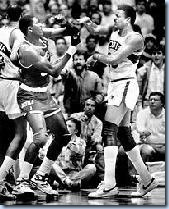
Maurice Lucas takes care of bid'ness Another spot on the floor that has changed over time was the power forward spot. For the longest time it was dominated by beefy characters who could bang, play defense, get boards, and get out of the way on offense. Individual talents like Bob Pettit and others tried to bring scoring into the fold; though guys like Maurice Lucas / Kermit Washington always seemed to find a home in the NBA being lunch-pail types at the 4. The evolution of the power forward took a quantum leap forward with Elgin Baylor -- a superb scorer par excellence. Elvin Hayes brought the toughness, but the examples of these individuals and Charles Barkley, Karl Malone and Chris Webber pointed out that it was really difficult to win the NBA title by focusing on a power forward.

Kevin Garnett won a title with the Boston Celtics as a top level power forward; however he was far from the primary offensive force for his club. Tim Duncan has won quite a few titles as a power forward; though one gets the feeling that had he been drafted by a club that was bereft of a David Robinson type that he would never have played there.

Today most teams look to the 4 spot to contribute on the glass and with defense -- like always; but now expectations for power forwards to score a bit more have been raised. Not many power forwards are known for being great shot blockers, though some exceptions to the rule exist. Most surprisingly the evolution of the power forward has branched out into seemingly different species as the needs of teams have changed.

Jason Maxiell is a power forward and so is Vladimir Radmanovic. The only similarities that these two guys seem to have is their heights, and that their talents are so focused that they are not capable of playing the three or the five. In some respects, the four spot is the utility spot. If you need extra athleticism, start Josh Smith there. If you need shot blocking, you've got Elton Brand. Shooting skills are easily found with Dallas' Dirk Nowitzki. Lamar Odom is a fantastic passer who has a great handle for a power forward. That said, which team is the best equipped (as far as the current make up of teams exist today) at Power Forward?

Atlantic Division:

Boston Celtics New Jersey Nets New York Knicks Philadelphia 76ers Toronto Raptors
Kevin Garnett Yi Jianlian Zach Randolph Elton Brand Chris Bosh
Glen Davis Eduardo Najera David Lee Reggie Evans Jermaine O'Neal
Kendrick Perkins Stromile Swift Wilson Chandler Marreese Speights Andrea Bargnani
Brian Scalabrine Sean Williams Malik Rose Jason Smith Kris Humphries
  Josh Boone Jared Jeffries   Nathan Jawai

Boston is anchored by KG and it quickly goes downhill from there. Big Baby, Perk (shifting over from the 5)and Scal are all bangers, and there is no real versatility here. New Jersey sports average talent in a number of bodies, Yi has the upside, Najera is a scrappy player, Stromile can sky in for dunks, Boone is a disappointment and Sean Williams (more of a true center) blocks shots. The Knicks manage to have both talent and depth -- Zach is a 20-10 guy when he wants to be, David Lee never gets tired, Jeffries is very versatile and Rose and Chandler are on opposite sides of the age/experience spectrum. Philly is interesting because they have Brand, who is a top level PF, and is backed by other bangers who can be rotation guys on almost every team. Evans and Evans Jr. (Speights) may seem a bit redundant, however Smith can shoot it well enough to give Philly an edge over the Knicks or the Nets. Toronto, though, is the class of the Atlantic when it comes to their power forwards. Chris Bosh is very underrated, he can do everything from hit game winning threes, to running up and down the court to block shots, and he makes all of his free throws. Behind him there is Bargnani (who will bounce back) and has unlimited range for a 4, Humphries hustles and bangs and rookie Jawai can play the 5 or the 4. Then there is Jermaine O'Neal who is a heck of a talent who does many things well. The Raptors have good defenders in Bosh and O'Neal, scrappy energy types like Humphries and Jawai and a very deadly outside shooter in Bargnani. All of these guys are tall, Jawai is the shortest, and he's only 6'10.

Winners: Toronto Raptors  
CB4 throws it down Anything is better than Indiana Look for a better season than his Soph slump All banger, no brains Man his arms are very long!
Chris Bosh Jermaine O'Neal Andrea Bargnani Kris Humphries Nathan Jawai


Central Division:

Chicago Bulls Cleveland Cavaliers Detroit Pistons Indiana Pacers Milwaukee Bucks
Drew Gooden Ben Wallace Antonio McDyess Troy Murphy Charlie Villanueva
Tyrus Thomas Anderson Varejao Jason Maxiell Josh McRoberts Joe Alexander
Andres Nocioni LeBron James Rasheed Wallace Shawne Williams Malik Allen
Joakim Noah JJ Hickson Amir Johnson Maceo Baston Luc Mbah a Moute
Cedric Simmons   Walter Herrmann Jeff Foster Dan Gadzuric

Chicago has quite a bit of talent here. Gooden is gooden enough to be a 15/10 guy with enough playing time, Tyrus has prime time athleticism, Nocioni is a heady player who can rebound, pass and shoot the ball, Noah (a center) can slide over and be a Tyrus clone, and Simmons shows a lot of potential as well. Cleveland is a special case, as they start Ben Wallace there, who while a shell of his former self, can still be counted on to at least intimidate. I don't know anything about JJ Hickson (or Lance Allred), but I know that Anderson Varejao can slide over from the 5 to play some 4. Cleveland really sucks at the 4, save for the fact that if they needed (or wanted) to, they could plop LeBron down here, and they'd be quite okay. Detroit has a good mix of veteran savvy (McDyess), tenacity (Maxiell), shot blocking and outside shooting (Wallace), a utility man (Herrmann) and potential (Johnson). Depending on the situation, Detroit has a variety of guys they can go to at the 4. Chicago (save for Nocioni) only has guys with limited ability outside of the paint. I am giving the edge to Detroit here. Indiana is the opposite of Chicago. they are all guys who are better outside of the paint than inside. Milwaukee is like the Nets, in that they have the ability to show a lot of different things at the 4, but they are all pretty average to poor. Detroit wins!

Winners: Detroit Pistons
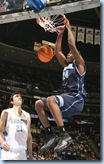
Gosh darn it, Ref, you're absolutely right about that call! Not pictured: eating babies I used to be a star! The CJ Miles of Bigmen I'm too sexy for this blog
Rasheed Wallace Jason Maxiell Antonio McDyess Amir Johnson Walter Herrmann


Southeast Division:

Atlanta Hawks Charlotte Bobcats Miami Heat Orlando Magic Washington Wizards
Josh Smith Emeka Okafor Udonis Haslem Rashard Lewis Antawn Jamison
Al Horford Gerald Wallace Michael Beasley Hidayet Turkoglu Oleksiy Pecherov
Solomon Jones Jared Dudley Shawn Marion Brian Cook Darius Songaila
Randolph Morris Sean May Joel Anthony Tony Battie  
  Alexis Ajinca David Padgett Marcin Gortat  

Atlanta is exciting with younger players like the hyper athletic Josh Smith and center worthy Al Horford. Aside from those two guys it's pretty much useless. Horford should play more center anyway, so it's pretty much just Josh Smith. He's a good player, but his limitations are obvious. The Bobcats are much more deep and versatile. Okafor is a defensive stalwart who is getting better offensively. Gerald Wallace is no slouch on defense, and he has the occasional ability to hit the three. He's mainly a slasher. Outside of these two are a few individuals playing out of position -- Jared Dudley is more of a 3 in the way Melo is, he can shoot and posts up, but isn't a full time 4. Sean May is a 5, but he can play a slow, but thick, 4 for a bit. The skinny but quick Ajinca is a 7'0 French player who can't possibly be thinking of playing the 5 over here in America. The Bobcats are pretty good here. Miami has three solid guys that could start: Haslem is one of the last Oakley types in the NBA, Beasley has all the potential in the world and Shawn Marion is very capable to do many different things well. It doesn't really matter after that. Marion cancels out whatever Gerald Wallace can do, Okafor is better than Haslem though. Is Beasley better than Dudley, May and Ajinca? Most definitely, so Miami is in the lead so far. Orlando is troubling. They basically play two small forwards (who are 6'10 and 6'11) here, and both of them are perimeter oriented offensive players who leave all the dirty work to Dwight Howard. That said, they won quite a few games for Orlando this season -- their clutch shooting was a great help to their team. Cook can also shoot it from the outside, and everyman Tony Battie can still get up there to block some shots (but he's mostly a 5). Marcin Grotat is probably a solid pick and pop guy as well. If you are looking at pure scoring, it's hard to say no to Orlando. Washington has Antawn Jamison, who is (statistically) one of the best PFs in the Eastern Conference, even if no one talks about him. Oleksiy Pecherov will one day pan out to be a poor man's Detlef. Darius Songaila is a poor man's Jamison. All three are capable outside shooters, and all three are solid rebounders. They don't have much depth and versatility -- all are basically differing talent levels of the same type of power forward archetype. Miami's lack of depth is a worse problem than Orlando's lack of inside muscle, or Washington's lack of versatility.

Winners: Miami Heat
I don't play well with others, go ask Steve and Amare Anyone remember Loy Vaught? Will he prevent Boozer from signing here? Joel spent the last season learning how to tank I'm here to let Beasley dunk on me in practice
Shawn Marion Udonis Haslem Michael Beasley Joel Anthony David Padgett


Southwest Division:

Dallas Mavericks Houston Rockets Memphis Grizzlies New Orleans Hornets San Antonio Spurs
Dirk Nowitzki Luis Scola Hakim Warrick David West Tim Duncan
Brandon Bass Carl Landry Antoine Walker Melvin Ely Kurt Thomas
James Singleton Chuck Hayes Darrell Arthur Julian Wright Matt Bonner
  Ron Artest Darko Milicic Ryan Bowen Ian Mahinmi
  Mike Harris   Hilton Armstrong Anthony Tolliver

Dallas begins and ends with Dirk. He is one of the Top 5 power forwards in the league. Behind him is the inside brute Brandon Bass. Singleton almost has to bring nothing, and the Dallas power forwards are one of the better ones in the league. Singleton is apparently very athletic, so he only makes Dallas stronger. Houston has a legion of guys 6'9 and under to throw at teams. Scola is the best of the bunch, and guys like Landry, Hayes and Harris are all inside players. Landry is quite a good defender. Speaking of crazy defenders, the Rockets may elect to play Ron Artest at the 4 in spurts. He is capable of playing good off the ball and man to man defense against taller players. In the absence of Ron Artest, Dallas is much better than Houston, even though Houston has many more fouls to go around. (Keep in mind that some of these guys on the Rockets are also their back-up centers) Memphis has Warrick, who is an exciting young player; alas, he's not good enough to elevate this rag-tag group of power forwards over any of the other groups in his division. Walker is crazy talented, but he's not playing in many games. Darko can slide over, but I doubt that he would -- unless Marc Gasol is really good. The Hornets have one of the best mid-range jump shooting bigmen in David West. Their back-up is really Ryan Bowen (think Harpring, but taller, and less capable), but I've include the ability for them to shift people around a bit (like centers Ely and Armstrong). The Hornets are good -- but not because of their fear inducing power forwards for certain. The Spurs have Tim Duncan, Kurt Thomas (like McDyess but better), Bonner (a guy for threes), Mahinmi (one of the better NBA-DL players out there) and this Tolliver guy. I know next to nothing about this guy, but I know he was drafted by the Spurs, and they rarely make mistakes. Dallas vs. San Antonio for this one . . . and . . . well, Duncan is way more clutch than Dirk in the playoffs.

Winners: San Antonio Spurs
Tim Duncan just wins, baby. Ancient doesn't even begin to define my knees The Red Rocket Je suis tres desole Must . . . impress . . . Eva . . .
Tim Duncan Kurt Thomas Matt Bonner Ian Mahinmi Anthony Tolliver


Northwest Division:

Denver Nuggets Minnesota Timberwolves Oklahoma City Thunder Portland Trailblazers Utah Jazz
Kenyon Martin Al Jefferson Chris Wilcox LaMarcus Aldridge Carlos Boozer
Nene Ryan Gomes Donyell Marshall Channing Frye Mehmet Okur
Renaldo Balkman Craig Smith Jeff Green Ike Diogu Andrei Kirilenko
Linas Kleiza Brian Cardinal Nick Collison Travis Outlaw Paul Millsap
Chris Anderson   Joe Smith Raef LaFrentz Kosta Koufos

Denver is talented here, K-Mart can run, jump and dunk. I'm not a fan of his, but on paper is he good enough to start on most teams. Nene -- probably the starting center -- can fit in well here as well. Balkman escapes from New York to bring his all around hustle to the Mile High city. Kleiza is a very accomplished shooter and international player who even put up something like 42 points against the Utah Jazz last season. The Birdman returns to the NBA as part of the Nuggets. All in all, they are very talented, have a solid outside spot up shooter in Kleiza and a couple of inside only guys. The T-Wolves are no slouches either. If Chris Bosh is one of the most under rated 4's in the league, Al Jefferson is not even mention at all. He is a beast on the inside. Gomes is very talented as well, and can do almost anything on the floor from hitting threes to blocking shots. Craig Smith is in that Maxiel/Millsap mold, but plays in relative obscurity. Brian Cardinal is Ryan Bowen with an outside shot. A solid group, but Gomes is not quite good enough to be a running four (like what Kleiza would be great at). Oklahoma is actually pretty good. Wilcox is the starter who can score in the paint. Donyell is a three point specialist to the point that he doesn't bring anything else to the table anymore. Jeff Green can slide over from the three to rebound and play well. Nick Collison is a rugged interior defender and Joe Smith is a very capable inside scorer. Portland just has LaMarcus -- and while he is a good young player, I'd rather have any other group of power forwards from the Northwest division than what Portland puts out there. Lastly, we have the Utah Jazz and, well, let's put it this way: three of these guys have been All-Stars. Carlos Boozer, for his defensive faults, is one of the best power forwards in the game -- he is a monster on the boards and is able to shoot from 18 feet or work inside with solid post moves. (Does David West have any post moves?) Mehmet Okur was a power forward up until Carlos Boozer finally got healthy two seasons ago. In Detroit he was a power forward and he was in Utah as well. He has great range, can block shots (like his game winning block), is an under rated man to man defender (like how he locked down Yao in games 5, 6 and 7 in 2006-2007) and can even drive. Andrei Kirilenko is very versatile, can guard guards and block the shot of centers. He shot 38% from deep last season and was European player of the year in 2007. He's also a very good shot blocker. Paul Millsap is the back-up of Boozer (because Ak is at the 3, and Memo at the 5), but in a true test of ability, he is farther down the depth charts. He is a tough defender who hustles for loose balls and is an energy player like Tyrus Thomas and others. Koufos is really a center, but his college game seems to translate better to the four. He's over 7' feet tall and can block shots and hit jumpers. I like what Oklahoma City has, I'm surprised at how good they are as a group. Denver is always tough, and they got much better by adding Balkman and Anderson -- though I can't vote against the Jazz. Not when three of their five guys at power forward have been All-Stars, and that any of their top three guys would start for almost every other team in the league.

Winners: Utah Jazz
Dunking is fundamental! Memo dunks on Amare Nyet to Carmelo! Millsap throws it down Kosta has balls
Carlos Boozer Mehmet Okur Andrei Kirilenko Paul Millsap Kosta Koufos


Pacific Division:

Golden State Warriors

Los Angeles Clippers

Los Angeles Lakers

Phoenix Suns

Sacramento Kings

Al Harrington

Al Thornton

Pau Gasol

Amare Stoudemire

Mikki Moore

Brandan Wright

Tim Thomas

Lamar Odom

Boris Diaw

Kenny Thomas

Rony Turiaf

Brian Skinner

Vladimir Radmanovic

Louis Admunson

Shelden Williams

Anthony Randolph

Steve Novak

Luke Walton

Robin Lopez

Shareef Abdur-Rahim

Richard Hendrix

Marcus Camby

Josh Powell

Matt Barnes

Jason Thompson

Golden State is interesting, they have a Jamison type with Al Harrington, and occasional center Rony Turiaf is quite good as a backup. They've channeled the Department of Redundancy Department with Brandan Wright and Anthony Randolph. Unfortunately for this group, I think the whole is less than the sum of their parts. The Clippers will probably have to use either Kaman or Camby here -- I guess Camby as he used to be a PF back in the olden days. Novak and Thomas can shoot it, and Thornton has potential to be something. The Lakers, on the other hand, have guys who are something. Gasol will have to move to the 4 to make room for Bynum. This makes Odom one of the most talented back-up power forwards of all time. He is great when he is on. Vlad Rad is all about shooting, and Luke struggles at time, but over all, he's not that bad. Phoenix has Amare, the ultra versatile Diaw, the monumental punk Matt Barnes (but he can sometimes hit a three), Mr. Hustle Louis Admunson and if they really need him, Robin Lopez. Over all, it's a solid group, but Gasol and Odom are greater than Amare and Diaw. Sacramento is were somewhat talented power forwards go to die. Easily the Lakers win this one.

Winners: Los Angeles Lakers
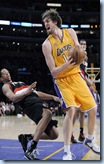
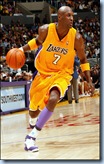
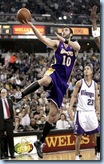
Halitosis attack! One of the best ball handling bigmen Am not an R Tard I'm good, really I am . . . Journeyman . . .
Pau Gasol Lamar Odom Valdimir Radmanovic Luke Walton Josh Powell

The question remains though . . . which of these six groups is the best? (remember to think about strengths, depth, versatility, offensive diversity, defense, star power, awards, and chemistry)