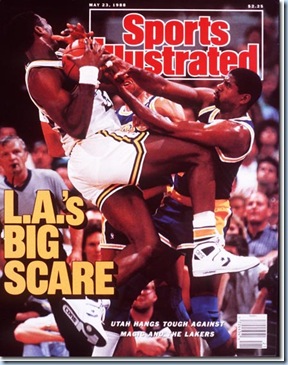
Showing posts with label 1987-1988. Show all posts

Monday, May 18, 2009

Who else is sick with the Great Hype surrounding Andrew “Bust”num?

Rehab aint easy . . . If you’ve ever wandered onto an LA Lakers blog, message board, or listened to a nationally broadcasted game by Mike “Fellatio for the Lakers 24/7” Tirico then you’ll know, with complete certainty, that Andrew Bynum is one of the best centers in the league, and will without giving any prior notice, become the next best center in the league and join the pantheon of great bigmen. He will rightfully sit alongside Wilt, Russell and Kareem while using Ewing, Robinson and O’Neal as foot rests. The third footrest will be necessary because of how great and grand his male organ must be – as he has been photographed at the Playboy mansion (who cares) and is curiously linked to Rihanna right now. (who? exactly.)

As impressive as his potential appears, and as great as his off-court life may or may not be (I’d rather hang out at the Acharya mansion any day of the week) – I’m less than impressed with him as a player. I’m even less impressed when I actually look at his accomplishments as a player in the playoffs (aka. when it counts). Furthermore, I’m pretty much sick to death by the hype that he has received from casual fans, homer fans, and the media alike. Now, this isn’t meant to trash the hopes of the future of the Lakers at all – I strive to temper the expectations of him a little bit. For his sake, and ours.

My brother is the most rational Lakers fan I know, he is passionate, but not completely under the spell that countless others are on the internet. He’s more concerned with consistent play, rebounding and solid defense from all of the Lakers and does not have the time to worry about if Bynum is going to be the next Kareem – he’s worried about right now. If I was a Lakers fan I wouldn’t be worried about right now – you guys will trounce Denver on your way to the NBA Finals (where anything can happen). I would, on the other hand, be worried about the past – specifically Bynum’s past.

He’s 21 years old right now and was drafted as a 17 year old. What do we know about him that should really count? How about the fact that he had an injury ruined high school career (leg/knee injury), and in the NBA has had two more leg/knee injuries in his young career. He’s tall, but not nearly as super athletic and fit as freaks like Dwight Howard or Amare Stoudemire are – I don’t expect him to be physically made of the same stuff as those guys are. When you get over 7 feet tall, any injuries to your lower body seriously limit how reliable you can be, regardless of how much work one may put on their upper bodies. (You’re only as strong as your base is – look at Yao Ming, who has just a storied lower body injury history as Bynum, he misses lots of games every year, and is never 100% due to the strain his body puts on his lower body) Amare had two career ending (had this been the 80’s/90’s) knee injuries, but has come back due to a great work ethic. Bynum puts women on his shoulders during rehab. I wouldn’t be making a huge leap by suggesting that Bynum may have a career that features a number of injuries to his lower body, not unlike Yao Ming – as opposed to being virtual injury free like Dwight Howard. But I have no crystal ball, I’m just going on the fact that he’s a big guy with a history of lower body injuries who was injury prone as a teen and only looks to put an increasingly large strain on those same joints as his ages and increases mass.

That’s not very empirical though, it’s just an assumed health arc based on his body type, job, apparent work ethic, how healthy other big guys his size have been and medical history. What is empirical, on the other hand, is to dig deep and look at stats. I love stats. Stats are flawed, as I’ve explained on this blog before, but they still give a pretty good indication of on court production. (After all, that’s what counts, points, rebounds, blocks, assists, steals, turn overs and fouls, right?)

After this last game against the Houston Rockets the total number of playoff games that Bynum has participated in stands at 18. These 18 games have taken him from 2005-2006 till now to amass. In that time he has been brought along slowly – thanks to the fact that he doesn’t need to be useful when he’s so far down the pecking order behind at least 4 other guys. That said, his production does not appear to be indicative of him joining the pantheon of great bigmen any decade soon. I want to look at his stats in the playoffs and see the promise that appears to be there (and only appears in regular season games against bad teams sandwiched between injuries). As a point of reference I looked at Patrick Ewing’s first 19 games (why not 18? wanted to complete that one series to make it an even number of playoff off series for the two) in the playoffs. Ewing was a great center, but never will he be called the best of his generation, and thus, not up for entry into the pantheon of greatest bigmen ever (though the media has already reserved a spot there for Bynum).

Bynum’s first 18 Playoff games, and how they stack up:

Bynum Ewing and Robinson Ewing creams Bynum statistically. And Ewing played in a time where big guys weren’t bailed out with foul shots, and played against much better competition. Bynum played against the Phoenix Suns, twice anchored in the paint by Frenchman Boris Diaw; the injury depleted Utah Jazz that was forced to start Jarron Collins; and the Houston Rockets, who during the course of the series, lost Yao Ming to injury a little more than 2 games in – and had to turn to a rotation of Chuck Hayes, Carl Landry and Luis Scola to battle LA’s 7 footers. Bynum gets killed – just look at the stats.

Alas, he is immune to any criticism for a great rebuttal exists: Ewing had much more experience from being a guy who actually went to college, won a National Title; and also played in the NBA for a few seasons before making the playoffs. All this is true, but nothing prevented Bynum from going to college himself – if he was really interested in experience. That said, I also took a chance to look at another young bigman, and saw how he faced the NBA pressure. David Robinson did manage to make the playoffs as a rookie (he led his team there, unlike Bynum who did his best to stay out of Kobe’s way). David Robinson is far from my favorite player in the world – but he also creams Bynum’s numbers when you take out experience and look just at Bynum’s FIRST FOUR SEASONS against David’s ROOKIE season.

Let’s not forget that David had to go to war against Joe Barry Carroll and the plethora of tough guys in the paint that Portland sported back when David was a rookie. Bynum, with 4 years of experience in the NBA, has yet to face anything like that in the NBA playoffs – and his numbers are completely pathetic.

Ewing: 22.1 ppg, 10.9 rpg, 2.37 bpg

Robinson: 24.4 ppg, 12.00 rpg, 4.00 bpg

Bynum: 4.83 ppg, 3.78 rpg, 0.67 bpg

Obviously the data is heavily skewed against poor, young Bynum. His first few playoff sorties were short and he was inexperienced. Obviously the stats are going to go against him when you include some of his early games. The Bynum of today is a beast though! Look at Bynum’s numbers from just his 4th season in the playoffs against other greats and you’ll see! You’ll all see!

Okay, let’s do that then.

Bynum’s Playoff stats from his 4th season, and how those stats stack up:

Bynum closer to Ostertag than Olajuwon Bynum’s numbers improve very slightly, he ups his ppg from 4.83 to 5.58, his free throw percentage from 62.96% to 76.47% and he swats almost 0.2 more blocks per game. Still not impressed. He’s a far cry from, let’s just randomly say, Hakeem Olajuwon. In the Dream’s 4th NBA season he happened to tear the NBA playoff’s a new one with his scoring -- 37.5 ppg (57.14 fg%, 88.37 ft%); rebounding – 16.75 rpg; and all around game – 2.75 bpg, 1.75 apg, 2.25 spg.

Not only did Hakeem obliterate Bynum’s pitiful offensive output by a magnitude nearing 7x, but absolutely owned him all over the boxscore. He also did it against much tougher competition as well.

Heck, Bynum is so far from being impressive that Greg Ostertag’s fourth year playoff stats could (and do) give Bynum’s fourth year playoff stats a run for their money. It’s horrible to say, but really Lakers fans (and media, or is that redundant?) – take a look and weep.

Bynum is a much better offensive player than Ostertag (is this even saying anything?), but Ostertag owns Bynum when it comes to rebounds and blocks. Greg even managed to out-assist Bynum and made less mistakes (as seen in less turn overs and fouls per game).

What’s worse, the fact that Bynum just got his lunch handed to him by Ostertag; or the fact that Ostertag was doing this against super duper vets and talented players like Vlade, Arvydas, Dale Davis and Rasheed (when Ostertag was a 4th year player) – and looking better than media adored Bynum going up against Chuck Hayes and the guy who was behind Ostertag on the depth chart?

Furthermore, Bynum’s had 5 scoreless games in the playoffs, out of 18. And he’s scored less than 5 points 11 times out of 18. Ouch.

Take a look at Hakeem’s 37.5 ppg average again. Ouch.

Of course, there HAS to be a rebuttal for this . . . no way can Bynum been so far behind Hakeem at the same stage of NBA experience, and yet so close to NBA laughingstock Greg Ostertag . . . right?  . . . .right? Don’t worry Lakers fans, of course there is . . . forget about NBA experience, that’s a flawed concept. Let’s not forget that Hakeem and Greg both played college ball (like Ewing and Robinson did) . . . Bynum didn’t play college. Look at how young he is! He’s only 21! Surely when you take that into account it makes up for 32 ppg (in the case of Hakeem), or nearly a block and a half (in the case of Ostertag)!!!

Okay, let’s take at a look at that. Try me.

Bynum’s Playoff stats as a 21 year old, and how those stats stack up against another 21 year old:

Bynum is a far cry from Shaq when looking at their stats at age 21 Bynum is a very brittle 21 year old who doesn’t have to do anything, and his team makes it to the NBA Finals. I’m not lying, the Lakers did that last season. That said, Bynum is a force of nature, and the future of the center position in the NBA. His 21 year old production is unrivaled. Right? Wrong. Take a look at this guy, and what he did in the playoffs at the tender age of 21 (his 2nd season in the L, not his 4th like Bynum). I just have one hyphenated word to describe this: Shaq-Attaq.

A lot of the same Lakers fans who champion Bynum marginalize how great Shaq was. I can clearly see why Kobe went out of his way to suggest that Bynum needed to be traded – because Kobe knew how good Shaq was. The difference between the two is quite telling when you look at these two centers at the age of 21, Bynum in his 4th season and Shaq in his 2nd.

The difference between the two was almost 15 points, 10 rebounds and over 2 blocks and almost 2 assists . . . in favor of the 2nd year player.

That’s a huge difference.

The difference between being called one of the best bigmen of all time, and being called a bust.

Bynum was a lotto pick man, and aside from his inspired dirty play in injuring two guys this season, and being afraid of Fesenko in the paint, he’s done nothing to earn the high praise that’s heaped on him. And he’s done nothing to make me feel like giving him any props.

His current playoff run isn’t over yet, and he’s got one, most likely two more playoff series to make his 2008-2009 playoffs slightly more memorable than his complete no-show in the 2007-2008 playoffs.

I’m taking it easy on Bynum here by comparing him to guys that he may yet one-day reach . . . even if it doesn’t seem like it. I could really try to down him if I wanted by comparing him to his contemporaries who are out-playing him right now. For example take Dwight Howard -- in his first 14 playoff games: 17.86 ppg (57.23 fg%, 51.72 ft%), 15.5 rpg, 2.71 bpg, 1.14 apg, 0.714 spg . . . those numbers are way better than Bynum’s. Also better are Dwight’s numbers as a 21 year old and Dwight’s numbers in his 4th NBA season.

If I really wanted to be a dick I’d mention that Dwight also has 3 less leg injuries. I’m not a dick though, so I’m not going to mention that.


What did we learn?

What did we learn? Well, for starters we learned that Andrew Bynum’s playoff performances leave much to be desired. His first 18 games in the playoffs pales in comparison to Ewing’s numbers over the same situations – and Ewing played against much better defensive clubs like Michael’s Bulls and the Bad Boy Pistons. We learned that David Robinson’s rookie season playoff numbers invalidates the argument that Bynum’s rookie numbers shouldn’t count. We also learned that Hakeem’s numbers as a fourth year player completely eclipse Bynum’s as a 4th year player. I didn’t even have to look up 2nd tier NBA centers like Rik Smits at all after I found out that at the same level of NBA experience that Greg Ostertag’s playoff performance was a wash with that of Bynum’s. Lastly, we learned that Bynum can’t even hide behind his age as an excuse for how poor his performances have been – as Shaq as a 21 year old eats Bynum up. Ultimately, we learned that it’s a bit too premature to call Bynum anything other than a bust at this stage. He’s much closer to Ostertag, albeit one who rebounds and blocks less, and fouls and turns the ball over more, than he is to being one of the greatest bigmen of all time – let alone in his own generation.

After all, Dwight’s numbers at each break down (first x number of games, 4th NBA season, and at age 21) are vastly superior to Bynum’s. Oh yeah, also Bynum has a history of injury problems to the same parts of his body and young guys who sustain so many injuries in short succession tend to have injury plagued careers. Yeah, I wasn’t supposed to mention that again . . . I guess I am a dick after all.

Bynum doesn’t deserve his hype until he does something. Something other than sucking when it counts, that is.

If you liked the stat breakdown, and would like a full version at full resolution, click on the image below. I dunno, maybe you are just into making Bynum look silly . . . or want a stat heavy window’s desktop wallpaper . . . or both? Go nuts!
Click to view in full resolution

Wednesday, February 25, 2009

The Jedi Voodoo Mind Trick Hype Machine

It should come as no surprise that after the Jazz started to get a) some of their injured guys back, and b) allowed some of their banged up guys (who were still playing) to get well again that c) the Jazz would start to win some games. Similarly so, people all over the world would start lauding Utah again. This has been par for the course over the last few seasons. In the 2004-2005 season the Jazz won only 26 games. Why? Not because of any extra-ordinary amount of 'suck', but because of injuries. (AK and Booz were out almost all of the season EACH) The next year -- when healthy -- the Jazz almost made the playoffs. End result: people started to talk about the Jazz. Since that time, the Jazz have increased their wins in each of the successive seasons. Alas, it would be folly to suggest that the Jazz did better when they weren't flying under the radar.

Flying under the radar

They do. A small market team that no one likes tends to band together better with the 'us against the world' attitude that happens with multiple all-star snubs, and poor projected win numbers. When everyone is flying high with the Jazz bad things happen. (After all, that 2004-2005 season where the Jazz won only 26 games was supposed to be a big win season according to ESPN.com, they had improved themselves the most over the off-season in their power rankings) Perhaps being disregarded early (due to poor playing in December and January each season) helps the team mentally get ready to "show everyone" that they were wrong for counting out the Jazz.

After all, no one was talking Jazz at the All-Star breaks the last few seasons (except for last season maybe), but each time the team is able to have spectacular runs in the final 30 games of the season and have won their division twice in a row. The mental edge that some of our players hone due to being passed over may not be so sharp right now when everyone and their grandmother is counting the Jazz in this time around.

Hollinger, of ESPN.com, once suggested that the Jazz would be the team to watch in 2009. Even after the season of injuries that the Jazz have suffered so far, he contends that the Jazz can still win the division. Mark Stein, also of ESPN.com, moved the Jazz up to 9th best in the league in his power rankings, and in his chat later on this week suggested that he should have moved then up to 7th best.  Chad Ford, again, ESPN.com, chimed in yesterday that when healthy "the Jazz . . . are the Lakers biggest competition in the West." Skeets and Tas over at TheBasketballJones suggest that the Jazz *are* this good, and only injuries got in the way.

As nice as all of this sounds, even the most vocal, yet highly respected, detractors of the Jazz have gotten on the respect wagon of late. AOL's NBA Fanhouse could be my browser homepage, their contributors get the news out from all over the league onto the net almost faster than anyone else. They recently had a roundtable discussion on the Jazz, and anyone who knows their writers knows not to expect glowing reviews. Matt Moore has contested for quite a long time that the Jazz are paper tigers. [fair enough...] He, however, did recant somewhat on his own blog, the amazing Hardwood Paroxysm, with his post "In the interest of fairness". (SLCDunk.com quoted MM yesterday on his LHM tribute) Moore even suggests that reading the comments in the Fanhouse roundtable elicited him to dig a little deeper.

"But I read the comments on our round table today, which featured an amazing combination of actually lucid, intelligent commenters, and I realized that I just didn’t fully give the story."

I'm guessing he wasn't talking about the comment calling everyone a moron, but perhaps maybe this one started things off. That "Doc A" guy sounds really smart. Now only if he had a blog that he could post his thoughts on . . . one that properly formatted itself depending on the browser settings of the viewer . . . grrrr. [For those who didn't get it, I'm "Doc A"] Tom Ziller (you should know who this guy is if you like reading basketball on the internet) goes where no one else has gone before and even suggests that we should, collectively, "Fear the Utah Jazz".

The recent love for the Jazz extends beyond the reaches of ESPN.com's columnists or bloggers . . . Kenny Smith (who has two rings), despite not being able to pronounce Deron Williams' name, goes out and heaps praise on our, small market team.

Charley Rosen, Phil Jackson's butt buddy, is an opinionated old coot whose analysis of games is limited to whatever game is on cable TV that month. Dude doesn't even go to games. Essentially, if you look past his mediocre success as an assistant coach in the CBA he has no greater insight into the game than anyone else with a remote control and a laptop. This week he found it within his back heart to say something nice about our players -- one in particular -- the same one that Kenny Smith can't pronounce despite covering him for at least two rounds in each of the last two playoffs.

All of this must sound great if you are a Jazz fan, right? On one hand it either shows that the world at large is a) respecting our team, or b) had their head so far up their sigmoid colon that they merely overlooked the Jazz and their lower seed record as evidence that the Jazz were just a bad team. I don't particularly find much comfort in either answer.

Deron dunks on Dampier

The Jazz don't do well with hype. You can look back and see what happened in that eventful 2004-2005 season, or look farther back at what happened in the 1998-1999 playoffs . . . or still farther back to one of those 5 first round exists during the early Stockton & Malone era after looking so good at such a young age by taking the Lakers to 7 games in 1987-1988. Hype can dull the edge, or worse, completely remove the chip off of the shoulders of our hungrier players. By giving the Jazz too much hype, perhaps, our expectations for them will never be attainable? Partly because of our expectations, but alternatively, also due to the hype removing some of the focused insanity that motivates people when they feel disrespected. Utah needs all the focus they can get, just look at their road record vs. under .500 teams . . . they don't play well unless they feel like they have something to prove.

These are not the serious playoff threats you are looking for

So please, for the sake of the Jazz, don't hype them.

Tuesday, October 21, 2008

YouTube Tuesdays! Mark Eaton throws it down!

Mark Eaton on Mychal Thompson (1988) [0:49] -- Uploaded by HRE:

The ridiculous part of this whole Stockton / Eaton pick and roll that results in an "and 1" for Mark Eaton is that I remember watching this on TV when it happened way back when.

It happened back in 1987-1988 and man, Stockton could really lead a guy with his passes. Enjoy this facial by Eaton on Mychal Thompson.

What a trip down memory lane. Karl Malone approves.

ESPN's Chad Ford likes him some Utah Jazz

In a recent ESPN Podcast (click on that if you want to listen to it) Ford talks for about 2 minutes about how gosh darn awesome the Jazz are. He starts by suggesting (what a lot of people thought, including himself) that the Jazz success in the 80's and 90's were primarily due to John Stockton and Karl Malone; however, he now sees that the influence of the system and Jerry Sloan had a lot to do with it. Case in point: this version of the Jazz who are pretty strong -- partly due to the system, and partly because of shrewd roster moves by GM Kevin O'Connor.

Furthermore, success in the Jazz system is predicated upon strong point guard play -- and none of this recent success would be possible without Deron Williams. Who Ford "thinks is one of the top 3 point guards in the NBA" (Chad Ford, 2008, via ESPN Podcast). He goes on about how dominant he is.

Next Ford talks about Boozer being an anchor in the paint; mentions AK-47 as a talented role player whose true contributions do not always show up on the box score; and that Mehmet Okur stretches the defense and had an amazing second half of the season for us. Surprisingly he gets himself a good seat on the Ronnie Brewer bandwagon and talks about his athleticism, his ability to play the passing lanes, he's potentially a ball hawk, and really is what the Jazz team are missing. Basically he's suggesting that he's going to be that athletic perimeter defender that we haven't had since, well, uh, Blue Edwards? (Jazz history isn't rife with great athletic shooting guard lore) Over-all the Utah Jazz's depth, head coach and system are hard to ignore. Such that:

ESPN Chad Ford

"I think that if anybody is going to be able to stop the Lakers this year it's the Utah Jazz -- they're great at home, they are getting [increasingly] confident, they have a great mixture of youth and veterans, and I think at the end of the day, if there's a team that is going to surprise us in the West, it's going to be the Utah Jazz." (Chad Ford, 2008, via ESPN Podcast)

Chad Ford, ESPN  

I haven't heard any of his other team podcasts, but I doubt he's going to be really critical (well, maybe the Pacers and Bobcats...) in any of them. If you want, you can listen to them all here. Over all, I agree with him -- our bench is under rated, our system works, and we have some athletic young talent for once. NBA Finals here we come!

Friday, September 26, 2008

Flashback Friday: The 1988-1989 Utah Jazz

This 1988-1989 Utah Jazz team is historic for a variety of reasons. First of all, this team was the first in franchise history to win 50 or more games in a season. (They would win 51, a mark that the Jazz have equaled or bested 12 times since then) Second, they featured a 25 year old Karl "The Mailman" Malone who was coming into his own.

Bigger, Stronger, and Faster than Amare Stoudemire

[Tangent Alert: I hate all the hype Amare gets, if dude is so good and a beast why isn't he scoring 30 a game like Karl did? Karl Malone >>>>> Amare Stoudemire. For the record, all Karl did that season was score 29.1 ppg (51.9 fg%), go to the free throw line 11.5 times a game, average 10.7 rpg, 2.7 apg, 1.8 spg and 0.9 bpg. What did the "Beast" Amare do at the age of 25? He got 25.2 ppg, 9.1 rpg, 1.5 apg, 0.8 spg and 2.1 bpg.

Amare didn't even get to the FT line 10 times a game, or ever has in his 6 year career, Malone did it 3 times in his first 6 years alone.

Karl even shot better from the three that season (5-16 [31.3%] to Amare's 5-31 [16.1%])! So aside from blocks, his age 25 stats are owned by Malone at 25. And as for blocks . . . Karl was playing with Mark Eaton who sent back 3.8 shots a game "so yeah . . . think about it!" (read the 3rd one on that page to get this joke)]

Back to that Jazz team . . . aside from Malone becoming a force of nature, he also had some help from Eaton (previously mentioned as blocking 3.8 shots a game, but also getting 10.3 rpg on his own on his way towards being named and All-Star and the Defensive Player of the Year); Thurl Bailey chipped in 19.5 ppg, 5.5 rpg and 1.1 bpg; Griffith kept people honest on defense with his outside shooting (61 3pt made in an era where that would be one of the top totals for any player) . . . and this John Stockton guy had one of his several seasons that are arguably better than Steve Nash's MVP seasons. John would finish up with 1118 assists that season, a pretty average output for him, but still 221 more than Nash's best ever season. [I guess the whole Stockton vs. Nash thing is another tangent altogether . . . so just click here if you want to read an empirical analysis of their recorded effect on the game.] This season was also the last for Frank Layden, who would give the coaching job to Jerry Sloan 17 games into the season.

Goliath? Is that you? Griffith brings the ball up the floor Frank Layden orders three hot dogs and a beer
Mark Eaton blocks one in the All-Star game . . . one of his over 300 blocks that season. Due to Karl's development, 6'11 Thurl was often left posting up on small forwards . . . to the tune of nearly 20 ppg as the 3rd option. Dr.Dunkenstein's career was wrapping up, but he still had enough to average more than Kirilenko or Brewer did last season. Frank Layden was a more fun coach than any coach after him . . . or perhaps before him.

There are many reasons why the 1988-1989 Utah Jazz team could be called historic. There were many good things that happened this season:

  • This team had a coaching change during mid-season, and they were motivated and rejuvenated by having a young coach at the helm
  • They had some very talented players (three All-Stars, Bailey and Griffith) to offset an anemic bench
  • They won the Mighty Midwest Division Title for the first time with this core group (the first time in post-Dantley, post-Maravich era)
  • Last season they took the NBA Champion LA Lakers to 7 games in the 2nd round of the playoffs -- and scared them good.
  • The sky was the limit for this team that turn into a 'contender'

This is somehow not a foul . . .

That said, there is one reason why I find this team particularly interesting. This team, for all of their successes, took a step back after building so much momentum. Sure, three seasons later they would reach the Western Conference Finals for the first time in franchise history (and reach there 5 times in the 7 successive seasons) -- but during this upswing in success the Jazz fell back down and were swept from the Playoffs in the 1st round. (Thanks Golden State!) This troubles me because right now the current Jazz franchise is experiencing a second upswing and a similarly linear progression . . . and it would really suck to have to go through those bumps and bruises all over again as a fan. (I've been emotionally invested in this team since the 1987 season, and am finally getting over all those 1st round losses)

I am even tempting fate here by even bringing all of this up right now . . . as our beloved Jazz are 'perhaps' (if history repeats itself) primed for a less than stellar playoffs? (After all, we did just play LA in the 2nd round of the playoffs 20 years after the first time it happened) Ultimately you have to look at all of the good things that happened this season and find them to be inconsequential when examined against a 0-3 playoff elimination in the 1st round to an underdog team with no bigs. The 1988-1989 Utah Jazz season was not a good one . . . simply because where they where and where they ended up fell below expectations. This Jazz team is even ahead of the curve because they've already been to the Western Conference Finals (2 seasons ago), while at this point 20 years ago, the Jazz were still three seasons away.

I wish for the best for the Jazz in this, and all seasons; but would really pray against another regression year. After all, there is no guarantee that our current window of opportunity as a contender will stay open for as long as the window we had 20 years ago.

Thursday, September 11, 2008

The Five Epic Errors of Jerry Eugene Sloan

I like Jerry Sloan and respect him for what he has done for the NBA, and what he has brought to the game. He and his staff (Phil Johnson, and any combination of Ty Corbin, Gordon Chiesa, Kenny Natt, Scott Layden, etc) are undervalued developers of talent and teachers of the game. For example, DeShawn Stevenson was not an NBA player when he joined the league -- 4 years learning in Utah made him a player. For one, they completely broke down his shot, and rebuilt it like the $6 Million Dollar man over those 4 years as he worked with Hornacek for quite a bit -- now he's a capable three point shooter, not an athletic Desmond Mason type with ugly mechanics and no outside shot. Another thing that is undervalued is the fact that Jerry Sloan (and staff) is quite good at making game to game adjustments. (Some will argue that he doesn't make meaningful adjustments -- but those are in-game adjustments, which I readily agree he is poor at -- his game to game adjustments are among the best in the league. For proof watch the NBA playoffs)

Can I has technical foul?

Sloan is well respected in league circles, though he is consistently regarded as a few notches down from the likes of Phil Jackson, Gregg Popovich, Pat Riley, Don Nelson (who has 3 CoY awards!), Larry Brown, Rudy Tomjanovich, Jeff Van Gundy (who is not currently employed as a coach) and others.

Sloan is well respected, but guys like Bryon Scott, Sam Mitchell, Rick Carlisle, Doc Rivers and Don Chaney have won Coach of the Year Awards. [Opinion Alert: I think that Sloan is a better coach than any of those guys]

Scott is an okay coach, Mitchell is a 5 game loss streak away from being fired, and Doc Rivers was fired as a coach something like 7 times already. Don Chaney has a .406 winning percentage, of if you will allow me, roughly a 60% losing percentage. He has two playoff wins in his career as a coach. He has been a CoY, while Sloan has not.

It's not about Coach of the Year Awards though, as Sloan's top assistant coach (Phil Johnson) was NBA Coach of the Year in 1974-1975. What it is about, though, is understanding why Sloan (for all of his good attributes) seems to be a step behind that first group, and stuck in a situation where former Players with little coaching experience get awards that have so far eluded him. What are the major lacunae in Jerry Sloan's abilities as a coach?

1. Playing Time / Rotation Management:

Only John has retained his hair from those days Not pictured: ref awarding Jordan two free throws Jerry Sloan has had the benefit of having John Stockton QB his teams since Jerry Sloan first became the Head Coach in '88. Stockton has always heeded Jerry's command (like any good soldier), and as such, he was at the mercy of Sloan during the most important 12 games of John Stockton's career -- the NBA Finals in 1996-1997 and 1997-1998. Jer' has coached John for quite a while, so you'd think Jerry knew how important these games were to John's career and future legacy.
Photographed by Andrew D. Bernstein/NBAE via Getty Images    

But one of Jerry Sloan's major flaws was expressed in those 12 games. Sloan likes to stick to a rotation, which may or may not have contributed to prolonging the careers of his players at the expense of wins. Malone and Stockton both played up to the age of 40 -- but a few seasons before they'd reach those milestones they were in the NBA Finals. In those years Sloan's regimented playing time and rotation scheme called for Stockton to exit the game at the 6 min mark of every first quarter -- regardless of any other circumstances in the game (who was on the floor, were the Jazz on a run, who had fouls, who were they playing against, what the score was, etc). Sure, this may have saved John for the playoffs -- but when the Jazz finally got to the finals, why did he continue to hold John back?

Stockton was easily the best and most consistent player during those finals runs, and it would be pure folly to imply that the Jazz weren't a better Jazz team with Stockton on the floor (no matter how very adequate, and sometimes amazing Howard Eisley actually was during those same years -- you know, like having your back-up PG go coast to coast to hit game winning threes with the audacity to not call a time out, or pass to a starter). The fact that the Jazz were better is not debatable. While there are many factors which influence a win (especially in the NBA Finals), in the games that the Jazz won against the Bulls over those two seasons had John Stockton averaging 37.0 mpg. What about in the Jazz losses? John was anchored to the bench for 33.8 mpg. Correlation does not always translate to causation -- but really Jerry, what were you saving Stockton for when you had him playing 31 mins and 33 mins in game 4 and 6 in the 1998 Finals -- games where the Jazz lost by a COMBINED 5 points, were you saving him for the next round after that, or the off-season? Now, I'm not saying that if Jerry played Stockton more that we would have won the title, no one can say that. What I am saying is that perhaps if he was on the floor more (like to end the 1st quarter, so the Jazz wouldn't start the 2nd quarter already behind and have to fight their way back into every game), the Jazz would have had a better shot to win more games.

  1996-1997       1997-1998    
Finals Game # Stockton's
Minutes Played
Outcome Difference   Stockton's
Minutes Played
Outcome Difference
Game 1 38 Loss -2   35 Win +3
Game 2 39 Loss -12   31 Loss -5
Game 3 37 Win +11   26 Loss -42
Game 4 38 Win +5   31 Loss -4
Game 5 36 Loss -2   38 Win +2
Game 6 37 Loss -4   33 Loss -1

Stockton's MPG in Wins: 37.0 mpg -- Stockton's MPG in Losses: 33.8 mpg.

Current examples of Jerry Sloan's crazy substitution pattern exist in the whole Matt Harpring / Andrei Kirilenko dynamic (where Harpring's mins have been cut a bit, but he still gets way more burn than he needs in the face of evidence that Andrei's magic number is 37 mpg, any less, and he's not amazing). And let's not even get into the whole "younger player" issue (you know, like playing Deron Williams so little as a rookie, and at that, playing him at Shooting Guard instead of Point Guard, and so forth -- but more on that below).

Jerry's use (or disuse) of Stockton at a very critical time is probably the best example of him being bull-headed and sticking to his system against evidence that suggests that it may be okay to run the horses a bit. Then again, this was the Jazz Sloan who used to play Adam Keefe 27.5 mpg or something insane like that.  

2. Very slow to adapt to changes in the game:

Do you ever watch games on TV and when one team goes on a run, to stop the momentum and regroup, the other team's coach may call a time out? Yeah, Jerry Sloan hardly ever does that. Jerry Sloan hoards time outs and possibly thinks that they are like roll-over minutes with his cell phone plan. Unfortunately they are not.

Some coaches can get away with not calling a time out, like Phil Jackson, but that's only because he has some heady vets on his team (like Kobe and Fisher, who have played in a few NBA Finals games) -- Sloan could get away with this back when the average age of the team was 33 and everyone was battle tested in the playoffs like in those Finals teams.

That's not the case with this team -- he should probably use time outs a bit more. Especially when other teams go on their 2nd quarter runs.
Jerry Sloan calls Time out by accident
  Photographed by unknown, NBAE/Getty Images

That's just one thing though . . . adaptation is the key to survival -- in nature and in the NBA. (unless you have tenure, like Sloan does) Sloan does an okay job making game-to-game adjustments as I've already mentioned . . . but he loves his game plan. He will go into a game with one plan, and one plan alone. If the plan does not work, he will continue with that plan just to prove a point or because he is stubborn, or maybe, because he honestly did not believe than an alternative plan was even needed. (As he sits dumbfounded with his mouth agape as the Jazz get blown out in the finals by 42 points in one game) If another guy is really hot, how often do we see any defensive scheme changes to counter this? Jerry Sloan's idea of changing things up defensively seems to just mean shuffling around who defends a particular player. (Hmmm, Tim Duncan is killing Memo one on one, let's put Boozer on him . . . hmmmm . . . Tim Duncan is killing Boozer one on one, let's put Jarron on him . . . . hmmmm . . . Tim Duncan is killing Jarron one on one, let's put Hoffa on him . . .  ad nauseam)

3. His Personal Pet Peeves hamstring the teams he coaches:

You ever wonder why some players just go off on the Jazz? It's partly because of the whole inability to make in-game changes. The other, probably more chronic, issue is the fact that Jerry Sloan has a very diverse and particular set of pet peeves. No, I'm not talking about everyone having to have their shirt tucked in, or no head bands or whatever . . . I'm talking about the fact that he'd rather kiss Phil Jackson's ass than actually set up a defensive scheme that calls for double teaming someone. Do you guys remember that game where LeBron James had his first 50+ point game of his career? The game where it was basically Devon Brown, Matt Harpring and Andrei Kirilenko guarding him one on one for 48 minutes? [just watch that video, each one of his baskets is made by being defended one on one, even after he had scored 39 points, Sloan keeps the Jazz in single, man to man defense] I know LeBron is good, Jerry should too by now. I know he can win a game by scoring 50+ points -- I'd rather go with him passing it up to Anderson Varejao or Eric Snow (who was on the team back then) and have them try to beat us instead.

Sloan asks the ref what this symbol means, and why the other team has the ability to make open jumpers . . . while Scott Layden attempts to eat his blue highlighter Forget the scrubs, if there is anywhere that the Jerry Sloan Jazz want you to beat them from it is from the outside. Utah has always seemed like they just wanted to dare other teams into taking outside shots. This strategy may be a remnant from the Sloan's Dick Motta inspired playbook that was created back when teams did not really shoot often from deep, nor did they have players who were good at that. Times have changed and today's NBA features many teams that not only like to take open three point shots, but have multiple threats from downtown. For example, just look at the LA Lakers who have tons of outside shooters (Kobe, Fisher, Sasha, Vlad-Rad, Farmar, Walton, Ariza and even Odom can knock down jumpers), is it any wonder why we lost to them?

Sloan: oh noes! Teams that can make wide open jumpers when no one is even close to defending the open man -- my ONE weakness . . . how did you know?
Photographed by Barry Gossage, NBAE/Getty Images  

The whole three point line thing seems to be just an under-explored and confusing aspect of the game for Sloan (like the concept of the female orgasm in good, old fashioned, 1950's America). Local heartthrob Kyle Korver admits that the Jazz do not have plays in the playbook for a last second three -- or any plays that really have the three point shot in mind at all. (Which explains why our last offensive play of the 2007-2008 season was a sequence of bricked shots, or why Matt Harpring was taking awkward looking, last second mid-range jumpers for us in previous seasons when we needed a bucket.) 

So he doesn't like to double team, which allows for the other teams' best offensive player to go to work and score a lot of points. He also doesn't like the outside shot -- and that would work great if there was a specific code of honor that all coaches lived by: 'I won't use the three point line, and you don't use it either, deal?' Jerry, other teams will take what you give them, and if you give them open looks from deep, they will take those shots and burry us with them. (And have been for seasons) Anything else?

He is pretty old school, and that old-school-ness can work for some players and be absolutely horrible for others. Greg Ostertag was a flawed player, but I have no doubt that if Ostertag had a more touchy-feely coach that he could have been no lesser than a Luc Longley (who was a solid starter), rather than a guy who was dunked on slightly less than Shawn Bradley.

His major pet peeve is perceived effort. Which probably explains why guys like Adam Keefe and Matt Harpring get burn over the more talented, yet apparently less hard working guys like Chris Morris and Gordan Giricek (when he was here). [Btw, look at Giri's career stats, he wasn't a bad player at all, neither was Morris . . . yet look at how they were used in our system. Were they bad players, or just used poorly?] I understand the meritocracy involved in rewarding hard working players with playing time, but what about wins?  Giricek and Sloan never saw eye to eye
  Photographed by Matthias B. Krause/Icon SMI

Chris Morris and Giricek would absolutely smoke Harpring and Keefe in a game of 2-on-2. They were better players, even if Sloan did not treat them as such. Which brings us to how Jerry Sloan . . .

4. Revels in Power Distance:

Jerry Sloan is the boss. His staff knows it. The owner of the team knows it. The media knows it. And most importantly, his players know it. And as far as being the boss, he's far from the most approachable, understanding, and cooperative one around. He takes issue with star player and scrub alike -- he admitted that if you could freeze time during that moment when Stockton got the defensive rebound and threw the football hail marry pass to Malone in the finals for a key bucket in the 4th quarter that he would have liked to strangle Stockton while the ball was in the air. (Really, who says these things, even if they are true?) The issues that he has with players can stem from a lot of root causes: perceived self-worth (Carlos Arroyo), consistent effort (Greg Ostertag), sexual orientation (John Amaechi), degree of free will and autonomy (Gordan Giricek), inability to read minds and/or complete objectives that are never fully explained or consistent from game to game (Andrei Kirilenko).

How many times do I have to tell you Andrei? You're only allowed to touch the ball on defense when you get weakside blocked shots because Memo and Booz don't play defense! I freely admit that I'm kind of an AK-47 homer. He used to be 'The Man' and has had to adjust to different roles on the fly -- while getting none of the credit that he deserves from Sloan. One season, he's the Point Forward and earns a trip to the All-Star game. The next, he's a leper. The next, he starts off as a leper, but due to injuries, his role is expanded. (Guess what, he started to play better!) His role has oscillated like a yo-yo for the last couple of seasons depending on roster moves and injuries to other guys. (as has his playing time) He can do everything from get a triple double or 5x5 to play point guard in the Western Conference Playoffs against Baron Davis. It is insane to think that he's not the most versatile and over-all talented player on the team.
Photographed by Matt Slocum, AP Photo  

Deron is the best player, and most consistent. This is not up for debate. Neither should be the fact that Andrei is paid on a scale that only makes sense based on his talent and ability -- and not how he is used or applied. (Who chooses how he is used again? The Head Coach.) As good as Andrei is the last few seasons with Jerry Sloan have pretty much ruined him. It would not surprise me to see Andrei leave the NBA for good after his contract is over and return to his native Russia a hero. Why am I blaming Jerry Sloan?

I'm blaming Sloan because he's the one who should be the guy who helps manage players -- especially players who have changing roles and need to make transitions. Probably no transition is harder to make than from being 'The Man' to being the 5th option on offense, yet the thankless workhorse on defense. Phil Jackson, for all of his smarmy-ness and douche-baggery , has been able to coax nutcases like Dennis Rodman, Bison Dele, Ron Harper, J.R. Rider and others to perform at a high level. Sloan and AK have worked together for 8 or so years now, why does AK still not know what he's supposed to be doing?

Maybe it happens to be because Sloan keeps changing his expectations of him, and due to his power distance, AK is the only one who gets the blame when things go wrong. Other players have long since gotten the boot for getting 'sideways' with Jerry Sloan. (Sloan just knows that AK's defense is so valuable that he can't completely kick him off the team) Personality is a big part of communication, and when you give someone so much power it's hard for their sense of 'right' to not come out in their personality. The psychological aspects of motivation are just as puzzling to Jerry Sloan as the three point shot appears to be. I guess in his hard headed universe (you know, the kind where there is no back up plan for any given game) there is only one way to motivate -- by yelling, swearing and saying mean things. This is probably a contributing factor as to why when AK is taken out of the game he sits as far away from Sloan as possible -- Sloan is just an impossible guy sometimes.

5. Makes mistakes, admits to making mistakes, does not change so mistakes can continue to be made in the future:

Jerry Sloan can be 'like' an abusive spouse in his consistent merry-go-round of making mistakes, admitting to making mistakes, suggesting that changes will be made, but actually no real changes are made, and mistakes continue to occur. How many times do we hear (after a season is over) that "I probably should have played __________ (insert breakout player's name here, some recent examples include Mehmet Okur, Deron Williams, and Ronnie Brewer) more during the season"? Pretty much every season. Memo had a break out year, and Sloan said that it was a mistake to not have played him more. The next season they draft Deron -- and again, Sloan does not play him as much as he should -- only to say that he should have, after the fact. What happens the next season? Ronnie Brewer doesn't play, and after his 2nd season Sloan basically says "My bad" again. And we just eat it up -- our neutral reaction to his maladaptive behavior reinforces his psychopathology.

Sloan is an old dog, and he does not want to learn new tricks. He has shown some improvement over time (that probably only I have noticed), he allows guys like Memo to shoot threes, and is not completely against a guy throwing an alley-oop now and then. (He still may not like it, but he's not going to bench a guy for getting an assist) Unfortunately, the majority of his change seems to occur over a span of 10 games. I don't want to belabor the point but part of the whole AK situation is that Andrei will complain because of how he is used, Sloan and him will talk and Sloan will agree to make changes, the next few games things are better and AK is more productive, then after 10 games or so, things will revert back to normal and the cycle will start again. (Part of the reason why this Sloan/AK deal is less resolved than it should be happens to be because it is never really resolved fully.)

Don't talk to me about Coach Sloan right now, I'm on vacation How many coaches would make a habit of pissing off their best players by not giving them the playing time that their skills deserve? Deron Williams will never fully heal, and while he respects Sloan as a coach (and his Boss), he still isn't shy about admitting that he knows he should have played more as a rookie (you know, the season where everyone was all about Chris Paul, and no one mentioned Deron because he wasn't playing?). I don't know if Memo cares about how he was treated, but the younger guys probably do care (like Brewer, and likely, C.J.). For the record, Deron, Ronnie, Andrei and Memo comprise 80% of the starting line-up. Those are all guys that Sloan has made significant impressions (first or most recent in the case of Andrei) on as 'the guy who is going to be a dick and not play you, even though you are better than the guys who get playing time'. One wonders who the 'next' guy he'll come out and suggest he should have played more will be? My money is on Fesenko, after next season when he starts off averaging 4.3 mpg with the Jazz only to end up being better than Jarron Collins and finally usurp his mpg.
Photo from memo13.com  

Sloan is old school and I appreciate and respect the fact that when he is wrong he is really okay with saying it like it is. He will admit to being wrong in the instances where he understands that he is wrong. (Unlike a guy like Phil Jackson who will make an infinite number of excuses for anything bad that happens, like blaming the physical play of the other team, their fans, injuries, etc) I would appreciate Sloan even more if he actually stuck to fixing the mistakes, even if that would prevent him from admitting to making them in the first place.

Conclusion:

Wow, if you add it all up these 5 errors truly are epic. This is pretty much a negative review of the only coach my team has had for the last 20 seasons . . . so I'm sure it will have to write a piece about the 5 great things that Sloan does. (And there are at least 5 of them) I don't hate Sloan, but that does not mean that I'm blind to the faults that he does have. I try to be objective on this regard. I think that there is room for improvement (and his staff helps out with this), and I do not know which coach I'd rather have take over my team if you gave me the choice to do so this moment. (Maybe years down the line after Phil Johnson says 'no thanks' I'd be okay with Ty stepping up) All coaches have their flaws, I'm just more intimately aware of Sloan's because I've been an obsessive Jazz fan for the over 60% of my life.

Friday, August 29, 2008

Flashback Friday: Remembering Duckworth


This last week we lost another large part of my youth as a basketball fan to the passage of time.

On Monday Kevin Duckworth passed due to complications of congestive heart failure. How old was he? Rather, how young was he? He died at the age of 44 -- which we all can agree, is just too soon to go.

Many bloggers have already discussed the event, their reactions to it, along with their memories of Duck.

Now I throw my hat in the ring as well.

  Kevin Duckworth Tribute [3:54] The best picture is the one with the deer. Such a gentle man, sad to see him taken from us so soon.

As a die hard Utah Jazz fan there are several franchises out there they I find it very hard to root for / feel sorry for when bad things happen to them. The first one would have to be the Los Angeles Lakers -- as they have (so far) book ended my career as a Jazz fan with 2nd round defeats (first a 7 Game series back in 1987-1988 and most recently in 2007-2008). The second team would have to be the Chicago Bulls -- as they defeated Utah in the finals twice -- partly due to some dubious calls (Game 6 of the Finals in '98 for example). The last one would be the Portland Trailblazers (though the Denver Nuggets and Charlotte New Orleans Hornets are getting up there). [Additionally the San Antonio Spurs have earned their own personal layer of hell in my heart, and don't fit into this equation.]

I still vividly remember the Jazz getting eaten up by Clyde Drexler, Terry Porter, Buck Williams and crew back in the 1990-1991 season, and how the Jazz lost in the West Finals to that Portland team (a team that featured Kevin Duckworth) again the next season in 1991-1992. Then Portland took the Jazz out a few seasons later in 1998-1999 -- and ended Jeff Hornacek's career in the 2nd round.

That said, losing Kevin Duckworth cannot make anyone, save for the greatest Portland hater happy.

I watched him play for many seasons and he just looked, moved and acted differently than other members of the Jailblazers Franchise. He was a starter on some very good teams and while he never averaged a double double in his career (that was over a decade long), he was an All-Star twice. He did average over 20 and 10 in the playoffs one season (1987-1988) though. As the Blazers continued to get better, and gather better talent, he appeared to be the weak link in their starting lineup. (Terry Porter, Clyde Drexler, Jerome Kersey, Buck Williams and Duck) Eventually he became a pariah and was not always loved by the fans (which conflicts with the revised story that they apparently always loved him, which came out after he died). I seemed like a really nice, Type B personality guy who for whatever reason, ended up playing basketball as well as he could -- but that was hardly good enough for some people. In that regard he reminds me of how fans, coaches and players treated Greg Ostertag. He was doing his best, but giving your all wasn't good enough sometimes.

Duckworth throws it down!

One great moment in time that I look back at happened on some TV game back in the early 90's. The Blazers were well on their way to winning the game. Their coach (Rick Adleman) was taking out the starters in slow waves and the home crowd gave each a healthy applause. The TV crew working the game (including Bill Walton and Steve Snapper Jones) concluded that he was leaving Duckworth for last because he had been playing spectacularly well -- and deserved the positive ego boost of hearing the crowd cheering him for his good work.

It was a grand gesture that would have made Duckworth happy -- and even though I hated the Blazers, the thought of him -- the underdog -- getting his day in the sun, made me happy.

Unfortunately there would be no happy ending, as after all the starters (save Duckworth) were on the bench and the celebrations started Adleman called a time-out, and Duckworth was substituted out in this manner -- he never got a chance to hear his name called over the arena PA system, he never got his applause, he never got the love that he deserved. And that really sucks.

The only other great Duckworth memory that I have was back when my brother and I would play video games together. We happened to be playing NBA Live '95 on the computer. He was using the keyboard, and I was playing with the mouse (which you can imagine was very hard to do). We were the Washington Bullets and playing against a much better team. It was a close game and many people had fouled out. I controlled Kevin Duckworth with the mouse, and as time was ticking down was able to push the computer's ball handler out of bounds (without a foul being called), thus giving us a final chance to win the game. (Which we did with a Rex Chapman buzzer beating three)

Anyway, Duckworth had career averages of 11.8 ppg (46.8 fg%, 73.6 ft%) and 5.8 rpg. His best seasons were between 1987-1988 and 1990-1991 where he scored at least 16 ppg every year and played around 30 mpg. He was an important cog in several NBA Final's teams, and did a great deal for the community after his death. I am sad to see him go. Why couldn't God have taken Bonzi Wells instead?


R.I.P. Kevin Duckworth.