Showing posts with label Amare Stoudemire. Show all posts

Tuesday, July 28, 2009

YouTube Tuesdays: Penetrating thoughts . . .

The best guards are the ones who can go where they want to go with the ball, despite what the other team is throwing at them. Essentially, the best guards can penetrate through the heart of the defense in order to better threaten for a score (or easy scoring opportunity for a teammate). Of course, not all guards/wing players are built the same. Though, you do have your archetypes . . .

The Blur: These guys have existed in the NBA since the Cenozoic era. They are short in stature, keep their dribble low, and rely upon blinding speed to get from Point A to Point B. Examples of this include Nate “Tiny” Archibald, Michael Adams, Muggsy Bogues and Avery Johnson. Modern incarnations may be a little bit taller (like the actually 6’0 Chris Paul), or a little bit stronger (like Nate Robinson). These guys all have amazing handles and often go deep into the lane and score amongst the trees. Probably the best examples of this type of player would be Isiah Thomas or Allen Iverson.

Mr.Quick first step: These players rely less upon their top speed, and more on their quick trigger muscles. They utilize a series of triple threat moves (ball fakes, jab steps, etc), or nothing at all, to unnerve their defender. With a drop of a hat (or more often, with the batting of an eyelid) these players explode into decisive motion while their defender fails to react. Another, obvious, component of having a quick first step is having a long stride. Taller guards who have both quickness and length display this form of penetration beautifully. Naturally, Michael Jordan possessed both attributes and mastered the quick first step. Behold! Today some of the best at this were guys who grew up and emulated Jordan’s move in their individual periods of basketball development: Vince Carter (think Toronto version), Tracy McGrady (think Orlando version) and yes, Kobe Bryant.

The Pure Athlete: These guys aren’t top speed demons like Chris Paul, nor do they have all that it takes to be Quick first step artists . . . but they do possess some combination of the two, have ridiculous length and hops. It’s not that they have all the tools needed to get into the lane at any cost, but more of what they can do when they are in the lane that counts. Dr.J fits the bill here, same with guys like Dominique Wilkins and today’s versions: Andre Iguodala, Ronnie Brewer and Jason Richardson. After reviewing these types of players on YouTube I’ve come to the decision that everyone should watch this Top 10 video featuring just Scottie Pippen highlights … not just because he proves my point, but because of the crazy music in the background.

The Guy with all the Moves: Obviously at some stage, players can fit into more than one of these categories. Yes, a young Vince Carter had a great first step, but let’s not forget that he was among the top 5 most athletic players in the history of the sport as well; so a player like Vince could easily be placed in the quick step *or* pure athlete category. This is not what I mean when I say “guy with all the moves” though; while Vince is nice here, he’s not a true acrobat who drives the lane like an elusive running back: juking, spinning, side-stepping, hesitating his way to the goal line.

Some NBA players have mastered this form of penetration which allows them to use practiced talent and a learned skill to take them where others rely on purely physical abilities to go. Guys with all the moves do have to have speed, quickness and athletic ability as well, but these players string together a sequence of moves almost effortlessly – the only physical force these guys rely upon is momentum. (Like these kids in Russia displaying some of their parcour prowess: this video gets crazy at the 2:19 markwatch at least 60 seconds of this video from that mark onwards, watch longer if you want to see this kid free run away from a dog in some guy’s private property.)

Additionally, these players have the over-all best handles in the game that allows them to use their Running back/Parcour movement skills while still holding onto the ball. Guys with all the moves eventually get from Point A to Point B, even if it takes a Point C, D and E to get there first. You may be familiar with their go-to move . . . the Crossover. Examples of guys who have all the moves include Earl “The Pearl” Monroe, “Pistol” Pete Maravich, Dwyane Wade, Kobe Bryant and Ball Don’t Lie’s Bedlam ‘09 Tournament winner: Deron Williams.


While this post was mostly to categorize the different types of ways guards get into the lane, I kind of wanted to touch on how bigger guys get there (and the chance to post a few more links to videos).

The Freight Train: For the majority of these guard type movement skills, strength is an afterthought. Pure Athletes and some guys with all the moves do need strength to finish the plays they start. But they are a far cry for how forwards and centers start, follow through, and finish plays with strength. Some of these hulks take the concept of momentum to a whole new level as they plow through the lane, dispassionately going through anyone in their way. Not only are these guys big, but they are all also great at running the floor – regardless of their size.

We’ve all seen that Charles Barkley clip where he has a full head of steam and goes coast to coast for a two hander where his momentum swings him around the entire basket support system. (1:56 in this 10 minute video) This is a prime example of the Freight Train. Other players we can easily include in this category are Karl Malone, Amaré Stoudemire and, of course, LeBron James.

The Black Tornado (only one player ever): Someone like Vince, Jordan, T-Mac or Wade may defy the laws of gravity. That’s nice. They are able to bend the rules of the natural world to pull off extraordinary moves.

Other guys are forces of nature altogether. You don’t need to bend any rules when you make the rules. Shaquille O’Neal took pity on our world, and self-banned this move which he called “The Black Tornado” – a move that he himself agreed was “illegal.” Take cover below!

It is only natural that players of different sizes, speeds, talents and ability would evolve different ways of getting into the lane. Penetration is usually the initiation of good things on offense, as players create advantageous passing angles, draw in defenders, or just plan dunk it on people themselves. Take notice of this, and enjoy these categories as you watch the upcoming season!

EDIT: I completely forgot this category:

The guy who does not look pretty dribbling, but makes amazing passes: Sometimes God gives you seemingly conflicting gifts. For one, you could be 6’9 and a great passer. Unfortunately for you, you are so tall that in order for you to dribble the ball effectively, yet not actually leave it wide open to get stolen from you, you have a really ugly dribble. Not every big guy who dribbles does it poorly, Lamar Odom has a very nice looking dribble and has a great handle with the ball. Magic Johnson also had a great handle on the ball, but he really had to pound the heck out of the ball to make sure it got back up to him fast enough that the guys who defended him (big time steals guys like Isiah Thomas, Alvin Robertson, Mo Cheeks, John Stockton, etc) did not pick his pocket each time down the floor. It was far from the prettiest dribble in the half-court set.

The modern player who immediately comes to mind when I think of guys who pass well, but don’t look like they can dribble at all is Andrei Kirilenko. This is a guy who has played point guard internationally and in the 2nd round of the NBA Playoffs – yet Jazz fans cringe whenever he drives to the basket. We don’t trust his dribbling skills at all – yet he does some really amazing things with the ball on occasion (not unlike Magic) with passes: through defenders legs (can’t find the vid of him doing this to Bosh); behind the back passes; no look passes (0:26); over the shoulder on a fast break (0:43); spinning through the lane (2:11); on the run in traffic with no eye-contact with any of your teammates passes; passes through his OWN legs; and so forth. Very good passer, and very creative player – he just looks like he’s murdering a goose when he dribbles. (really, the video to the left is a mixtape which starts out with him dribbling off his foot, and his goose killing continues at the 0:20 mark!)

Monday, May 18, 2009

Who else is sick with the Great Hype surrounding Andrew “Bust”num?

Rehab aint easy . . . If you’ve ever wandered onto an LA Lakers blog, message board, or listened to a nationally broadcasted game by Mike “Fellatio for the Lakers 24/7” Tirico then you’ll know, with complete certainty, that Andrew Bynum is one of the best centers in the league, and will without giving any prior notice, become the next best center in the league and join the pantheon of great bigmen. He will rightfully sit alongside Wilt, Russell and Kareem while using Ewing, Robinson and O’Neal as foot rests. The third footrest will be necessary because of how great and grand his male organ must be – as he has been photographed at the Playboy mansion (who cares) and is curiously linked to Rihanna right now. (who? exactly.)

As impressive as his potential appears, and as great as his off-court life may or may not be (I’d rather hang out at the Acharya mansion any day of the week) – I’m less than impressed with him as a player. I’m even less impressed when I actually look at his accomplishments as a player in the playoffs (aka. when it counts). Furthermore, I’m pretty much sick to death by the hype that he has received from casual fans, homer fans, and the media alike. Now, this isn’t meant to trash the hopes of the future of the Lakers at all – I strive to temper the expectations of him a little bit. For his sake, and ours.

My brother is the most rational Lakers fan I know, he is passionate, but not completely under the spell that countless others are on the internet. He’s more concerned with consistent play, rebounding and solid defense from all of the Lakers and does not have the time to worry about if Bynum is going to be the next Kareem – he’s worried about right now. If I was a Lakers fan I wouldn’t be worried about right now – you guys will trounce Denver on your way to the NBA Finals (where anything can happen). I would, on the other hand, be worried about the past – specifically Bynum’s past.

He’s 21 years old right now and was drafted as a 17 year old. What do we know about him that should really count? How about the fact that he had an injury ruined high school career (leg/knee injury), and in the NBA has had two more leg/knee injuries in his young career. He’s tall, but not nearly as super athletic and fit as freaks like Dwight Howard or Amare Stoudemire are – I don’t expect him to be physically made of the same stuff as those guys are. When you get over 7 feet tall, any injuries to your lower body seriously limit how reliable you can be, regardless of how much work one may put on their upper bodies. (You’re only as strong as your base is – look at Yao Ming, who has just a storied lower body injury history as Bynum, he misses lots of games every year, and is never 100% due to the strain his body puts on his lower body) Amare had two career ending (had this been the 80’s/90’s) knee injuries, but has come back due to a great work ethic. Bynum puts women on his shoulders during rehab. I wouldn’t be making a huge leap by suggesting that Bynum may have a career that features a number of injuries to his lower body, not unlike Yao Ming – as opposed to being virtual injury free like Dwight Howard. But I have no crystal ball, I’m just going on the fact that he’s a big guy with a history of lower body injuries who was injury prone as a teen and only looks to put an increasingly large strain on those same joints as his ages and increases mass.

That’s not very empirical though, it’s just an assumed health arc based on his body type, job, apparent work ethic, how healthy other big guys his size have been and medical history. What is empirical, on the other hand, is to dig deep and look at stats. I love stats. Stats are flawed, as I’ve explained on this blog before, but they still give a pretty good indication of on court production. (After all, that’s what counts, points, rebounds, blocks, assists, steals, turn overs and fouls, right?)

After this last game against the Houston Rockets the total number of playoff games that Bynum has participated in stands at 18. These 18 games have taken him from 2005-2006 till now to amass. In that time he has been brought along slowly – thanks to the fact that he doesn’t need to be useful when he’s so far down the pecking order behind at least 4 other guys. That said, his production does not appear to be indicative of him joining the pantheon of great bigmen any decade soon. I want to look at his stats in the playoffs and see the promise that appears to be there (and only appears in regular season games against bad teams sandwiched between injuries). As a point of reference I looked at Patrick Ewing’s first 19 games (why not 18? wanted to complete that one series to make it an even number of playoff off series for the two) in the playoffs. Ewing was a great center, but never will he be called the best of his generation, and thus, not up for entry into the pantheon of greatest bigmen ever (though the media has already reserved a spot there for Bynum).

Bynum’s first 18 Playoff games, and how they stack up:

Bynum Ewing and Robinson Ewing creams Bynum statistically. And Ewing played in a time where big guys weren’t bailed out with foul shots, and played against much better competition. Bynum played against the Phoenix Suns, twice anchored in the paint by Frenchman Boris Diaw; the injury depleted Utah Jazz that was forced to start Jarron Collins; and the Houston Rockets, who during the course of the series, lost Yao Ming to injury a little more than 2 games in – and had to turn to a rotation of Chuck Hayes, Carl Landry and Luis Scola to battle LA’s 7 footers. Bynum gets killed – just look at the stats.

Alas, he is immune to any criticism for a great rebuttal exists: Ewing had much more experience from being a guy who actually went to college, won a National Title; and also played in the NBA for a few seasons before making the playoffs. All this is true, but nothing prevented Bynum from going to college himself – if he was really interested in experience. That said, I also took a chance to look at another young bigman, and saw how he faced the NBA pressure. David Robinson did manage to make the playoffs as a rookie (he led his team there, unlike Bynum who did his best to stay out of Kobe’s way). David Robinson is far from my favorite player in the world – but he also creams Bynum’s numbers when you take out experience and look just at Bynum’s FIRST FOUR SEASONS against David’s ROOKIE season.

Let’s not forget that David had to go to war against Joe Barry Carroll and the plethora of tough guys in the paint that Portland sported back when David was a rookie. Bynum, with 4 years of experience in the NBA, has yet to face anything like that in the NBA playoffs – and his numbers are completely pathetic.

Ewing: 22.1 ppg, 10.9 rpg, 2.37 bpg

Robinson: 24.4 ppg, 12.00 rpg, 4.00 bpg

Bynum: 4.83 ppg, 3.78 rpg, 0.67 bpg

Obviously the data is heavily skewed against poor, young Bynum. His first few playoff sorties were short and he was inexperienced. Obviously the stats are going to go against him when you include some of his early games. The Bynum of today is a beast though! Look at Bynum’s numbers from just his 4th season in the playoffs against other greats and you’ll see! You’ll all see!

Okay, let’s do that then.

Bynum’s Playoff stats from his 4th season, and how those stats stack up:

Bynum closer to Ostertag than Olajuwon Bynum’s numbers improve very slightly, he ups his ppg from 4.83 to 5.58, his free throw percentage from 62.96% to 76.47% and he swats almost 0.2 more blocks per game. Still not impressed. He’s a far cry from, let’s just randomly say, Hakeem Olajuwon. In the Dream’s 4th NBA season he happened to tear the NBA playoff’s a new one with his scoring -- 37.5 ppg (57.14 fg%, 88.37 ft%); rebounding – 16.75 rpg; and all around game – 2.75 bpg, 1.75 apg, 2.25 spg.

Not only did Hakeem obliterate Bynum’s pitiful offensive output by a magnitude nearing 7x, but absolutely owned him all over the boxscore. He also did it against much tougher competition as well.

Heck, Bynum is so far from being impressive that Greg Ostertag’s fourth year playoff stats could (and do) give Bynum’s fourth year playoff stats a run for their money. It’s horrible to say, but really Lakers fans (and media, or is that redundant?) – take a look and weep.

Bynum is a much better offensive player than Ostertag (is this even saying anything?), but Ostertag owns Bynum when it comes to rebounds and blocks. Greg even managed to out-assist Bynum and made less mistakes (as seen in less turn overs and fouls per game).

What’s worse, the fact that Bynum just got his lunch handed to him by Ostertag; or the fact that Ostertag was doing this against super duper vets and talented players like Vlade, Arvydas, Dale Davis and Rasheed (when Ostertag was a 4th year player) – and looking better than media adored Bynum going up against Chuck Hayes and the guy who was behind Ostertag on the depth chart?

Furthermore, Bynum’s had 5 scoreless games in the playoffs, out of 18. And he’s scored less than 5 points 11 times out of 18. Ouch.

Take a look at Hakeem’s 37.5 ppg average again. Ouch.

Of course, there HAS to be a rebuttal for this . . . no way can Bynum been so far behind Hakeem at the same stage of NBA experience, and yet so close to NBA laughingstock Greg Ostertag . . . right?  . . . .right? Don’t worry Lakers fans, of course there is . . . forget about NBA experience, that’s a flawed concept. Let’s not forget that Hakeem and Greg both played college ball (like Ewing and Robinson did) . . . Bynum didn’t play college. Look at how young he is! He’s only 21! Surely when you take that into account it makes up for 32 ppg (in the case of Hakeem), or nearly a block and a half (in the case of Ostertag)!!!

Okay, let’s take at a look at that. Try me.

Bynum’s Playoff stats as a 21 year old, and how those stats stack up against another 21 year old:

Bynum is a far cry from Shaq when looking at their stats at age 21 Bynum is a very brittle 21 year old who doesn’t have to do anything, and his team makes it to the NBA Finals. I’m not lying, the Lakers did that last season. That said, Bynum is a force of nature, and the future of the center position in the NBA. His 21 year old production is unrivaled. Right? Wrong. Take a look at this guy, and what he did in the playoffs at the tender age of 21 (his 2nd season in the L, not his 4th like Bynum). I just have one hyphenated word to describe this: Shaq-Attaq.

A lot of the same Lakers fans who champion Bynum marginalize how great Shaq was. I can clearly see why Kobe went out of his way to suggest that Bynum needed to be traded – because Kobe knew how good Shaq was. The difference between the two is quite telling when you look at these two centers at the age of 21, Bynum in his 4th season and Shaq in his 2nd.

The difference between the two was almost 15 points, 10 rebounds and over 2 blocks and almost 2 assists . . . in favor of the 2nd year player.

That’s a huge difference.

The difference between being called one of the best bigmen of all time, and being called a bust.

Bynum was a lotto pick man, and aside from his inspired dirty play in injuring two guys this season, and being afraid of Fesenko in the paint, he’s done nothing to earn the high praise that’s heaped on him. And he’s done nothing to make me feel like giving him any props.

His current playoff run isn’t over yet, and he’s got one, most likely two more playoff series to make his 2008-2009 playoffs slightly more memorable than his complete no-show in the 2007-2008 playoffs.

I’m taking it easy on Bynum here by comparing him to guys that he may yet one-day reach . . . even if it doesn’t seem like it. I could really try to down him if I wanted by comparing him to his contemporaries who are out-playing him right now. For example take Dwight Howard -- in his first 14 playoff games: 17.86 ppg (57.23 fg%, 51.72 ft%), 15.5 rpg, 2.71 bpg, 1.14 apg, 0.714 spg . . . those numbers are way better than Bynum’s. Also better are Dwight’s numbers as a 21 year old and Dwight’s numbers in his 4th NBA season.

If I really wanted to be a dick I’d mention that Dwight also has 3 less leg injuries. I’m not a dick though, so I’m not going to mention that.


What did we learn?

What did we learn? Well, for starters we learned that Andrew Bynum’s playoff performances leave much to be desired. His first 18 games in the playoffs pales in comparison to Ewing’s numbers over the same situations – and Ewing played against much better defensive clubs like Michael’s Bulls and the Bad Boy Pistons. We learned that David Robinson’s rookie season playoff numbers invalidates the argument that Bynum’s rookie numbers shouldn’t count. We also learned that Hakeem’s numbers as a fourth year player completely eclipse Bynum’s as a 4th year player. I didn’t even have to look up 2nd tier NBA centers like Rik Smits at all after I found out that at the same level of NBA experience that Greg Ostertag’s playoff performance was a wash with that of Bynum’s. Lastly, we learned that Bynum can’t even hide behind his age as an excuse for how poor his performances have been – as Shaq as a 21 year old eats Bynum up. Ultimately, we learned that it’s a bit too premature to call Bynum anything other than a bust at this stage. He’s much closer to Ostertag, albeit one who rebounds and blocks less, and fouls and turns the ball over more, than he is to being one of the greatest bigmen of all time – let alone in his own generation.

After all, Dwight’s numbers at each break down (first x number of games, 4th NBA season, and at age 21) are vastly superior to Bynum’s. Oh yeah, also Bynum has a history of injury problems to the same parts of his body and young guys who sustain so many injuries in short succession tend to have injury plagued careers. Yeah, I wasn’t supposed to mention that again . . . I guess I am a dick after all.

Bynum doesn’t deserve his hype until he does something. Something other than sucking when it counts, that is.

If you liked the stat breakdown, and would like a full version at full resolution, click on the image below. I dunno, maybe you are just into making Bynum look silly . . . or want a stat heavy window’s desktop wallpaper . . . or both? Go nuts!
Click to view in full resolution

Wednesday, October 29, 2008

Utah Jazz 2008-2009 Playing time and Rotation:

One of the greatest strengths for the Utah Jazz this season is the versatility of the roster. Even Jerry Sloan has seen it and he's fiddled with a variety of line-ups, everything from the very small (5'10 Brevin Knight, 6'1 Ronnie Price and 6'5 C.J. Miles as the 1, 2 and 3) to the very large (6'8 Paul Millsap at small forward, 7'1 Kosta Koufos at the four, and 7'1 Kyrylo Fesenko in the middle). In all only two players out of our total 15 man roster are an exclusivists in that they only play one position. Brevin Knight is a pure point guard who does not have the offensive range, or size to play shooting guard. Similarly, Kyrylo Fesenko is too big to play power forward, and he would be a liability on defense trying to guard people like Amare and David West one on one. Everyone else can play at least two spots -- and as a result, gives Jerry Sloan and the rest of the Jazz Brass a lot of chances to fiddle away. Here's a visual representation of the five different positions, and the guys who could conceivably play there during the course of any given game:

Point Guard Shooting Guard Small Forward Power Forward Center
Deron Williams Ronnie Brewer Andrei Kirilenko Carlos Boozer Mehmet Okur
Ronnie Price Kyle Korver Matt Harpring Paul Millsap Jarron Collins
Brevin Knight C.J. Miles C.J. Miles Andrei Kirilenko Kyrylo Fesenko
Andrei Kirilenko Morris Almond Kyle Kover Mehmet Okur Kosta Koufos
C.J. Miles Andrei Kirilenko Morris Almond Kosta Koufos Carlos Boozer
  Deron Williams Paul Millsap    
  Ronnie Price      
  Matt Harpring      

Unfortunately, the game is only 48 minutes long, and you can only play a maximum of 12 total guys in any given game. You would think, then, that there is a maximum total of 48 minutes available for each position, and thus -- 240 minutes per game to dish out. The math makes sense so far but gets more complicated when you look at the actual MPG from the team last season. Basically, the math does not add up. This is because not every player plays in every game. For example there are 48 minutes to give out at center . . . and last year our centers averaged 33.2 mpg (Okur), 10.0 mpg (Collins), and 7.8 mpg (Fesenko). That adds up to 51 minutes, which is 3 minutes over. Further muddying the waters is that Carlos played some five last season as well. As you can see, trying to reverse engineer a playing time chart based on the MPG played last season is not as easy as one would have previously thought.

I first tried to construct a playing time chart based upon the 240 minutes total theory, but that basically would result in some very upset players (we can't reasonably expect to give Matt Harpring DNP's all season long). Last season if you added up all of the MPG averages for all players (making up for Brevin Knight by using Jason Hart's time) the total was 277.9 mpg. That 37.9 extra mpg makes up for how some players do not play in every game, and how other players end up getting injured and so forth. However, that was for a total roster of 14 people -- and this season we have a full 15 man roster. In order to get what the new total should be I found the average playing time of what we had previously (278/14) and added that to 278. Thus, when I constructed my playing time chart I made it out of a total 298 minutes, and not 240. What do I end up with? (All the MPG for last season was rounded up or down accordingly)

  2007-2008 MPG Proposed 2008-2009 MPG + / - Justification?
Point Guard        
D. Williams 37 37 0

He doesn't need to play any more or any less, though our depth allows for him to play less this season.

R. Price 10 10 0

Price will play in more games this season than Knight, and this, will average less MPG as his mins will fluctuate.

B. Knight 23 10.5 -12.5

Knight will be playing nearly 13 mpg less than he did last season with the LA Clippers, and he will be playing in less games as the 3rd string PG. However, the games he will be playing in will be games where he plays more mpg as they will be games where Deron is out of.

Shooting Guard        
R. Brewer 28 29 +1

Brewer needs more playing time, but it's hard to get more.

K. Korver 22 21 -1

Kyle is playing great right now, but for us to be a really good team, he may have to just play better with less time, as we need defense.

M. Almond 4 9 +6

Almond is going to spend most of the season with the Flash again, and not see significant burn during the season. That said, he's going to play more MPG in the NBA this year.

Small Forward      

C.J. Miles 12 16 +4

C.J. is starting for now, and needs to make the best of his time on the floor -- lest others take it from him.

Andrei Kirilenko 31 37 +6

I have my reasons, you can read about them here if you wish.

Matt Harpring 18 13.5 -4.5

This is justified by his MPG trends over the last 4 seasons compounded by his cumulative injury history.

Power Forward      

Carlos Boozer 35 35 0

Boozer seems to do well in this amount of playing time, though in a contract year he may want more, though . . .

Paul Millsap 21 23 +2

. . . Paul Millsap is also in a contract year. There are only so many minutes to go around at the PF, so expect Boozer to be the back-up Center for us this season.

Center      

Mehmet Okur 33 35 +2

Memo plays better when he plays more, need empirical proof? Read this take.

Jarron Collins 10 6 -4

Collins needs zero MPG, but it's not going to happen. Too bad!

Kyrylo Fesenko 8 11 +3

The only way that he's going to be the defensive big that we need is if he gets some time actually playing against guys like Bynum, Dwight, Yao and Oden. Nearly a quarter of every game he plays in should feature him getting said experience.

Kosta Koufos n/a 5 +5

His job this year will be to play well in Orem, playing more MPG than Almond did in the NBA as a rookie will just be the icing on top.

This does cause some problems when trying to understand how any random, given game will go. The way I look at it, a random game somewhere after the all-star break will feature Morris Almond (Flash), Kosta Koufos (Flash) and CJ Miles on the IR. Harpring will be back, and playing minutes for us (you know, because he's Matt Harpring). So this is how I could reasonably accept the playing time to be divided:

PG SG SF PF C  
D. Williams 37 R. Brewer 29 A. Kirilenko 35 C. Boozer 25 M. Okur 35
R. Price 7 K. Korver 19 M. Harpring 10 P. Millsap 21 C. Boozer 10
B. Knight 4     K. Korver 3 A. Kirilenko 2 K. Fesenko 3
                   
Totals 48   48   48   48   48

Sure, this is playing 11 guys like Jarron Collins gets the DNP-CD . . . but I can see Price picking up two fouls in the 1st half making Knight need to get off the bench. Similarly, Okur could sit at the end of the first half letting Fes get some burn. I think it is important to stress that Jerry Sloan will like to keep 3 PGs on the active roster for as many games as he can. Back when the Jazz only used to keep 12 people on the roster there were always three PGs signed. (Yeah, like back in the Stockton, Farmer, Les days when current Memphis Coach Mark Iavaroni used to start for the Jazz) Also, I think Sloan wants to have at least 5 bigs: three of which will be Boozer, Okur and Millsap. For this game I felt like he'd want to have the veteran Collins there, as he always seems to be on the active roster for games, and Fesenko -- as Koufos would be currently assigned to the Flash at this point in time. I would rather have Harpring be on the IR, and have CJ be active . . . but Harpring is going to play this season, even in my hypothetical scenarios.

This is way more than I ever wanted to type about this . . . it's not like Sloan is going to listen to me, and recognize the optimum playing times for certain players (i.e. Memo @ 35+, AK @ 37, etc.), and let them play that much time. So in a way this was completely pointless . . . but in another way, this is the essence of blogging. It's all very Taoist in that regard.

Wednesday, October 22, 2008

Things to look for this season: Mehmet Okur

Memo is a man-mountain of offensive firepower. (not unlike the Janissary warriors of his Turkish heritage) He's a fantastic spot up shooter for a guy 6'11, and has legit range all over the court and is pretty clutch. He can play pick and pop, pick and roll, or even take his man off the dribble after a cute little pump fake. (Something he worked on all last season with Tyrone Corbin) Most people don't know that he's pretty good in the paint as well, heck, Memo routinely schools Amare Stoudemire when he posts up. After the All-Star break last season Memo averaged 17 and 10, and while a lot of NBA fans think that he's just a soft Euro because he has three point range may have failed to notice his absolutely insane rebounding numbers down the stretch. [15 games of 13 or more boards, 6 games of 16 or more, a season high 19 against the Lakers in the playoffs]

Memo is a bad ass He nails threes . . . . . . and has an under-rated floor game.
All photos by Melissa Majchrzak for NBAE/Getty Images    

Okur was almost Dirk-like from February onwards, as he averaged a double double. Moreover, in games where Memo played in 35 minutes or more [he averages 33 mpg in the regular season] from February onwards he averaged 18.7 ppg and 11.2 rpg. If you further select only games where he plays a Dirk-like 38 mpg then his numbers balloon to 19.3 ppg and 12.1 rpg. You're a pretty good team if your 3rd option is giving you 19.3 and 12.1 when he plays big minutes. "Oh," you say, "these are only for the regular season." Well, In the playoffs he averaged 15.4 ppg and 11.8 rpg. [Up from 14.5 and 7.7 in the regular season] In the games where he only played 38 minutes or above (again, Dirk like numbers) he ends up getting 16.5 ppg, 13.1 rpg -- and 2 apg and 0.78 bpg to boot. If you ramp his stats up to just the games he played over 40 mpg those go to 2.8 apg and 1 bpg respectively if you were wondering. This may even prompt us to ask ourselves if we really do have a center problem when ours averages a double double and pulls down over 13 rebounds per game in the playoffs (in games where he gets star player minutes)?

I'm sorry, for whatever reason people (outside of Utah, Detroit and Turkey) have failed to recognize that Mehmet Okur is a serious bad-ass. Tyson Chandler has that rep, and he averaged 8 ppg and 10.3 rpg in the playoffs. If you forgot already, Okur averaged 15.4 and 11.8. Tyson blocks more shots [a whole 2/3rds of a block more when Memo plays big minutes -- but then Tyson's 8 ppg looks really bad against Memo's 17.2 ppg], but Memo actually makes his free throws and hits threes. If Okur gets better stats than Tyson, why is Tyson a bad-ass, and Memo is soft? There are many reasons, but this isn't the time to discuss racial provincialism in NBA fans. What is it time for is time to talk about what three things we should look for this season from Memo:

  1. We need him to start off 'Hot': This is especially true when we've got two rotation guys currently down (Deron Williams, Matt Harpring). Memo is a capable player, his stats from February on through the playoffs show this. He was an All-Star two seasons ago, and the Jazz are going to need him to start off 'Hot' this season, instead of allow him to sleep-walk for half the season, and then turn it on in a Shaq-like development. Thankfully he has come into camp in the best shape of his life and he's been getting praised for his added mobility by coaches and the media alike. This is potentially a contract year for him as well, and if he could be nominated for the All-Star game it would greatly improve his asking price. Memo is an All-Star level talent when he's on the floor for star minutes (35+ mpg) and is averaging 19 and 12.
  2. Needs to get to the line more: Did you know that one of our top scoring options and top free throw shooters (by percentage) only gets to the line 3.2 times a game, based on last year's statistics? That was remarkably low for him, as in his previous seasons he was going to the line 4.7, 5.5 and 4.8 times per game. The Jazz offense should put Memo in more situations where he draws fouls (maybe on those pump-fake drives of his, or dare I say it, more post up work). I think Memo needs to shoot between 5 and 6 free throws a game. Andrei went to the line 3.6 times per game and he never even has the ball in his hands on offense, what gives? Even Tyson Chandler went to the line more, at a whopping 3.7 FTA/game, not that he did much good there (59.3 ft%), but that's besides the point. Only Kyle Korver shot better from the line than Memo last season, we need to get our best FT shooters to the line more for easy points.
  3. Three point accuracy: It kind of begins and ends with Memo's three point shooting. Being a three point ace makes him a three point threat. Being a three point threat allows him to pump fake people closing out on him, which allows him to put the ball on the floor and drive. Driving allows him to get fouled more, and thus, go to the line more for freebies. Memo needs to shoot a high percentage from deep again this year, especially with Deron possibly being out for a few games we're a little week on outside shooting for the time being. Dirk was like this as well, but he just ended up shooting less and less threes every year and now people remember that he's a three point maker, but he doesn't actually make three pointers. Last season Dirk made 79 threes (up from 72 the season before), but only at the rate of 35.9 3pt%. Last season the Jazz had a few people who shot a higher percentage than Dirk did: Deron @ 39.5%, C.J. @ 39.0%,  Memo and Kyle both @ 38.8%, AK-47 @ 37.9%. I think that Memo's driving ability should make him take (potentially) less threes, but with the over-all result of making him take (shoot and make) a higher percentage of threes. I want to see him shoot above 40% from deep this season while still making more than 100 of them (last season he hit 114 threes, the season before he made 129) . I think that he can.

Friday, September 26, 2008

Flashback Friday: The 1988-1989 Utah Jazz

This 1988-1989 Utah Jazz team is historic for a variety of reasons. First of all, this team was the first in franchise history to win 50 or more games in a season. (They would win 51, a mark that the Jazz have equaled or bested 12 times since then) Second, they featured a 25 year old Karl "The Mailman" Malone who was coming into his own.

Bigger, Stronger, and Faster than Amare Stoudemire

[Tangent Alert: I hate all the hype Amare gets, if dude is so good and a beast why isn't he scoring 30 a game like Karl did? Karl Malone >>>>> Amare Stoudemire. For the record, all Karl did that season was score 29.1 ppg (51.9 fg%), go to the free throw line 11.5 times a game, average 10.7 rpg, 2.7 apg, 1.8 spg and 0.9 bpg. What did the "Beast" Amare do at the age of 25? He got 25.2 ppg, 9.1 rpg, 1.5 apg, 0.8 spg and 2.1 bpg.

Amare didn't even get to the FT line 10 times a game, or ever has in his 6 year career, Malone did it 3 times in his first 6 years alone.

Karl even shot better from the three that season (5-16 [31.3%] to Amare's 5-31 [16.1%])! So aside from blocks, his age 25 stats are owned by Malone at 25. And as for blocks . . . Karl was playing with Mark Eaton who sent back 3.8 shots a game "so yeah . . . think about it!" (read the 3rd one on that page to get this joke)]

Back to that Jazz team . . . aside from Malone becoming a force of nature, he also had some help from Eaton (previously mentioned as blocking 3.8 shots a game, but also getting 10.3 rpg on his own on his way towards being named and All-Star and the Defensive Player of the Year); Thurl Bailey chipped in 19.5 ppg, 5.5 rpg and 1.1 bpg; Griffith kept people honest on defense with his outside shooting (61 3pt made in an era where that would be one of the top totals for any player) . . . and this John Stockton guy had one of his several seasons that are arguably better than Steve Nash's MVP seasons. John would finish up with 1118 assists that season, a pretty average output for him, but still 221 more than Nash's best ever season. [I guess the whole Stockton vs. Nash thing is another tangent altogether . . . so just click here if you want to read an empirical analysis of their recorded effect on the game.] This season was also the last for Frank Layden, who would give the coaching job to Jerry Sloan 17 games into the season.

Goliath? Is that you? Griffith brings the ball up the floor Frank Layden orders three hot dogs and a beer
Mark Eaton blocks one in the All-Star game . . . one of his over 300 blocks that season. Due to Karl's development, 6'11 Thurl was often left posting up on small forwards . . . to the tune of nearly 20 ppg as the 3rd option. Dr.Dunkenstein's career was wrapping up, but he still had enough to average more than Kirilenko or Brewer did last season. Frank Layden was a more fun coach than any coach after him . . . or perhaps before him.

There are many reasons why the 1988-1989 Utah Jazz team could be called historic. There were many good things that happened this season:

  • This team had a coaching change during mid-season, and they were motivated and rejuvenated by having a young coach at the helm
  • They had some very talented players (three All-Stars, Bailey and Griffith) to offset an anemic bench
  • They won the Mighty Midwest Division Title for the first time with this core group (the first time in post-Dantley, post-Maravich era)
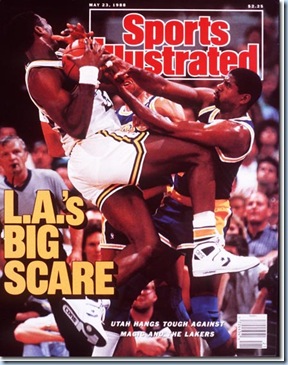
  • Last season they took the NBA Champion LA Lakers to 7 games in the 2nd round of the playoffs -- and scared them good.
  • The sky was the limit for this team that turn into a 'contender'

This is somehow not a foul . . .

That said, there is one reason why I find this team particularly interesting. This team, for all of their successes, took a step back after building so much momentum. Sure, three seasons later they would reach the Western Conference Finals for the first time in franchise history (and reach there 5 times in the 7 successive seasons) -- but during this upswing in success the Jazz fell back down and were swept from the Playoffs in the 1st round. (Thanks Golden State!) This troubles me because right now the current Jazz franchise is experiencing a second upswing and a similarly linear progression . . . and it would really suck to have to go through those bumps and bruises all over again as a fan. (I've been emotionally invested in this team since the 1987 season, and am finally getting over all those 1st round losses)

I am even tempting fate here by even bringing all of this up right now . . . as our beloved Jazz are 'perhaps' (if history repeats itself) primed for a less than stellar playoffs? (After all, we did just play LA in the 2nd round of the playoffs 20 years after the first time it happened) Ultimately you have to look at all of the good things that happened this season and find them to be inconsequential when examined against a 0-3 playoff elimination in the 1st round to an underdog team with no bigs. The 1988-1989 Utah Jazz season was not a good one . . . simply because where they where and where they ended up fell below expectations. This Jazz team is even ahead of the curve because they've already been to the Western Conference Finals (2 seasons ago), while at this point 20 years ago, the Jazz were still three seasons away.

I wish for the best for the Jazz in this, and all seasons; but would really pray against another regression year. After all, there is no guarantee that our current window of opportunity as a contender will stay open for as long as the window we had 20 years ago.

Thursday, September 11, 2008

Utah Jazz on National TV -- what to look for!

I guess this is improvement on some level, you know what I'm talking about . . . I've been a hardcore Jazz fan for 20 years or so now, and I've never seen them on National TV so much in one regular season. How many times are the Jazz going to be seen nationally? 11 times! That is really a lot, as I'm used to the 3-6 games a season that I may get a chance to see (mostly on TNT double headers). Anyway, let's take a look at what to we're bound to see:

November 12th, 2008   December 5th, 2008  
TV execs are counting on Agent Zero to do something amazing

Utah @ Washington on ESPN -- This is the first game on National TV for the Jazz and they face off against a team of excellent outside shooters, led by Gilbert Arenas. He and Deron will feature prominently in this game.

All-Star Power Forwards collide in the ultimate game that a casual fan will never watch

Utah vs. Toronto on ESPN -- I don't know the last time that the Raptors won in Utah, but they are not to be slept on. This game has two deep teams, starting with All-Star Power Forwards Chris Bosh and Carlos Boozer.

Photograph by Pablo Martinez Monsivais for AP Photo   Photograph by Unknown for NBAE/Getty Images  
       
December 11th, 2008   February 5th, 2009  
Roy will continue to give our guards fits

Utah vs. Portland on TNT -- Roy, Aldridge, Oden, that Spanish kid and more . . . why don't we just give them the NBA Title already? (Oh wait, didn't the media already give that to the Rockets or Lakers? I keep getting confused with all the conflicting hype.)

Dirk teaches Andrei why he should not pump fake Dirk in the air

Utah vs. Dallas on TNT -- For some silly reason I think the Mavs will be better (and more desperate) this season. This should be a good match where the good guys should hopefully win. This could be projected as a potential 1st round match up, hence TNT picking this game

Photograph by Unknown for NBAE/Getty Images   Photograph by Melissa Majchrzak for NBAE/Getty Images  
       
February 19th, 2009   March 6th, 2009  
Hopefully we will not have to rely on Harpring for defense on this night

Utah vs. Boston on TNT -- Hopefully the Jazz can avenge their loss to the C's in Utah with a win against the NBA Champs on their home floor. Boston didn't get better this off-season, while we did. Hopefully Ray Allen is shooting blanks.

Let's see more of this, this time in HD!

Utah vs. Denver on ESPN -- Denver really got worse over the off-season, no Camby means that Boozer will probably have a big game, which would be nice seeing how it has become an increasingly rare thing lately.

Photograph by Melissa Majchrzak for NBAE/Getty Images, remixed by Basketballjohn.com   Photograph by Unknown for AP Photo  
       
March 24th, 2009   March 28th, 2009  
Brewer needs more national recognition, and hopefully, will force the refs to call fouls on him less

Utah vs. Houston on TNT -- I fully expect something insane to happen between Ron Artest and Matt Harpring. I also half expect one of the other two stars on Houston to be injured for this game. Yet, I can easily see Houston winning this game.

For all the haters, here is Memo scoring in the paint while double teamed by Amare and Shaq

Utah @ Phoenix on ESPN -- Memo vs. Shaq, Nash vs. Deron and two power forwards who don't play any defense . . . the perfect TV Game if there ever was one. The team that makes it first to 110 will probably win the game.

Photograph by Harry How for NBAE/Getty Images   Photograph by Unknown for NBAE/Getty Images  
       
April 2nd, 2009   April 8th, 2009  
Boozer shows off the lower back massage style of defense that is still highly controversial

Utah @ Denver on TNT -- Remember this guy? Hopefully he doesn't go for 40 again as the Jazz face off for the 2nd time on National TV against Northwest Division Rivals Denver.

Boozer shows off the 'watch the guy shoot with your arms down' controversial defensive stance here

Utah @ Dallas on ESPN -- The Jazz need to start beating home teams on the road (besides Detroit and Boston). Dallas would be a good place to display this on TV for all the see. Look for Kidd to get the business from Deron.

Photograph by Unknown for NBAE/Getty Images   Photograph by Unknown for NBAE/Getty Images  
       
April 14, 2009      
Kobe suggests that AllthatJazzbasketball.blogspot.com is #1

Utah @ LA Lakers on TNT -- As it's a televised game against the Lakers on the road I fully expect the Jazz to lose. No doubt this game will have playoff implications, most likely are we in the 3 vs. 6 bracket, or the 4 vs. 5 bracket.

   
Photograph by Unknown for NBAE/Getty Images      

Ideally, I would like the Jazz to play games on national TV against crappy teams, so that I can watch the Jazz win. Each of these contests (save maybe for Denver in SLC) should be very close. I'm happy to see Utah getting some TV time though, so I shouldn't complain.