Showing posts with label The Man. Show all posts

Tuesday, October 21, 2008

Larry H. Miller talks about AK off the bench

1320 KFan's David Locke talked with team owner, and Utah Icon, Larry H. Miller back on October 16th; and among the things they talked about they discussed the whole Andrei off the bench deal. Particularly interesting (to me) was the point that David Locke believes that Andrei really does need to be involved on offense in order to stay hungry on defense -- and that Sloan should probably put Andrei in a situation where that can happen. Perhaps being 'The Man' of the bench unit will afford Kirilenko more ball handling and creating opportunities. Larry H. Miller adds that Jerry Sloan is still learning, and feels like he needs to learn to put players where their talents are instead of trying to shoe horn players to fit a specific mold.

Raja Bell says hi to his former boss AK in a red summit The Microwave
Photographed by Jason Olson for Deseret News Photographed by Unknown for NBAE/Getty Images Photographed by Tim DeFrisco for unknown

Both appear to be cautiously optimistic about this possibility, as are most of the Utah Jazz fans out there on message boards, and on blogs all over the Internet. Miller gets a chance to show off some of his knowledge of NBA History and suggests that it would greatly help the Jazz if they had a guy who can produce right off the bench like The Microwave (Vinnie Johnson). AK isn't going to be that type of guy who'll just start jacking shots, but he can bring energy right off the bench and make plays. Miller says that AK just really wants to win, and as a result, he'll do what is needed to win. (You know, as long as he's playing 30 minutes a game)

Click here for the podcast, and the Jazz talk really starts from 3:41 and goes onwards till around 8:54.

Thursday, October 16, 2008

Things to look for this season: Morris Almond

If you've been following this blog for a while (perhaps by some court ordered mandate or potential Gitmo torture method) you may have noticed that I associate C.J. Miles' trials and tribulations to that of the works of Shakespeare. (And really, it's almost apt!) Morris Almond (or 'Mobe' as I like to call him) requires a whole other author to describe him -- probably Charles Dickens. Most specifically the whole "It was the best of times, it was the worst of times" bit from A Tale of Two Cities. For Almond the two cities are -- obviously -- Salt Lake City, Utah and Orem, Utah. These are the respective homes of the NBA's Utah Jazz and the NBA-DL's Utah Flash franchises.

Orem, Utah Salt Lake City, Utah
Between the legs jump shot, why not? Hustle? What is this hustle you speak of? (Oct 9 2008 [Steve C Wilson AP Photo] )

Morris Almond is the star player for the Utah Flash, the NBA-DL's Impact player of the year who gave teams 50 twice that year and was involved in everything from the All-Star game, H.O.R.S.E. and set league scoring records.

In the Salt Lake he is a guy who only gets burn in garbage time, and seems to be unremarkable in any distinct way . . . save for his lack of hustle on defense and below average quickness and court vision. (3 assists last season, total)

Morris Almond is coming off quite the 'tale of two cities' Rookie campaign in 2007-2008 -- if it wasn't made absolutely clear by now already. This season his Rocky Mountain Review Summer League ball had ups and downs, but over all it showed us that he is a dynamite scorer with NBA ready moves -- but does not really grasp the team game yet (hence the name "Mobe", like "Kobe"). His work so far in the Pre-Season has been -- pretty much -- more of the same of what we expect of him -- just in less minutes.

  • 8 points per game
  • 12 FGM - 29 FGA (41.4 FG%)
  • 7.25 Field Goals Attempted per Game
  • 1 Shot for ever 2.45 minutes played
  • 1 - 3 from the three point line (33.3 3pt%)
  • 7 - 9 at the free throw line (77.8 ft%)
  • 1.5 rebounds per game (RPG)
  • 0.25 assists per game (APG)
  • 0.50 steals per game (SPG)
  • 1.25 turn overs per game (TOpg)
  • 17:45 average minutes per game (MPG)

Ideally he'd have more than 1 assist in 4 pre-season games -- but let's not forget that is probably better than what he was getting in Summer League this past season. Some of his troubles must stem from the fact that he is essentially two different people depending on if he's with the Jazz or the Flash. In Orem his role is that of 'The Man' and he knows that on every offensive possession his team has the best chance of making a bucket if the ball goes through him. It's pretty much a continuation of what he had to deal with his last two seasons at Rice in the NCAA's. When he's wearing a Jazz uniform it's completely different -- he's at the bottom of the totem pole and his role is completely different. The offense doesn't run through him, it's his job to be a cog in the larger Utah Jazz offensive machine.

In some ways we kind of know who he is, and what he can do -- there's very little benefit to having him run in the NBA-DL anymore because it's not like that improves him as a player, nor does it better prepare him to play with the Jazz (as what the Flash need out of him is pretty much the opposite of what Jerry Sloan wants to see from him). That said, what three things should we look forward to this season from Morris Almond?

  1. Pass the Rock more -- Being a good offensive player is more than just being able to give other teams' buckets. If he's not going to get on with the hustling, rebounding and defending -- the least he can do is learn the playbook and make passes. I'm sure it's quite discouraging to actually pass the ball to an open guy in the NBA Developmental League, only to have him clang the shot. I watched every Summer League Game and I saw Morris passing the ball, only for his team (and his boxscore) to be rewarded with nothing. Pretty much he's been somewhat classically conditioned to dislike passing. Here I am being all Mr.Psychology and getting past the FA-err and try to figure out why he's seen as an offensive black hole. Whatever the cause, he has to break out of it. My solution would be with the Cognitive-Behavioral therapy of systematic desensitization. Basically, the more time he plays with other guys who can make shots the more and more he'll understand that positive results can happen when he passes the ball. He hasn't really played with good players (even in garbage time he's running out there with Jarron Collins, and not Mehmet Okur), so it's not like he's had good targets. If he's running around against second string guys with Korver, AK and Millsap I'm sure we'll see some more passes -- after all, passing is contagious.
  2. Get caught up in a numbers game -- See what I did there? I put him on the bench in our team in Salt Lake City . . . I guess assuming that a) Brewer and Miles start and b) Harpring is still out for part of the season. The grim reality is that there are too many talented people for too few minutes. (96 total at the wings -- Brewer and Andrei need at least 30, and Kover needs around 20, so that leaves 16 TOTAL to be divided between C.J., Morris and Harpring) If you just take out guys playing small forward there's only 48 minutes to go round for four guys -- which is just insane any way you slice it. The time Morris does see on NBA courts are going to be high pressure situations for him as he tries to make a name for himself and earn more playing time. Basically this could just lead to him jacking a lot of shots as that's probably what he does best. That's quickly not going to fly with the Jazz brass, and even though it doesn't make him better, makes it harder for him to adjust to his role on the Jazz, and reinforces bad habits -- eventually may lead to him playing the majority of this 2008-2009 season in Orem . . . just like last year.
  3. Take it out on the NBA-DL -- And that's just going to make him angry, and cause him to go all Hulk like on the NBA-DL out of frustration. (After all, he can audition for other teams that way, as it's filled with scouts, and after he drops 50 a few times next year some Shooting Guard anemic teams may drop Kevin O'Connor an e-mail or two).

I may be in the minority here, but I really think that the bad parts of the NBA-DL outweigh the benefits of sending Morris down there. I don't know what they do down there in Flash practice, but when it's game time they want to win, and they do that by having Almond shoot a lot. I only watched about 5 or 6 Flash games last season, and it doesn't look like they do anything but post him up, or run plays for him. Jerry doesn't call those plays in Utah -- so it's not like sending him down there makes him any better prepared for playing for Jerry. The best way to make him earn playing time with the Jazz is to -- I dunno -- have him be on the active roster? And for the record, he had more asissts per game with the Flash than Harpring did with the Jazz (and with better shooters) . . . I just say put Harp on the IR, and have Almond and others take his place. (unless we are playing Ron Artest or Carmelo Anthony -- he completely takes those guys out of their games)

Thursday, September 18, 2008

News Headlines - The calm before the storm

Can you believe that it's almost October? Really? We're less than half a month away and more and more NBA news will be coming in the near future. [point of reference: us bloggers have lamented how boring the Month of August was, imagine how bereft of information it will be in those non-Olympic years!] Anyway, here is a quick rundown of some Jazz related stories:

Yes, I know what ubiquitous means . . .

* The Dominator is ubiquitous -- Deron Williams is "The Man" of this team, and lives in SLC full time, and as a result, he's been busy there full time giving back to the community, read about in the Desert Morning News!

"When Williams first appeared in Utah, he was confident but guarded. Charles Barkley he wasn't. But as time passed, he became increasingly willing to show his humor. Sometimes it's simply a glint in his eye or a short one-liner. For those he trusts, he's engaging and cooperative, the proverbial good guy. Which raises the obvious question: What's in it for him? Is this some kind of radical publicity blitz?

Probably not, since he had already signed his contract extension before most of this happened.

"We didn't just sit down and say, 'Deron, we've got to come up with a major media crash course,' like we're promoting a movie," said Wright. "It's not like that. People were calling and saying, 'Can you go here?' And a lot of it, if it fit into his schedule, we did."

Wright says Williams also did it because he understands he's the Jazz's guy. His team, his town, his responsibility. Which is quite unusual. The team has three players who have been All-Stars (Boozer, Kirilenko and Mehmet Okur), yet the most popular, and the unchallenged leader, is Williams." (Brad Rock, 2008, Deseret News)


We love Isiah

* Steve Luhm (of the Salt Lake Tribune) talks about the 2010 Draft pick that we own, and how the improvement of the New York Knicks may reduce what looked like a for sure lock at a Top 5 pick in that draft.

"The Knicks weren't going anywhere under Isiah Thomas and the Jazz's chances of being in the top five or top 10 of the 2010 draft with the pick previously acquired from New York would have improved had he stayed in charge.

The hiring of Donnie Walsh as team president and Mike D'Antoni as coach is first step toward respectability for the Knicks, which is not good news for the Jazz.

Walsh's track record and reputation are impeccable. He's one of the best in the business and was the perfect choice to direct the reconstruction in New York.

D'Antoni?

I've known him since he was hired as Denver's director of player personnel in 1997. During the lockout-shortened 1999 season, D'Antoni inherited the impossible job of head coach and guided the Nuggets to a 14-36 record. He was not retained, but got a second chance to be an NBA head coach in Phoenix, starting early in the 2003-04 season.

Everybody who follows the NBA knows what kind of job D'Antoni did with the Suns." (Luhm, 2008, Salt Lake Tribune)


I am a big freak!

* AK back to Russia, for reals this time, people! -- People love to jump to unreasonable conclusions, as a story grows exponentially with each blog that links to it, and gives their take -- I read this blog post from "The Hoop" from a variety of sources (ballhype and dimemag) today, and Dime even goes the distance to suggest that solving the financial burden in Utah is as easy as shipping AK off to CSKA Moscow (reading jazzfanz much?)-- because of their "reported" interest in him.

Didn't they have 'reported' interest in Ben Gordon too? How did that work out?

The Hoop reports from somewhere else (krepsinis.net?) that this can be a done deal, and that it may have some weight because Andrei hasn't renewed his contract with the Utah Jazz yet. First of all, it's good to check your sources.

There are a few places on the net that show these financial facts quite easily . . . Andrei is under contract for three more seasons @ $15 million, $16.5 million and $17.8 million. So not only is AK not able to renew his contract (as it's not expiring), but this means that CSKA would have to buy out his contract from the Jazz (much like how when NBA teams have to buy out contracts from big dogs across the pond, it works both ways guys). This guy (Anthony) said it best:

"I mean, CSKA's got money, but I don't know if they have 3 years/50 mil of buyout money to go along with a similar sized contract. His wife has a shop in Salt Lake, he's good friends with the other Eastern European dudes on the team, and he has one of the best point guards in the league (and if Boozer bolts he'd become his preferred target). Something tells me that this won't happen.

Scratch that, everything tells me that this won't happen."  (comment from The Hoop article, 2008)


* Training camp Tid-bits -- It basically starts on September 29th with media day (yes, we'll get to find out what hair color Fesenko currently has, or if Kover finally got that 'Thugg Life' tattoo he kept suggesting that he'd get over the summer), then they're off to Boise from September 30th to October 3rd. (Mark your calendar, Masha!)

Greg Ostertag always pays attention to when Jerry Sloan speaks. And by always, we of course mean 'never'.

When this happens each year I think of Jerry Sloan telling all the players that for that point in time that he's going to be their daddies, and that he forces integration by having unlikely pals to room mate together -- like, a few seasons ago we may have had Greg Ostertag sharing a room with DeShawn Stevenson. Okay, sure, my entire concept of Jazz training camp is like that sequence from "Remember the Titans".
Just fast-forward to the 3:30 mark if you don't want to watch all of this, the best part (the part I'm talking about) starts at 6:30 . . .anyway . . . the first pre-season game is against the Lakers on October 7th in Anaheim. Woo!


gas-pump

* Trickle down economics means that during an energy crisis air travel is more expensive . . . duh. Thanks for showing up Jasen Lee.

Thursday, September 11, 2008

The Five Epic Errors of Jerry Eugene Sloan

I like Jerry Sloan and respect him for what he has done for the NBA, and what he has brought to the game. He and his staff (Phil Johnson, and any combination of Ty Corbin, Gordon Chiesa, Kenny Natt, Scott Layden, etc) are undervalued developers of talent and teachers of the game. For example, DeShawn Stevenson was not an NBA player when he joined the league -- 4 years learning in Utah made him a player. For one, they completely broke down his shot, and rebuilt it like the $6 Million Dollar man over those 4 years as he worked with Hornacek for quite a bit -- now he's a capable three point shooter, not an athletic Desmond Mason type with ugly mechanics and no outside shot. Another thing that is undervalued is the fact that Jerry Sloan (and staff) is quite good at making game to game adjustments. (Some will argue that he doesn't make meaningful adjustments -- but those are in-game adjustments, which I readily agree he is poor at -- his game to game adjustments are among the best in the league. For proof watch the NBA playoffs)
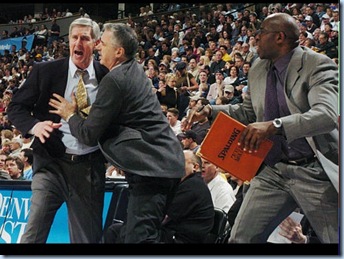
Can I has technical foul?

Sloan is well respected in league circles, though he is consistently regarded as a few notches down from the likes of Phil Jackson, Gregg Popovich, Pat Riley, Don Nelson (who has 3 CoY awards!), Larry Brown, Rudy Tomjanovich, Jeff Van Gundy (who is not currently employed as a coach) and others.

Sloan is well respected, but guys like Bryon Scott, Sam Mitchell, Rick Carlisle, Doc Rivers and Don Chaney have won Coach of the Year Awards. [Opinion Alert: I think that Sloan is a better coach than any of those guys]

Scott is an okay coach, Mitchell is a 5 game loss streak away from being fired, and Doc Rivers was fired as a coach something like 7 times already. Don Chaney has a .406 winning percentage, of if you will allow me, roughly a 60% losing percentage. He has two playoff wins in his career as a coach. He has been a CoY, while Sloan has not.

It's not about Coach of the Year Awards though, as Sloan's top assistant coach (Phil Johnson) was NBA Coach of the Year in 1974-1975. What it is about, though, is understanding why Sloan (for all of his good attributes) seems to be a step behind that first group, and stuck in a situation where former Players with little coaching experience get awards that have so far eluded him. What are the major lacunae in Jerry Sloan's abilities as a coach?

1. Playing Time / Rotation Management:
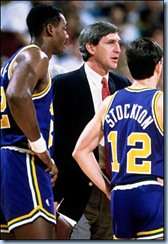
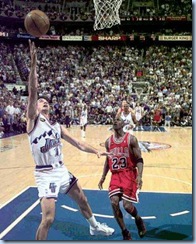
Only John has retained his hair from those days Not pictured: ref awarding Jordan two free throws Jerry Sloan has had the benefit of having John Stockton QB his teams since Jerry Sloan first became the Head Coach in '88. Stockton has always heeded Jerry's command (like any good soldier), and as such, he was at the mercy of Sloan during the most important 12 games of John Stockton's career -- the NBA Finals in 1996-1997 and 1997-1998. Jer' has coached John for quite a while, so you'd think Jerry knew how important these games were to John's career and future legacy.
Photographed by Andrew D. Bernstein/NBAE via Getty Images    

But one of Jerry Sloan's major flaws was expressed in those 12 games. Sloan likes to stick to a rotation, which may or may not have contributed to prolonging the careers of his players at the expense of wins. Malone and Stockton both played up to the age of 40 -- but a few seasons before they'd reach those milestones they were in the NBA Finals. In those years Sloan's regimented playing time and rotation scheme called for Stockton to exit the game at the 6 min mark of every first quarter -- regardless of any other circumstances in the game (who was on the floor, were the Jazz on a run, who had fouls, who were they playing against, what the score was, etc). Sure, this may have saved John for the playoffs -- but when the Jazz finally got to the finals, why did he continue to hold John back?

Stockton was easily the best and most consistent player during those finals runs, and it would be pure folly to imply that the Jazz weren't a better Jazz team with Stockton on the floor (no matter how very adequate, and sometimes amazing Howard Eisley actually was during those same years -- you know, like having your back-up PG go coast to coast to hit game winning threes with the audacity to not call a time out, or pass to a starter). The fact that the Jazz were better is not debatable. While there are many factors which influence a win (especially in the NBA Finals), in the games that the Jazz won against the Bulls over those two seasons had John Stockton averaging 37.0 mpg. What about in the Jazz losses? John was anchored to the bench for 33.8 mpg. Correlation does not always translate to causation -- but really Jerry, what were you saving Stockton for when you had him playing 31 mins and 33 mins in game 4 and 6 in the 1998 Finals -- games where the Jazz lost by a COMBINED 5 points, were you saving him for the next round after that, or the off-season? Now, I'm not saying that if Jerry played Stockton more that we would have won the title, no one can say that. What I am saying is that perhaps if he was on the floor more (like to end the 1st quarter, so the Jazz wouldn't start the 2nd quarter already behind and have to fight their way back into every game), the Jazz would have had a better shot to win more games.

  1996-1997       1997-1998    
Finals Game # Stockton's
Minutes Played
Outcome Difference   Stockton's
Minutes Played
Outcome Difference
Game 1 38 Loss -2   35 Win +3
Game 2 39 Loss -12   31 Loss -5
Game 3 37 Win +11   26 Loss -42
Game 4 38 Win +5   31 Loss -4
Game 5 36 Loss -2   38 Win +2
Game 6 37 Loss -4   33 Loss -1

Stockton's MPG in Wins: 37.0 mpg -- Stockton's MPG in Losses: 33.8 mpg.

Current examples of Jerry Sloan's crazy substitution pattern exist in the whole Matt Harpring / Andrei Kirilenko dynamic (where Harpring's mins have been cut a bit, but he still gets way more burn than he needs in the face of evidence that Andrei's magic number is 37 mpg, any less, and he's not amazing). And let's not even get into the whole "younger player" issue (you know, like playing Deron Williams so little as a rookie, and at that, playing him at Shooting Guard instead of Point Guard, and so forth -- but more on that below).

Jerry's use (or disuse) of Stockton at a very critical time is probably the best example of him being bull-headed and sticking to his system against evidence that suggests that it may be okay to run the horses a bit. Then again, this was the Jazz Sloan who used to play Adam Keefe 27.5 mpg or something insane like that.  

2. Very slow to adapt to changes in the game:

Do you ever watch games on TV and when one team goes on a run, to stop the momentum and regroup, the other team's coach may call a time out? Yeah, Jerry Sloan hardly ever does that. Jerry Sloan hoards time outs and possibly thinks that they are like roll-over minutes with his cell phone plan. Unfortunately they are not.

Some coaches can get away with not calling a time out, like Phil Jackson, but that's only because he has some heady vets on his team (like Kobe and Fisher, who have played in a few NBA Finals games) -- Sloan could get away with this back when the average age of the team was 33 and everyone was battle tested in the playoffs like in those Finals teams.

That's not the case with this team -- he should probably use time outs a bit more. Especially when other teams go on their 2nd quarter runs.
Jerry Sloan calls Time out by accident
  Photographed by unknown, NBAE/Getty Images

That's just one thing though . . . adaptation is the key to survival -- in nature and in the NBA. (unless you have tenure, like Sloan does) Sloan does an okay job making game-to-game adjustments as I've already mentioned . . . but he loves his game plan. He will go into a game with one plan, and one plan alone. If the plan does not work, he will continue with that plan just to prove a point or because he is stubborn, or maybe, because he honestly did not believe than an alternative plan was even needed. (As he sits dumbfounded with his mouth agape as the Jazz get blown out in the finals by 42 points in one game) If another guy is really hot, how often do we see any defensive scheme changes to counter this? Jerry Sloan's idea of changing things up defensively seems to just mean shuffling around who defends a particular player. (Hmmm, Tim Duncan is killing Memo one on one, let's put Boozer on him . . . hmmmm . . . Tim Duncan is killing Boozer one on one, let's put Jarron on him . . . . hmmmm . . . Tim Duncan is killing Jarron one on one, let's put Hoffa on him . . .  ad nauseam)

3. His Personal Pet Peeves hamstring the teams he coaches:

You ever wonder why some players just go off on the Jazz? It's partly because of the whole inability to make in-game changes. The other, probably more chronic, issue is the fact that Jerry Sloan has a very diverse and particular set of pet peeves. No, I'm not talking about everyone having to have their shirt tucked in, or no head bands or whatever . . . I'm talking about the fact that he'd rather kiss Phil Jackson's ass than actually set up a defensive scheme that calls for double teaming someone. Do you guys remember that game where LeBron James had his first 50+ point game of his career? The game where it was basically Devon Brown, Matt Harpring and Andrei Kirilenko guarding him one on one for 48 minutes? [just watch that video, each one of his baskets is made by being defended one on one, even after he had scored 39 points, Sloan keeps the Jazz in single, man to man defense] I know LeBron is good, Jerry should too by now. I know he can win a game by scoring 50+ points -- I'd rather go with him passing it up to Anderson Varejao or Eric Snow (who was on the team back then) and have them try to beat us instead.
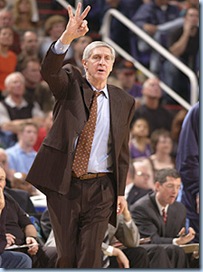
Sloan asks the ref what this symbol means, and why the other team has the ability to make open jumpers . . . while Scott Layden attempts to eat his blue highlighter Forget the scrubs, if there is anywhere that the Jerry Sloan Jazz want you to beat them from it is from the outside. Utah has always seemed like they just wanted to dare other teams into taking outside shots. This strategy may be a remnant from the Sloan's Dick Motta inspired playbook that was created back when teams did not really shoot often from deep, nor did they have players who were good at that. Times have changed and today's NBA features many teams that not only like to take open three point shots, but have multiple threats from downtown. For example, just look at the LA Lakers who have tons of outside shooters (Kobe, Fisher, Sasha, Vlad-Rad, Farmar, Walton, Ariza and even Odom can knock down jumpers), is it any wonder why we lost to them?

Sloan: oh noes! Teams that can make wide open jumpers when no one is even close to defending the open man -- my ONE weakness . . . how did you know?
Photographed by Barry Gossage, NBAE/Getty Images  

The whole three point line thing seems to be just an under-explored and confusing aspect of the game for Sloan (like the concept of the female orgasm in good, old fashioned, 1950's America). Local heartthrob Kyle Korver admits that the Jazz do not have plays in the playbook for a last second three -- or any plays that really have the three point shot in mind at all. (Which explains why our last offensive play of the 2007-2008 season was a sequence of bricked shots, or why Matt Harpring was taking awkward looking, last second mid-range jumpers for us in previous seasons when we needed a bucket.) 

So he doesn't like to double team, which allows for the other teams' best offensive player to go to work and score a lot of points. He also doesn't like the outside shot -- and that would work great if there was a specific code of honor that all coaches lived by: 'I won't use the three point line, and you don't use it either, deal?' Jerry, other teams will take what you give them, and if you give them open looks from deep, they will take those shots and burry us with them. (And have been for seasons) Anything else?

He is pretty old school, and that old-school-ness can work for some players and be absolutely horrible for others. Greg Ostertag was a flawed player, but I have no doubt that if Ostertag had a more touchy-feely coach that he could have been no lesser than a Luc Longley (who was a solid starter), rather than a guy who was dunked on slightly less than Shawn Bradley.

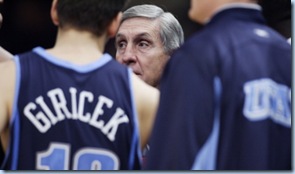
His major pet peeve is perceived effort. Which probably explains why guys like Adam Keefe and Matt Harpring get burn over the more talented, yet apparently less hard working guys like Chris Morris and Gordan Giricek (when he was here). [Btw, look at Giri's career stats, he wasn't a bad player at all, neither was Morris . . . yet look at how they were used in our system. Were they bad players, or just used poorly?] I understand the meritocracy involved in rewarding hard working players with playing time, but what about wins?  Giricek and Sloan never saw eye to eye
  Photographed by Matthias B. Krause/Icon SMI

Chris Morris and Giricek would absolutely smoke Harpring and Keefe in a game of 2-on-2. They were better players, even if Sloan did not treat them as such. Which brings us to how Jerry Sloan . . .

4. Revels in Power Distance:

Jerry Sloan is the boss. His staff knows it. The owner of the team knows it. The media knows it. And most importantly, his players know it. And as far as being the boss, he's far from the most approachable, understanding, and cooperative one around. He takes issue with star player and scrub alike -- he admitted that if you could freeze time during that moment when Stockton got the defensive rebound and threw the football hail marry pass to Malone in the finals for a key bucket in the 4th quarter that he would have liked to strangle Stockton while the ball was in the air. (Really, who says these things, even if they are true?) The issues that he has with players can stem from a lot of root causes: perceived self-worth (Carlos Arroyo), consistent effort (Greg Ostertag), sexual orientation (John Amaechi), degree of free will and autonomy (Gordan Giricek), inability to read minds and/or complete objectives that are never fully explained or consistent from game to game (Andrei Kirilenko).
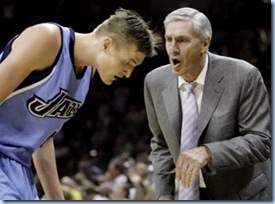
How many times do I have to tell you Andrei? You're only allowed to touch the ball on defense when you get weakside blocked shots because Memo and Booz don't play defense! I freely admit that I'm kind of an AK-47 homer. He used to be 'The Man' and has had to adjust to different roles on the fly -- while getting none of the credit that he deserves from Sloan. One season, he's the Point Forward and earns a trip to the All-Star game. The next, he's a leper. The next, he starts off as a leper, but due to injuries, his role is expanded. (Guess what, he started to play better!) His role has oscillated like a yo-yo for the last couple of seasons depending on roster moves and injuries to other guys. (as has his playing time) He can do everything from get a triple double or 5x5 to play point guard in the Western Conference Playoffs against Baron Davis. It is insane to think that he's not the most versatile and over-all talented player on the team.
Photographed by Matt Slocum, AP Photo  

Deron is the best player, and most consistent. This is not up for debate. Neither should be the fact that Andrei is paid on a scale that only makes sense based on his talent and ability -- and not how he is used or applied. (Who chooses how he is used again? The Head Coach.) As good as Andrei is the last few seasons with Jerry Sloan have pretty much ruined him. It would not surprise me to see Andrei leave the NBA for good after his contract is over and return to his native Russia a hero. Why am I blaming Jerry Sloan?

I'm blaming Sloan because he's the one who should be the guy who helps manage players -- especially players who have changing roles and need to make transitions. Probably no transition is harder to make than from being 'The Man' to being the 5th option on offense, yet the thankless workhorse on defense. Phil Jackson, for all of his smarmy-ness and douche-baggery , has been able to coax nutcases like Dennis Rodman, Bison Dele, Ron Harper, J.R. Rider and others to perform at a high level. Sloan and AK have worked together for 8 or so years now, why does AK still not know what he's supposed to be doing?

Maybe it happens to be because Sloan keeps changing his expectations of him, and due to his power distance, AK is the only one who gets the blame when things go wrong. Other players have long since gotten the boot for getting 'sideways' with Jerry Sloan. (Sloan just knows that AK's defense is so valuable that he can't completely kick him off the team) Personality is a big part of communication, and when you give someone so much power it's hard for their sense of 'right' to not come out in their personality. The psychological aspects of motivation are just as puzzling to Jerry Sloan as the three point shot appears to be. I guess in his hard headed universe (you know, the kind where there is no back up plan for any given game) there is only one way to motivate -- by yelling, swearing and saying mean things. This is probably a contributing factor as to why when AK is taken out of the game he sits as far away from Sloan as possible -- Sloan is just an impossible guy sometimes.

5. Makes mistakes, admits to making mistakes, does not change so mistakes can continue to be made in the future:

Jerry Sloan can be 'like' an abusive spouse in his consistent merry-go-round of making mistakes, admitting to making mistakes, suggesting that changes will be made, but actually no real changes are made, and mistakes continue to occur. How many times do we hear (after a season is over) that "I probably should have played __________ (insert breakout player's name here, some recent examples include Mehmet Okur, Deron Williams, and Ronnie Brewer) more during the season"? Pretty much every season. Memo had a break out year, and Sloan said that it was a mistake to not have played him more. The next season they draft Deron -- and again, Sloan does not play him as much as he should -- only to say that he should have, after the fact. What happens the next season? Ronnie Brewer doesn't play, and after his 2nd season Sloan basically says "My bad" again. And we just eat it up -- our neutral reaction to his maladaptive behavior reinforces his psychopathology.

Sloan is an old dog, and he does not want to learn new tricks. He has shown some improvement over time (that probably only I have noticed), he allows guys like Memo to shoot threes, and is not completely against a guy throwing an alley-oop now and then. (He still may not like it, but he's not going to bench a guy for getting an assist) Unfortunately, the majority of his change seems to occur over a span of 10 games. I don't want to belabor the point but part of the whole AK situation is that Andrei will complain because of how he is used, Sloan and him will talk and Sloan will agree to make changes, the next few games things are better and AK is more productive, then after 10 games or so, things will revert back to normal and the cycle will start again. (Part of the reason why this Sloan/AK deal is less resolved than it should be happens to be because it is never really resolved fully.)
Don't talk to me about Coach Sloan right now, I'm on vacation How many coaches would make a habit of pissing off their best players by not giving them the playing time that their skills deserve? Deron Williams will never fully heal, and while he respects Sloan as a coach (and his Boss), he still isn't shy about admitting that he knows he should have played more as a rookie (you know, the season where everyone was all about Chris Paul, and no one mentioned Deron because he wasn't playing?). I don't know if Memo cares about how he was treated, but the younger guys probably do care (like Brewer, and likely, C.J.). For the record, Deron, Ronnie, Andrei and Memo comprise 80% of the starting line-up. Those are all guys that Sloan has made significant impressions (first or most recent in the case of Andrei) on as 'the guy who is going to be a dick and not play you, even though you are better than the guys who get playing time'. One wonders who the 'next' guy he'll come out and suggest he should have played more will be? My money is on Fesenko, after next season when he starts off averaging 4.3 mpg with the Jazz only to end up being better than Jarron Collins and finally usurp his mpg.
Photo from memo13.com  

Sloan is old school and I appreciate and respect the fact that when he is wrong he is really okay with saying it like it is. He will admit to being wrong in the instances where he understands that he is wrong. (Unlike a guy like Phil Jackson who will make an infinite number of excuses for anything bad that happens, like blaming the physical play of the other team, their fans, injuries, etc) I would appreciate Sloan even more if he actually stuck to fixing the mistakes, even if that would prevent him from admitting to making them in the first place.

Conclusion:

Wow, if you add it all up these 5 errors truly are epic. This is pretty much a negative review of the only coach my team has had for the last 20 seasons . . . so I'm sure it will have to write a piece about the 5 great things that Sloan does. (And there are at least 5 of them) I don't hate Sloan, but that does not mean that I'm blind to the faults that he does have. I try to be objective on this regard. I think that there is room for improvement (and his staff helps out with this), and I do not know which coach I'd rather have take over my team if you gave me the choice to do so this moment. (Maybe years down the line after Phil Johnson says 'no thanks' I'd be okay with Ty stepping up) All coaches have their flaws, I'm just more intimately aware of Sloan's because I've been an obsessive Jazz fan for the over 60% of my life.

Sunday, September 7, 2008

Adrian Dantley -- better late than never

No doubt by now we've all heard the good news -- that Adrian Dantley is now, finally, a member of the Basketball Hall of Fame. In one of the great mysteries of the cosmos, he has been overlooked for this honor for quite a long time. In respect for that abnormality I am posting this article about it a few days late (in solidarity of him being in the Hall a few years late). Either that, or I've been busy lately. Anyway, it's pretty ridiculous that AD "was a finalist six times before finally getting at least 18 votes from the 24-member Honors Committee," (Steven Luhm, via the Salt Lake Tribune, 2008). It's ridiculous, but after looking over how generally insane people are with how they vote on sports, it's not far fetched. But just so everyone is up to speed on what he accomplished in his career, let's review:

AD, all of 6'5, does the inside work as Bailey, 6'11, and Eaton, 7'4, watch

* Career averages of 24.3 ppg (54.0 fg%, 8.7 FTA/Game, 81.8 ft%), 5.7 rpg, 3.0 apg, and 1.0 spg
* "Glory years" between 1979-1980 season and 1985-1986 season where he averaged 28.0 ppg, 30.7 ppg, 30.3 ppg, 30.7 ppg, 30.6 ppg, 26.6 ppg and 29.8 ppg in consecutive seasons
* Scored over 23,100 points in his career (23rd best all time)
* Career average of 24.3 ppg (17th best all time)
* Top 5 in PPG 5 different times: #3 (1979-1980), #1 (1980-1981), #3 (1981-1982), #1 (1983-1984), #2 (1985-1986)
* Career average of 54.0 fg% (20th best all time)
* Career True Shooting percentage of 61.7% (4th best all time)
* Made 6832 free throws (6th best all time) out of 8351 takes (11th best all time) in his career
* Career Offensive Rating of 119.3 (8th best all time)
* NBA Rookie of the year in 1976-1977
* 6 time NBA All Star (1979-1980, 1980-1981, 1981-1982, 1983-1984, 1984-1985 and 1985-1986)
* All-NBA 2nd team (1980-1981, 1983-1984)
* 1976 Olympic Men's Basketball Gold Medal
* NCAA AP All-American 1st team (1974-1975, 1975-1976)

Photograph: Deseret Morning News Archives  

So, if you didn't already know, he was a beast. He was "The Man" for those Utah Jazz teams and bridged the gap between those early, pathetic New Orleans Jazz teams and the Stockton and Malone powerhouse Utah Jazz teams of the late 80's and beyond. More than any of his stats, Adrian Dantley brought the wins. Who was The Man on the first Utah Jazz team to win the Midwest Division title? Dantley was. [since then the Jazz have been among the leaders in Midwest and Northwest Division titles] Who was The Man on the first Utah Jazz team to make the playoffs? Dantley was. Who was The Man on the first Utah Jazz team to win a playoff series? Yeah, that's right . . . Adrian Dantley. [Pistol Pete didn't do any of those things] In his later years he did take some time to mentor younger players (this is a 3:48 minute video of his career, btw) like Karl Malone and Joe Dumars, and teach them about, among other things, hard work and discipline. For all his NBA greatness, he was under-appreciated as a player -- and his career has been overlooked for quite some time.

Back in college he was destroying people -- and averaged 28.6 ppg and 10.2 rpg in 1974-1975, and in his last season of NCAA ball he averaged 30.4 ppg and 10.1 rpg. He was named National Player of the Year in 1975-1976. He was a huge part of their program, yet when he was informed that he would finally be making the hall the news hardly caused any ripple at all back there. (In fact, they actually picked up on a news report from the Deseret Morning News for their information. Isn't he an alumni member? Don't they even care for their own?)

After being The Man on a Gold Medal winning team in the Olympics he was the NBA Rookie of the year for the Buffalo Braves. The majority of his best playing days were with the Utah Jazz -- but even they seem to share part of the blame for over looking Dantley. (A crime that not only the Hall of Fame board selection committee is guilty of...)

"It's long, long, long overdue. It's an absolute disgrace that he's had to wait this long. It's terrible. I just think it's a disgrace that it didn't happen long before," said Tom Nissalke, who was Jazz coach when then-general manager Frank Layden traded Spencer Haywood to Los Angeles for Dantley in September 1979, just a few months after the Jazz moved to Salt Lake City and before they played their first game in the old Salt Palace. (T. Nissalke, via the Deseret Morning News, 2008)

Frank Layden adds that "It's long overdue and well-deserved," (Desert Morning News, 2008) but is quick to admit that part of the reason could be because Dantley's number was not even retired by the Jazz up until two years ago. (Probably should have been the 2nd or 3rd retired Jersey, but ended up being the 8th -- and most recent -- retiree in Jazz franchise history) How's that for being overlooked?

Though the Utah contingent of Layden and Nissalke are equally quick to point out that even if Adrian never played a single game in the NBA, that he should have been in the Hall of Fame because of his ridiculously outstanding High School, Collegiate and Olympic career -- and that his status of his jersey being retired is a highly invalid reason for not voting him into the Hall of Fame earlier. (btw, his High School record is 52-7) That said, he was an invaluable part of the Utah Jazz franchise, and we are all glad that he did play in the NBA.

"He carried us, he was the franchise," recalled Mark Eaton. "He was the guy you could count on for 30 [points] every night -- the one bona fide All-Star we had." (Mark Eaton via The Salt Lake Tribune, 2008)

Eaton would know, because Dantley scored enough for the both of them in the early part of Mark's career. AD was much more than just a scorer for the Jazz. The Jazz franchise had just moved to Utah -- and were still in financial trouble. (Which is why they traded their draft rights to Dominique Wilkins to Atlanta for cash back in 1981) They even played an entire season without a location name on their jerseys because there were fears that they would quickly have to move to another city mid-season!

Adrian's
winning ways helped to build a fanbase in Utah -- and if it wasn't for him, perhaps the Jazz would have been playing in Oklahoma City all these years? Who knows . . . What we do know, is that Adrian Dantley is finally a member of the storied Basketball Hall of Fame.

Adrian Dantley and Dominique Wilkins could have been major parts of the Jazz franchise -- just maybe not in Utah
  Photographed by Scott Cunningham for NBAE/Getty Images

To that I say that: It's better late than never.

Thanks but no thanks, voters!

Photographed by Nathaniel S. Butler for NBAE/Getty Images

Thursday, August 21, 2008

Paying Homage, or plain being a homer?

I was reminded recently when looking over the wiki article listing the NBA players with retired jerseys list that some teams have a greater history than others. For example, the Lakers franchise celebrates (or will after Shaq retires, as his number is currently out of circulation) 15 people, while the cross town Clippers have nothing going on up in their part of the rafters in Staples Center. Additionally, some players are celebrated even in places that they have no affiliation for -- for example Michael Jordan (who is not from Miami, didn't play college in Florida, and has never played for any franchise down there) has his jersey retired by the Heat. The only thing I can think of that links the two is that Jordan used to kill the Heat and Knicks -- both teams when Pat Riley was the coach there. Well, Jordan is so larger than life that he was playing ball for the Bulls with his #45 while his #23 was up in the rafters -- then later unretired his jersey (paid the small fine) and was balling in that to end his Bulls career. Seriously, what a douche-bag. The list is interesting to look over, did you know that Jim Loscutoff, a Celtics player, actually asked for his number to be free to use by others?

"Loscutoff asked that his legacy be honored by allowing other Celtics to wear his number in the future. It was later retired in honor of [Dave] Cowens. Loscutoff is represented by a square with the letters "LOSCY"."(Wikipedia, 2008)

Look upon our works and despair! jordan_heat
The Celtics keep it pretty simple Does this mean that the Jazz have to retire a Kobe jersey?

Out of all the numbers retired (and some not retired . . .) there has to be some politics involved. Jazz fans know about the whole Adrian Dantley situation. He was a key player for our teams back when he played in Utah (1979-1986), and was 'The Man' when the Jazz first started winning division titles and going to the playoffs. He was a top 3 scorer in the NBA five different times, and was recently inducted into the Basketball Hall of Fame. He left the Jazz under sour terms and his jersey retirement was passed over for many years while the Jazz franchise took care of these franchise icons first: Frank Layden in 1988, Darrell Griffith in 1993, Mark Eaton in 1996, Jeff Hornacek in 2002, John Stockton in 2004, and Karl Malone in 2006. They finally got around to Dantley (who had been retired since 1991, before every one of those guys but Coach Layden) in April of 2007. So getting your jersey retired involves more than just being a good player for a franchise. Just look at Jazz franchise great Pete Maravich.

Dantley did his work on the low block and at the foul line -- and was a mentor to a young Karl Malone It's not a lot, but it's more than most teams Hey, at least he played for our franchise
Adrian Dantley All 8 of 'em . . . "Pistol" Pete

Pistol Pete was born in Pennsylvania and played college at LSU. He was drafted by the Atlanta Hawks back in 1969-1970 NBA Draft. He was traded to the expansion New Orleans Jazz franchise (1974-1975 season) for Dean Meminger, Bob Kauffman, two 1st round draft picks and two 2nd round draft picks. It is interesting to note that his years in New Orleans were relatively poor seasons for the team. If New Orleans was so great, why did they have to leave in the first place? If the fans really cared they never would have left. Yeah. The New Orleans fanbase is terrible. The fans have no heart, and don't really care about supporting their basketball franchise -- or at least they didn't back when Pete played there. (compare that to the wild fanbase that the Jazz franchise now is happy to have, it's a great contrast really)

That said, the Charlotte Hornets franchise decided to retire "Pistol" Pete's jersey when they moved to New Orleans. This is stupid, and their franchise is too. Pete was a great player at LSU (basically owning the entire NCAA), and was one of the most spectacular players in the NBA during his peak. But the New Orleans Hornets have no legitimate claim to Pete at all. The Utah Jazz did not retire Moses Malone's jersey -- even though he played for the Utah Stars back in the day. The New Orleans Hornets did not retire Shaquille O'Neal's jersey -- and he was a great player for LSU who also never played for the Charlotte Hornets franchise either. (Seriously, isn't that the qualification to get your jersey retired in New Orleans now-a-days?)

What I see this as is a cheap ploy to drum up interest in a city that has a history of not caring about their basketball team. If the Bulls team moves from Chicago to, lets say, Madrid (in David Stern's world, how far fetched is this in our lifetimes?), and Milwaukee's franchise gets relocated to the Chicago area does this mean that the Bucks franchise can now put up banners proclaiming Michael Jordan as one of their best players in franchise history? (Not that Jordan would care, the more retirements the merrier for him)

Or if the Sacramento Kings get relocated to Seattle, do they get the right to put up Gary Payton and Nate McMillan jerseys before their first home game? It would be one thing for the Charlotte Hornets to pick up the past of a dead franchise upon moving to a new city. (Like how the Toronto Raptors share some history with the Toronto Huskies) But it is an entirely different thing to steal players and history from an existing (and much better) franchise that previously played all of 4.5 seasons there. (as opposed to the 28.5 seasons in Utah)

Seriously Charlotte/New Orleans -- hang up some Muggsy Bogues jerseys instead -- you know, some players who actually played in your pitiful franchise. Rex Chapman isn't doing much now a days, maybe you can sell some more tickets that way. Not that it matters really . . . 19,907 > 14,181. Maybe we can loan you guys Karl Malone too, he played at Louisiana Tech in college and the Utah Jazz in the NBA as well. So that obviously makes him a franchise cornerstone for the Charlotte Hornets. Go knock yourselves out, New Orleans fans.

Friday, August 15, 2008

Returning to the Promised Land

The Jazz brass, coaches and owner have done three things well in the post Stockton-to-Malone era:

Jerry Sloan is consistently intimidating to his players.
Retuning to the NBA Finals does not occur by chance, but by following out a long term plan.

I. The first thing that the Jazz brass (and co.) has done well is they've established a winning formula, and have enjoyed a consistency that other franchises have lacked. While this has the drawback at some level of inherent stagnancy, the NBA mandated rules changes have kept the Jazz coaches on their toes. One particular rule change which threw a major wrench in the system was the removal of the previous Illegal defense rules. Now Zone Defenses are allowed -- even pseudo-Zones are hard for the Jazz to handle as it's man-to-man defense, but an extra guy to rove around and get in passing lanes -- daring the pound it inside Jazz to shoot from outside. (This was particularly difficult for the Jazz to do during December of that 2007-2008 season, which resulted in many losses)

The Zone Defense friendly NBA forced the hand of the Jazz brass and they have endeavored to start playing 5 on 5 basketball on offense for the first time ever (but more on that later). They needed to avoid Zone defenses in order to properly run their offensive sets. Previous versions of the Jazz would run their forward based offensive sets (Malone, Dantley, Bailey) and involve strong guard play all while the center fell asleep at the top of the key.

This has always been the case as the Jazz used to park Mark Eaton up at the top of the circle while he watched the finesse guys do their thing. Then Greg Ostertag came in and was able to use his height to exploit a high-low passing game inside. If you did that now, no one would follow Mark or Greg outside, and the paint would get clogged very quickly. To counter that the Jazz have further evolved by getting one of the few true bigmen (check out his rebounding games in the playoffs if you don't believe me that he's a bigman) who has a very legit three point shot -- Mehmet Okur. While the NBA has made several rule changes since the Stockton-to-Malone era, the evolution of the Jazz sets has been sped along because of smart roster moves.

The signing of Okur allows for the Jazz to move him farther than Jerry Sloan had ever imagine moving Eaton or Ostertag -- out beyond the three point line. Furthermore, Okur needs to be defended out there -- thus necessitating luring out the guy who defends him (a defensive big), or a smaller guard (causing a miss match somewhere else on the floor). The biggest benefit to this roster quirk is that it retains the floor spacing that is needed for the majority of the Jazz sets: pick and roll with the PG and PF, or finding a cutter in the vacuum left by a vacating center for easy dunks for Andrei and Brewer.

I'm surprised at how well it works, and encouraged by this -- it shows that the coaches are working with the front office to get players that can do good things on the court, and work within a system. You couldn't get away with this offensive set back in the Stockton-to-Malone days . . .
Memo shooting threes = opposing bigman is not in paint + good floor space = easy to score in the paint

II. The second thing that the Jazz brass (particularly the coaches) have done well is that they've tried to learn from their mistakes. Often Stockton was the only guy on the floor who could get the job done; and often, he was the best player on the floor. All too often (save for that elimination game 4th quarter vs. the Rockets where it was Stockton vs. Houston); unfortunately John didn't call his own number enough -- and that hurt the team. What have the Jazz done now? They've got a good passer and floor leader at the point guard -- but someone who is ultimately the most confident in his own abilities. We've had Deron for three seasons now, as we know that when it counts he's not afraid to be 'The Man' -- something Stockton always deferred to Karl (who, honestly, was not as clutch) about.

Another example happens to be expanding the game to involve more people on offense. At their most dangerous the Stockton-to-Malone teams were filled with subordinates like Hornacek and Russell, or Bailey and Griffith. Never did they fully get a chance to have 5 good offensive players on the floor at the same time (thanks, Rony Seikaly -- you could have really helped against Michael Jordan and the Chicago Bulls back then). It's hard to win titles playing 4 on 5.

If the point of the game is to score more than the other team, then five guys who can score > four guys who can score This version of the Jazz has the ability to play 5 on 5 on offense for the first time in franchise history -- and this has not come at the expense of needing to change the entire playbook. Once the Jazz secured a good, smart point guard to tandem with their beast of a power forward (acquired as a free agent) it was going to be the pick and roll show all over again. This play used to kill teams back in the illegal defense era. Now people are allowed to zone, and as a result, relying on the pick and roll is harder to do.

In order to prevent the picker getting immediately double teamed by bigmen the Jazz need to lure out a bigman outside. Chicken and egg thing with Point I and Point II -- but that displays how inter-related things are: in order to learn from your mistakes you have to have a winning game plan. Thus, if the Jazz wanted to keep relying on forward based offensive scoring sets from the paint, some tweaks were going to be needed to be made.

III. The final thing that they have done well is that they've been able to key in, identify and get similar types of players on the roster -- attempting for coax lightning to strike twice. The obvious comparisons exist -- Carlos Boozer plays like an older, jump shooting Malone. Deron Williams is an adept passing lead guard who is clutch at the end of games, like Stockton. As always, it's more than just replacing Stockton and Malone.

Then: Now: Difference:
John Stockton Deron Williams

Not better: but more willing to step up in crunch time

Maybe they would have gotten out of the 1st round much more if we saw more of this guy? Deron Williams is 'The Man' for our team

Stockton was the consummate professional and floor leader. Possessing not just physical tools (like good health and excellent stamina), he also had vast amounts of Basketball IQ -- essentially being another coach on the floor. There would be no success without John. Similarly, Deron Williams is the heart of this version of the Jazz. He is adept at passing (had over 10 apg in his 2nd NBA season, John didn't break that barrier until his 4th). He's not the coach on the floor though, but the Quarterback who calls his own plays -- and is much more willing to do it himself. Sadly, the Jazz could have used a more selfish version of John Stockton. They may have the next best thing in Deron Williams.

Jeff Hornacek Kyle Korver

Gives up floor game and passing for a more min/maxed player

Hornacek was much more than a guy who has two Long Distance Shooting trophies at home Korver would do well to add a bit more to his game on offense

Jeff Hornacek, some people forget, was an All-Star for the West. He was the principle piece that the Sixers got back for trading Barkley -- and all he did was put up 19 ppg (.47/.39/.87), 7 apg, and 2 spg in return. Not too shabby. Hornacek had every shot, and was a much more skilled NBA player. His age and lingering injuries prevented him from being a great defender for the Jazz. Kyle Korver, also acquired in a mid-season trade from the Sixers, is more of a specialist. He is statistically a better three point shooter and free throw shooter. Over this last season Kover received shooting training with Hornacek -- and Jeff admits in his 'aw shucks' type of way that Kyle is a really great shooter, maybe better than Jeff. Jeff brought more to the table though and started.

Bryon Russell Andrei Kirilenko

Better: much more creative and a great shot blocker

Ha ha ha (silently: one day I will kill you Michael . . . one day . . . ) Why is Kobe shooting freethrows already, I haven't even checked into the game?

Before being emasculated by Jordan in the finals Russell was a confident and competent forward who was the best defensive stopper on the Jazz who could run, dunk, do whatever was asked of him, and unassumingly hit threes just when the Jazz needed them. Sound like anyone we know? Andrei is more versatile -- playing everything but center in the playoffs for us between 2006-2007 and 2007-2008; though, let's not forget that in 1998-1999 Russell had to guard Chris Webber in the playoffs due to foul trouble. Like Russell, AK-47 always has to guard to other teams' best offensive player and as often as he gets beat, he comes up with a timely deflection, steal, or block at a more critical juncture in the game. His offensive ability is truncated in his role with the Jazz, but is the most talented player on the team.

Karl Malone Carlos Boozer

Worse: but possibly owns more left-handed post moves though

Hmmm, almost time to make more kids . . . Can I has work ethic for defense plz?

Carlos Boozer is a beast by today's standards. (at least in the regular season) If you put Karl Malone at his peak in today's game he would own all of these passive, physical play avoiding bigmen. (Seriously, Amare Stoudemire never step on the same court against Charles Oakley.) Both have (at least in the eyes of jaded Jazz fans) built a reputation for not being able to equal their production in the playoffs. Unfortunately for Boozer, his drop off is so severe that it's pure folly to even talk about these two forwards in the same breath. If you want to really get a picture of how ridiculous the comparison is then read this.

Antoine Carr Paul Millsap

The same: the only difference is age and experience vs. youth

What foul? Veteran savvy FTW! How is this an offensive foul? WTF?!

The "Big Dawg" was taller and at that stage, a very savvy veteran who had all the sneaky, esoteric knowledge on how to get away with fouls. Millsap gets called for a ton of fouls -- though they are essentially the same player. Millsap is younger, has some upside, and has a lot more energy and vigor. Both had surprisingly developed offensive games -- but mostly scored close to the basket, often on put backs / tip ins. Carr was a great bench guy for any playoff team, who defended the paint, got boards and blocked some shots. He even had a 20 point game in the NBA finals once. It's not impossible to see Millsap do that well. 

Howard Eisley Brevin Knight Better: Knight + Price > Eisley + Vaughn
No one remembers how good I was Back up point guard: three point shooting not included

Eisley's career before the Jazz was nothing to write home about, and his NBA career after the Jazz was almost as pathetic as Shandon's was. Because of this many people fail to realize that he was the best back-up point guard the Jazz have ever had since John Stockton was coming off the bench. He could push the ball up the floor, knew all of the sets, was active defensively and was able to shoot the three with deadly accuracy and even hit game winners. That game winner that Deron had vs. the Cavs last season? Well, Eisley used to do that type of thing back for the Jazz in 1998. While there is little chance for Knight to be as good all-around as Howard was for the Jazz, Knight is a very solid veteran who can run a club, never turns the ball over, and is a good steals guy. This looks like another downgrade; however I'd take Knight and Price (basically a younger, more exciting Howard Eisley with less playmaking and more highlight making skills) over Eisley and Jaques Vaughn any day of the week.

Shandon Anderson Ronnie Brewer

Better: by sheer virtue of Brewer being taller and able to play the 1, 2 or 3

 I made a living off of the other team not defending meeeee! . . . and so shall I !!!

Shandon Anderson was a young, athletic, defensive minded player who played within his limitations. He never tried to become an outside bomber. His bread and butter was to sneak around and find an open spot on the floor as the other team was concentrating on the other guys (Stockton, Hornacek and Malone) more than they were on him. He turned hard cuts into layups and dunks. Ronnie Brewer is much the same, being an offensive opportunist using his speed, size and athleticism to get easy dunks as the defense pays him no attention. Both benefited from playing with eager passers (Stockton, Hornacek and Malone for Shandon; Williams, Kirilenko and Boozer for Ronnie). Both are the 2nd member of their families to be part of the NBA (Shandon's older brother, and Ronnie's dad both played). Ronnie is longer, faster and has top 5% NBA athleticism (as seen in the pre-draft combine). His shot is broken, but appears to give more to the Jazz than Shandon did -- for one thing, Ronnie starts.

Greg Foster Mehmet Okur Better: and it's not even close
Yeah! I made an open jumper! I'm the machine! Let's see you try it when you're defended and it's the playoffs . . .

Foster was an occasional starter during the two finals seasons, managing to do so in over 50 games. Okur is our full-time starting center. Both were outside shooting bigmen who were not regarded as big-time rebounders. Memo is a much better rebounder, defender, outside shooter, inside player, and is a serious playoff perform who does all the clutch things you need to win (game winners, or offensive rebounds). Foster was a better dunker -- and both guys are some crappy fight in them. Foster getting into it with the Lakers' Rick Fox, and Memo coming close to throwing down on Juwan Howard among others. Foster was an okay player, but was very annoying in that Sasha Vujacic type of way. Memo has been an All-Star and is a serious upgrade for the Jazz.

Adam Keefe Matt Harpring

Better: and also a better fitting role for this type of player

Must . . . not . . . break . . . rim with shot Must . . . not . . . break . . . knee . . . with landing

I guess we need a frame of reference when bad mouthing our own players. Adam Keefe used to start on one of our NBA Finals teams. (and play 25.6 mpg!!!) How insane is that? Keefe, who may be a better beach volleyball player than basketball player, couldn't shoot, and hardly ever caught passes. At least those are two things that Matt Harpring does (sometimes). They both were solid rebounders from the small forward spot, and both did not have three point range. Both used to get torched on defense -- but at least Harpring occasionally has one of those games where he gets 14 points, 1 steal and 5 rebounds. Keefe didn't even give us that as a starter. Harpring is a good bench guy.

Chris Morris C.J. Miles

Not Better, Not Worse: Anything we do get will be better though

I'm a good player, man . . . just give me some playing time! I'm a good player, man . . . just give me some playing time . . . or like a gameboy for the bench, either is good.

By the time Chris Morris made his way the Utah, he was a serious NBA performer who could put the ball in the basket. After three NBA seasons C.J. Miles is a guy who can't get off the bench, but who could one day be a serious NBA player. Both are taking lesser roles to play here -- Morris was a starter in New Jersey; and C.J. Miles could start for some teams (or at least, get more playing time). Both have legit three point range and can bust out for some nasty jams. Both have had clashes with Jerry Sloan -- especially over their roles. Right now we can only hope that C.J. can one day become the player that Chris Morris was before coming to the Jazz. If not, then whatever, we still have Morris Almond . . .

The Jazz brass has done a more than adequate job of emulating the roster of those Finals teams. Those finals teams sported a good mix of talent -- two Olympians, who were also All-Stars mixed in with another former All-Star and a variety of (mostly older) veteran role players. There were no specialists off the bench save for Foster who could hit an outside jumper better than most centers in that era. This team currently has three Olympians, an All-Star mixed in with two other former All-Stars (and one to be in Deron Williams). The bench is almost exclusively comprised of specialists -- Korver is the shooter, Harpring is the hustle guy, Millsap is the paint terror. There have been improvements on all major archetypes save for the fact that Morris/Miles, Carr/Millsap and Hornacek/Korver are all pretty much washes. Okur is clearly better than Foster and while Stockton is ahead of Williams in career ability, Deron Williams is far from a bad player on any given playoff game. Malone destroys Boozer, but the overall talent is upgraded. Kudos to the Jazz for being able to (at least on paper) recreate their championship contending team. Is that all? Is this team NBA Finals worthy?

One large piece is missing . . . you know, a big (7 feet tall at least), rebounding and shot blocking guy. It's a roughly Greg Ostertag sized hole. A Mark Eaton or Ostertag -- something the Jazz has always had the advantage of having, is just not an archetype that the Jazz Brass has been able to duplicate on this version of the team. Three potential prospects exist though -- one is an American born, 7'0, 19 year old Greek who can block shots, but is more likely to make them; another is a 7'1, skinny Croatian who is far removed from playing in the NBA; and the last is a 7'1 Ukrainian who has a questionable work ethic. The previous Jazz teams had to fight against the passage of time. The limiting reagent in this equation happens to be the salary cap.

Compared to those glory year teams, our current roster is better -- but we are behind in the big defensive galoot department. Does that mean that the one guy who is hated for his play, but loved for his goofiness (Ostertag) is the dividing line between serious championship contender and what the Jazz currently have? Essentially, this appears to be more truth than fiction -- as the only major weakness exists as a lack of a shot blocking presence stationed in the paint. Ideally internal improvement of our young centers will satisfy this component -- we do not need a quantum leap in center ability, we just need to get Kosta or Kyrylo to channel their inner-Ostertag. And then we'll be back in the promised land.