Showing posts with label Thurl Bailey. Show all posts

Tuesday, October 21, 2008

Things to look for this season: Matt Harpring

Love him or hate him, we can all be pretty secure in the knowledge that when (not "if") Matt gets back off the IR, that he's going to play at least 10 mpg at small forward for the rest of the season [Unless Ceejay levels up a few times while Matty is out and becomes a real NBA Starter, of course, but I'm not going to hold my breath]. I could go on and make this a very short post, but I think Matty deserves better.

Like so many other players (Mark Eaton, Thurl Bailey, Jeff Malone, David Benoit, Donyell Marshall, etc), his best years were playing off of Stockton and Malone -- but those years were almost a lifetime ago. In my mind he is now probably best suited as a 'life coach' for our younger players . . . if they could adopt his work ethic then I think we'll be sitting pretty at the center spot in a few seasons. That said: he is still useful on the court.

Before you leave this website forever let me further explain what I mean.

Harpring is a physical three who rebounds well for his position and doesn't back down from anyone. In recent seasons he's been a thorn in the side of everyone from Carmelo Anthony to Ron Artest. Guys like Korver, Miles and Almond are just not going to be able to make Ron Artest get ejected or take 'Melo out of his game. He's useful in specific situations, especially because we do not have anyone who can replace what he gives on the 'toughness' angle just yet. [I highly recommend this uploaded video by xunlucky17x]

Harpring elevates for his patented missed field goal shot

That does not mean I think he needs to be playing big minutes, but he's a special type of player that is useful in certain situations. He's like your 2nd string fullback in American football -- he may not be the starter, or useful in all situations, but on a 3rd and short he's going to get the job done. If you put Harp out there to muscle up against another physical small forward then he is actually useful.

If the other team isn't using a physical small forward then don't put Harpring in the game. Simple as that. Why? Well, for starters: statistically he is getting worse, his shooting range seems to be positively correlated with my shrinking hair line. Back in the early 2000's Harpring could hit threes and I had a full head of hair. Now Harpring misses layups and I have to comb my hair down. It's a sad time for both of us. You don't want to have Harpring on the floor unless you really need to have him on the floor. (Especially when we're close to a title and need to have our younger guys be developed now rather than later) If you need any other reason why you don't want him on the floor just ask yourself if you think Harpring is quick enough to defend any perimeter small forwards any more. The answer is, of course, no.

Harpring is still one of the few tough guys our team has Matt Harpring Games and Playing time

Harp will not let go of playing time without a fight, just like he wont let go of this ball unless he gets to keep Luke Ridnour's forearm as a prize.

Click on the image to make it bigger

Here's a chart that (tries to) depict how many games Matty has played in each of the 6 seasons that he's been with the Utah Jazz. [This is the dark blue bar] This chart also (tries to) depict how many minutes he plays per game.[This is the light blue bar] As you can see he usually plays over 70 games per season (he has averaged 75.5 games per season in the last four seasons). He played 36.6 minutes per game back in 2003-2004 -- his most as a Jazz player -- but since then there's been quite a decline which corresponds with accumulated injuries and advancing age.

If you've done the math (and I have, if you want I can e-mail you the spread sheet) over the last four seasons (from age 28 to 31) his minutes per game has been going down by (on average) 4.625 mpg in each successive season. [Data: -3.5 between 2002-2003 and 2003-2004; -5.7 between 2003-2004 and 2004-2005; -1.9 between 2004-2005 and 2005-2006; and -7.4 between 2006-2007 and last season, 2007-2008] For you math geeks out there who remember their y=mx +b and slope = y2-y1 / x2-x1 formulas the average rate of declined MPG (in this case, -4.625) is also equal to the slope if you use the points (2, 36.6) and (6, 18.1).

If you extrapolate this to the next season, this current season (2008-2009), then you get 18.1 - 4.625 . . . or 13.475 mpg. I could live with Harpring playing 13.5 mpg this season, I'd be happier with 12, but I'll take what I can get. It remains to be seen if his playing time decline is going to be so linear . . . he may very well just play in under 70 games this season, but in those games play closer to 20 mpg for all I know. All of this gobble-dee-gook aside, what three things can we look for this season from Matt Harpring?

  1. He's not going to be rushed back: The Jazz have enough wings to weather the storm until he comes back to "anchor" the 2nd unit with his veteran play. (Anchor, as in, he brings the play down, check out his +/- stats sometime, 4th worst on the team last season) In as way, his injury has come at a good time when Sloan is more open to trying out different line-ups and open to developing his young talent. We've already seen C.J. Miles take the starting role while AK supplants Harpring and the key bench veteran. Matt Harpring's current injury is the main reason why Jerry Sloan has had to change up the line up this off-season. (Sure, Deron's injury is an acute issue right now, but the line up was changed before he got injured) You can be sure that when he comes back that Jerry Sloan will shuffle things all over again. Right now AK is being put in the veteran off the bench role that our second unit really needs for stability. This is usually Harpring's role, and I can easily see Jerry Sloan immediately revert to putting AK at the 3 in the starting line up after Harpring is back. Though, Jerry does some funny things time to time, like how in 2005-2006 to finish the season Memo was the starting 4, and Carlos was the 5, because Memo had been playing the 4 most of the season while Carlos was on the injured reserve. I can't really predict what's going to happen when Harpring gets back, but I know that he's going to play. He's not going to give up playing time without a fight either. Thankfully, there is no current time table for his return, so we're not going to see him for a while.
  2. Frustrate the fans: Some fans are going to complain that when he comes back that he still plays too many minutes. Some will complain that he's not playing enough and that "we need his _____" (defense, rebounding, toughness, scoring, veteran play, hustle, flops, crew cut, fouls, whiteness ?). Both sides are not going to be placated until he retires from the NBA and joins the Georgia High school Football Hall of Fame. (Apparently there is such a thing, and here's Harpring's high school team's record) He's one of the most divisive players in Utah Jazz history, and part of the reason stems from the fact that many fans would rather develop his eventual replacement instead of keep giving a guy all these minutes as he breaks down every season. (Jazz career average for games played per season: 68.5) He's injured right now, and there's no time table for his return -- so the "sit Harpring" contingent will have an undisclosed amount of time to sit Harpring all they want. To be clear, I think I fall neatly in that contingent as well, but I don't think that it's time to take him out behind the barn and shoot him yet. (That's next season...)
  3. Continue to play physical, smash-mouth basketball: If the Jazz are in the playoffs, he is going to play in them. I don't know when his immune system is going to be back online, but I can empathize with him as I've been a little sick lately. When he does come back, I feel bad for the forwards that'll match up with him when he's finally been given the green light to play at full velocity. (Speed just isn't a strong enough word to describe his game) He only knows how to play the game one way, and you can be sure that he'll be a force to be reckoned with when he's on the court this season. (Just a force for which team, ours or theirs, remains to be seen) If we have to face a team with a physical small forward in the playoffs I can see him getting a lot more burn than 10-14 mpg like he will this regular season. I'm pretty sure that he can rattle a guy like Artest if they face off against each other in the playoffs.

I don't know when he's going to play for us, but it's a safe bet that the Jazz may start off by watching his minutes very closely. This may contribute to continuing a downward trend in minutes played per game for Matt, and as a 32 year old with the knees of a 45 year old, I'm sure his body (if not his mind) will appreciate it. Now only if he can continue to teach the younglings (Kosta and Kyrylo) how to throw their body around and play physical like he has all these years . . .

Friday, September 26, 2008

Flashback Friday: The 1988-1989 Utah Jazz

This 1988-1989 Utah Jazz team is historic for a variety of reasons. First of all, this team was the first in franchise history to win 50 or more games in a season. (They would win 51, a mark that the Jazz have equaled or bested 12 times since then) Second, they featured a 25 year old Karl "The Mailman" Malone who was coming into his own.

Bigger, Stronger, and Faster than Amare Stoudemire

[Tangent Alert: I hate all the hype Amare gets, if dude is so good and a beast why isn't he scoring 30 a game like Karl did? Karl Malone >>>>> Amare Stoudemire. For the record, all Karl did that season was score 29.1 ppg (51.9 fg%), go to the free throw line 11.5 times a game, average 10.7 rpg, 2.7 apg, 1.8 spg and 0.9 bpg. What did the "Beast" Amare do at the age of 25? He got 25.2 ppg, 9.1 rpg, 1.5 apg, 0.8 spg and 2.1 bpg.

Amare didn't even get to the FT line 10 times a game, or ever has in his 6 year career, Malone did it 3 times in his first 6 years alone.

Karl even shot better from the three that season (5-16 [31.3%] to Amare's 5-31 [16.1%])! So aside from blocks, his age 25 stats are owned by Malone at 25. And as for blocks . . . Karl was playing with Mark Eaton who sent back 3.8 shots a game "so yeah . . . think about it!" (read the 3rd one on that page to get this joke)]

Back to that Jazz team . . . aside from Malone becoming a force of nature, he also had some help from Eaton (previously mentioned as blocking 3.8 shots a game, but also getting 10.3 rpg on his own on his way towards being named and All-Star and the Defensive Player of the Year); Thurl Bailey chipped in 19.5 ppg, 5.5 rpg and 1.1 bpg; Griffith kept people honest on defense with his outside shooting (61 3pt made in an era where that would be one of the top totals for any player) . . . and this John Stockton guy had one of his several seasons that are arguably better than Steve Nash's MVP seasons. John would finish up with 1118 assists that season, a pretty average output for him, but still 221 more than Nash's best ever season. [I guess the whole Stockton vs. Nash thing is another tangent altogether . . . so just click here if you want to read an empirical analysis of their recorded effect on the game.] This season was also the last for Frank Layden, who would give the coaching job to Jerry Sloan 17 games into the season.

Goliath? Is that you? Griffith brings the ball up the floor Frank Layden orders three hot dogs and a beer
Mark Eaton blocks one in the All-Star game . . . one of his over 300 blocks that season. Due to Karl's development, 6'11 Thurl was often left posting up on small forwards . . . to the tune of nearly 20 ppg as the 3rd option. Dr.Dunkenstein's career was wrapping up, but he still had enough to average more than Kirilenko or Brewer did last season. Frank Layden was a more fun coach than any coach after him . . . or perhaps before him.

There are many reasons why the 1988-1989 Utah Jazz team could be called historic. There were many good things that happened this season:

  • This team had a coaching change during mid-season, and they were motivated and rejuvenated by having a young coach at the helm
  • They had some very talented players (three All-Stars, Bailey and Griffith) to offset an anemic bench
  • They won the Mighty Midwest Division Title for the first time with this core group (the first time in post-Dantley, post-Maravich era)
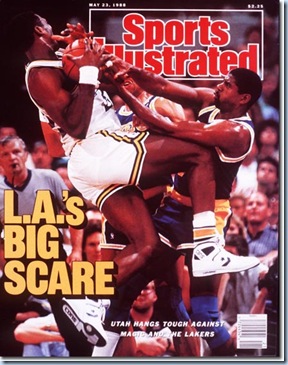
  • Last season they took the NBA Champion LA Lakers to 7 games in the 2nd round of the playoffs -- and scared them good.
  • The sky was the limit for this team that turn into a 'contender'

This is somehow not a foul . . .

That said, there is one reason why I find this team particularly interesting. This team, for all of their successes, took a step back after building so much momentum. Sure, three seasons later they would reach the Western Conference Finals for the first time in franchise history (and reach there 5 times in the 7 successive seasons) -- but during this upswing in success the Jazz fell back down and were swept from the Playoffs in the 1st round. (Thanks Golden State!) This troubles me because right now the current Jazz franchise is experiencing a second upswing and a similarly linear progression . . . and it would really suck to have to go through those bumps and bruises all over again as a fan. (I've been emotionally invested in this team since the 1987 season, and am finally getting over all those 1st round losses)

I am even tempting fate here by even bringing all of this up right now . . . as our beloved Jazz are 'perhaps' (if history repeats itself) primed for a less than stellar playoffs? (After all, we did just play LA in the 2nd round of the playoffs 20 years after the first time it happened) Ultimately you have to look at all of the good things that happened this season and find them to be inconsequential when examined against a 0-3 playoff elimination in the 1st round to an underdog team with no bigs. The 1988-1989 Utah Jazz season was not a good one . . . simply because where they where and where they ended up fell below expectations. This Jazz team is even ahead of the curve because they've already been to the Western Conference Finals (2 seasons ago), while at this point 20 years ago, the Jazz were still three seasons away.

I wish for the best for the Jazz in this, and all seasons; but would really pray against another regression year. After all, there is no guarantee that our current window of opportunity as a contender will stay open for as long as the window we had 20 years ago.

Monday, September 22, 2008

Tangent Alert: sports figures ARE public figures

I received an e-mail from the bloggers @ Hugging Harold Reynolds and they pointed me to their post on Sports Figures at the RNC. (If you don't know what the RNC is then you are just not 'there' enough to deserve to vote) Among those ex-jocks (or current jocks) who spoke was none other than Thurl Bailey. (Who had a great NCAA career and a solid NBA career for our Utah Jazz -- his life outside the game has been quite fulfilling as well for Bailey who is a pastor and member of the LDS, and was part of a great singing bible video where he plays the part of Goliath) This got me thinking . . . aside from how it is super de rigueur now to be politically active (e.g. black athletes saying that they are for Obama . . . riiiiight, because those guys feel the same way about his energy policy or ideas about stem cell research as he does) professional athletes have been relatively mum about issues for quite some time.

Please buy my $hoes . . . i'm not very good as a GM

Perhaps this is due to how these guys don't want to go out of their way and tell the world how they feel for fear of losing money somewhere down the line. LeBron James has a great platform to make some change in the world because of his fame and popularity, though he's been focusing on making money for Nike and Microsoft instead.

(Quite similar to how Jordan was such an icon that he could have done so much more, but instead chose to party it up while selling shoes to make himself independently wealthy -- Julia Roberts gave more money to help with Katrina than he did, and she never sold one sweatshop created shoe in her life)

The opposite happens to be people who talk too much, among this list are guys like Shaq (Kobe, how does my ass taste?), Ron Artest (who is smart, but not wise) and most recently, Josh Howard (who doesn't salute the flag). Sure, some guys like Charles Barkley can say anything he wants without people really being upset anymore as he's a caricature of who he used to be. While others like Rasheed Wallace are known by reputation alone, and his interview responses have been given with the cadence and passion of someone who had just had a full frontal lobotomy -- yet he is vilified in the press for his explosive expressiveness.

That said, behind sports individuals being highly guarded now with what they say and do (thanks John Rocker!) the major issue appears to be a lack of desire to do what previous eras of sports figures were willing to do. Namely, be public figures.

I remember watching those old NBA ads that were public service announcements, you may remember the ad of Mark Eaton talking about child abuse. I remember that one, and that was from back when sports figures were not afraid to actually take stands on things. Older guys, like Dikembe Mutombo, are concerned with the world that they live in and try to use sports as a starting point towards greater things. Few others look at sports as a launching pad, but rather a privilege that they use towards fame and wealth.

Some guys like Kobe (with large conflict diamond in ear) and T-mac have spoken out about Darfur in recent months, though when someone less famous (Ira Newble) tries to actually do something that gets to the root of the problem, he gets the cold shoulder from the ever image conscious NBA. I guess the whole point is to avoid controversy, and in doing so, professional athletes are encouraged to avoid doing anything. That's like cutting off the leg to get rid of an infected toe. Which is a very safe, but ineffectual way to be a public figure.

Friday, August 15, 2008

Returning to the Promised Land

The Jazz brass, coaches and owner have done three things well in the post Stockton-to-Malone era:

Jerry Sloan is consistently intimidating to his players.
Retuning to the NBA Finals does not occur by chance, but by following out a long term plan.

I. The first thing that the Jazz brass (and co.) has done well is they've established a winning formula, and have enjoyed a consistency that other franchises have lacked. While this has the drawback at some level of inherent stagnancy, the NBA mandated rules changes have kept the Jazz coaches on their toes. One particular rule change which threw a major wrench in the system was the removal of the previous Illegal defense rules. Now Zone Defenses are allowed -- even pseudo-Zones are hard for the Jazz to handle as it's man-to-man defense, but an extra guy to rove around and get in passing lanes -- daring the pound it inside Jazz to shoot from outside. (This was particularly difficult for the Jazz to do during December of that 2007-2008 season, which resulted in many losses)

The Zone Defense friendly NBA forced the hand of the Jazz brass and they have endeavored to start playing 5 on 5 basketball on offense for the first time ever (but more on that later). They needed to avoid Zone defenses in order to properly run their offensive sets. Previous versions of the Jazz would run their forward based offensive sets (Malone, Dantley, Bailey) and involve strong guard play all while the center fell asleep at the top of the key.

This has always been the case as the Jazz used to park Mark Eaton up at the top of the circle while he watched the finesse guys do their thing. Then Greg Ostertag came in and was able to use his height to exploit a high-low passing game inside. If you did that now, no one would follow Mark or Greg outside, and the paint would get clogged very quickly. To counter that the Jazz have further evolved by getting one of the few true bigmen (check out his rebounding games in the playoffs if you don't believe me that he's a bigman) who has a very legit three point shot -- Mehmet Okur. While the NBA has made several rule changes since the Stockton-to-Malone era, the evolution of the Jazz sets has been sped along because of smart roster moves.

The signing of Okur allows for the Jazz to move him farther than Jerry Sloan had ever imagine moving Eaton or Ostertag -- out beyond the three point line. Furthermore, Okur needs to be defended out there -- thus necessitating luring out the guy who defends him (a defensive big), or a smaller guard (causing a miss match somewhere else on the floor). The biggest benefit to this roster quirk is that it retains the floor spacing that is needed for the majority of the Jazz sets: pick and roll with the PG and PF, or finding a cutter in the vacuum left by a vacating center for easy dunks for Andrei and Brewer.

I'm surprised at how well it works, and encouraged by this -- it shows that the coaches are working with the front office to get players that can do good things on the court, and work within a system. You couldn't get away with this offensive set back in the Stockton-to-Malone days . . .
Memo shooting threes = opposing bigman is not in paint + good floor space = easy to score in the paint

II. The second thing that the Jazz brass (particularly the coaches) have done well is that they've tried to learn from their mistakes. Often Stockton was the only guy on the floor who could get the job done; and often, he was the best player on the floor. All too often (save for that elimination game 4th quarter vs. the Rockets where it was Stockton vs. Houston); unfortunately John didn't call his own number enough -- and that hurt the team. What have the Jazz done now? They've got a good passer and floor leader at the point guard -- but someone who is ultimately the most confident in his own abilities. We've had Deron for three seasons now, as we know that when it counts he's not afraid to be 'The Man' -- something Stockton always deferred to Karl (who, honestly, was not as clutch) about.

Another example happens to be expanding the game to involve more people on offense. At their most dangerous the Stockton-to-Malone teams were filled with subordinates like Hornacek and Russell, or Bailey and Griffith. Never did they fully get a chance to have 5 good offensive players on the floor at the same time (thanks, Rony Seikaly -- you could have really helped against Michael Jordan and the Chicago Bulls back then). It's hard to win titles playing 4 on 5.

If the point of the game is to score more than the other team, then five guys who can score > four guys who can score This version of the Jazz has the ability to play 5 on 5 on offense for the first time in franchise history -- and this has not come at the expense of needing to change the entire playbook. Once the Jazz secured a good, smart point guard to tandem with their beast of a power forward (acquired as a free agent) it was going to be the pick and roll show all over again. This play used to kill teams back in the illegal defense era. Now people are allowed to zone, and as a result, relying on the pick and roll is harder to do.

In order to prevent the picker getting immediately double teamed by bigmen the Jazz need to lure out a bigman outside. Chicken and egg thing with Point I and Point II -- but that displays how inter-related things are: in order to learn from your mistakes you have to have a winning game plan. Thus, if the Jazz wanted to keep relying on forward based offensive scoring sets from the paint, some tweaks were going to be needed to be made.

III. The final thing that they have done well is that they've been able to key in, identify and get similar types of players on the roster -- attempting for coax lightning to strike twice. The obvious comparisons exist -- Carlos Boozer plays like an older, jump shooting Malone. Deron Williams is an adept passing lead guard who is clutch at the end of games, like Stockton. As always, it's more than just replacing Stockton and Malone.

Then: Now: Difference:
John Stockton Deron Williams

Not better: but more willing to step up in crunch time

Maybe they would have gotten out of the 1st round much more if we saw more of this guy? Deron Williams is 'The Man' for our team

Stockton was the consummate professional and floor leader. Possessing not just physical tools (like good health and excellent stamina), he also had vast amounts of Basketball IQ -- essentially being another coach on the floor. There would be no success without John. Similarly, Deron Williams is the heart of this version of the Jazz. He is adept at passing (had over 10 apg in his 2nd NBA season, John didn't break that barrier until his 4th). He's not the coach on the floor though, but the Quarterback who calls his own plays -- and is much more willing to do it himself. Sadly, the Jazz could have used a more selfish version of John Stockton. They may have the next best thing in Deron Williams.

Jeff Hornacek Kyle Korver

Gives up floor game and passing for a more min/maxed player

Hornacek was much more than a guy who has two Long Distance Shooting trophies at home Korver would do well to add a bit more to his game on offense

Jeff Hornacek, some people forget, was an All-Star for the West. He was the principle piece that the Sixers got back for trading Barkley -- and all he did was put up 19 ppg (.47/.39/.87), 7 apg, and 2 spg in return. Not too shabby. Hornacek had every shot, and was a much more skilled NBA player. His age and lingering injuries prevented him from being a great defender for the Jazz. Kyle Korver, also acquired in a mid-season trade from the Sixers, is more of a specialist. He is statistically a better three point shooter and free throw shooter. Over this last season Kover received shooting training with Hornacek -- and Jeff admits in his 'aw shucks' type of way that Kyle is a really great shooter, maybe better than Jeff. Jeff brought more to the table though and started.

Bryon Russell Andrei Kirilenko

Better: much more creative and a great shot blocker

Ha ha ha (silently: one day I will kill you Michael . . . one day . . . ) Why is Kobe shooting freethrows already, I haven't even checked into the game?

Before being emasculated by Jordan in the finals Russell was a confident and competent forward who was the best defensive stopper on the Jazz who could run, dunk, do whatever was asked of him, and unassumingly hit threes just when the Jazz needed them. Sound like anyone we know? Andrei is more versatile -- playing everything but center in the playoffs for us between 2006-2007 and 2007-2008; though, let's not forget that in 1998-1999 Russell had to guard Chris Webber in the playoffs due to foul trouble. Like Russell, AK-47 always has to guard to other teams' best offensive player and as often as he gets beat, he comes up with a timely deflection, steal, or block at a more critical juncture in the game. His offensive ability is truncated in his role with the Jazz, but is the most talented player on the team.

Karl Malone Carlos Boozer

Worse: but possibly owns more left-handed post moves though

Hmmm, almost time to make more kids . . . Can I has work ethic for defense plz?

Carlos Boozer is a beast by today's standards. (at least in the regular season) If you put Karl Malone at his peak in today's game he would own all of these passive, physical play avoiding bigmen. (Seriously, Amare Stoudemire never step on the same court against Charles Oakley.) Both have (at least in the eyes of jaded Jazz fans) built a reputation for not being able to equal their production in the playoffs. Unfortunately for Boozer, his drop off is so severe that it's pure folly to even talk about these two forwards in the same breath. If you want to really get a picture of how ridiculous the comparison is then read this.

Antoine Carr Paul Millsap

The same: the only difference is age and experience vs. youth

What foul? Veteran savvy FTW! How is this an offensive foul? WTF?!

The "Big Dawg" was taller and at that stage, a very savvy veteran who had all the sneaky, esoteric knowledge on how to get away with fouls. Millsap gets called for a ton of fouls -- though they are essentially the same player. Millsap is younger, has some upside, and has a lot more energy and vigor. Both had surprisingly developed offensive games -- but mostly scored close to the basket, often on put backs / tip ins. Carr was a great bench guy for any playoff team, who defended the paint, got boards and blocked some shots. He even had a 20 point game in the NBA finals once. It's not impossible to see Millsap do that well. 

Howard Eisley Brevin Knight Better: Knight + Price > Eisley + Vaughn
No one remembers how good I was Back up point guard: three point shooting not included

Eisley's career before the Jazz was nothing to write home about, and his NBA career after the Jazz was almost as pathetic as Shandon's was. Because of this many people fail to realize that he was the best back-up point guard the Jazz have ever had since John Stockton was coming off the bench. He could push the ball up the floor, knew all of the sets, was active defensively and was able to shoot the three with deadly accuracy and even hit game winners. That game winner that Deron had vs. the Cavs last season? Well, Eisley used to do that type of thing back for the Jazz in 1998. While there is little chance for Knight to be as good all-around as Howard was for the Jazz, Knight is a very solid veteran who can run a club, never turns the ball over, and is a good steals guy. This looks like another downgrade; however I'd take Knight and Price (basically a younger, more exciting Howard Eisley with less playmaking and more highlight making skills) over Eisley and Jaques Vaughn any day of the week.

Shandon Anderson Ronnie Brewer

Better: by sheer virtue of Brewer being taller and able to play the 1, 2 or 3

 I made a living off of the other team not defending meeeee! . . . and so shall I !!!

Shandon Anderson was a young, athletic, defensive minded player who played within his limitations. He never tried to become an outside bomber. His bread and butter was to sneak around and find an open spot on the floor as the other team was concentrating on the other guys (Stockton, Hornacek and Malone) more than they were on him. He turned hard cuts into layups and dunks. Ronnie Brewer is much the same, being an offensive opportunist using his speed, size and athleticism to get easy dunks as the defense pays him no attention. Both benefited from playing with eager passers (Stockton, Hornacek and Malone for Shandon; Williams, Kirilenko and Boozer for Ronnie). Both are the 2nd member of their families to be part of the NBA (Shandon's older brother, and Ronnie's dad both played). Ronnie is longer, faster and has top 5% NBA athleticism (as seen in the pre-draft combine). His shot is broken, but appears to give more to the Jazz than Shandon did -- for one thing, Ronnie starts.

Greg Foster Mehmet Okur Better: and it's not even close
Yeah! I made an open jumper! I'm the machine! Let's see you try it when you're defended and it's the playoffs . . .

Foster was an occasional starter during the two finals seasons, managing to do so in over 50 games. Okur is our full-time starting center. Both were outside shooting bigmen who were not regarded as big-time rebounders. Memo is a much better rebounder, defender, outside shooter, inside player, and is a serious playoff perform who does all the clutch things you need to win (game winners, or offensive rebounds). Foster was a better dunker -- and both guys are some crappy fight in them. Foster getting into it with the Lakers' Rick Fox, and Memo coming close to throwing down on Juwan Howard among others. Foster was an okay player, but was very annoying in that Sasha Vujacic type of way. Memo has been an All-Star and is a serious upgrade for the Jazz.

Adam Keefe Matt Harpring

Better: and also a better fitting role for this type of player

Must . . . not . . . break . . . rim with shot Must . . . not . . . break . . . knee . . . with landing

I guess we need a frame of reference when bad mouthing our own players. Adam Keefe used to start on one of our NBA Finals teams. (and play 25.6 mpg!!!) How insane is that? Keefe, who may be a better beach volleyball player than basketball player, couldn't shoot, and hardly ever caught passes. At least those are two things that Matt Harpring does (sometimes). They both were solid rebounders from the small forward spot, and both did not have three point range. Both used to get torched on defense -- but at least Harpring occasionally has one of those games where he gets 14 points, 1 steal and 5 rebounds. Keefe didn't even give us that as a starter. Harpring is a good bench guy.

Chris Morris C.J. Miles

Not Better, Not Worse: Anything we do get will be better though

I'm a good player, man . . . just give me some playing time! I'm a good player, man . . . just give me some playing time . . . or like a gameboy for the bench, either is good.

By the time Chris Morris made his way the Utah, he was a serious NBA performer who could put the ball in the basket. After three NBA seasons C.J. Miles is a guy who can't get off the bench, but who could one day be a serious NBA player. Both are taking lesser roles to play here -- Morris was a starter in New Jersey; and C.J. Miles could start for some teams (or at least, get more playing time). Both have legit three point range and can bust out for some nasty jams. Both have had clashes with Jerry Sloan -- especially over their roles. Right now we can only hope that C.J. can one day become the player that Chris Morris was before coming to the Jazz. If not, then whatever, we still have Morris Almond . . .

The Jazz brass has done a more than adequate job of emulating the roster of those Finals teams. Those finals teams sported a good mix of talent -- two Olympians, who were also All-Stars mixed in with another former All-Star and a variety of (mostly older) veteran role players. There were no specialists off the bench save for Foster who could hit an outside jumper better than most centers in that era. This team currently has three Olympians, an All-Star mixed in with two other former All-Stars (and one to be in Deron Williams). The bench is almost exclusively comprised of specialists -- Korver is the shooter, Harpring is the hustle guy, Millsap is the paint terror. There have been improvements on all major archetypes save for the fact that Morris/Miles, Carr/Millsap and Hornacek/Korver are all pretty much washes. Okur is clearly better than Foster and while Stockton is ahead of Williams in career ability, Deron Williams is far from a bad player on any given playoff game. Malone destroys Boozer, but the overall talent is upgraded. Kudos to the Jazz for being able to (at least on paper) recreate their championship contending team. Is that all? Is this team NBA Finals worthy?

One large piece is missing . . . you know, a big (7 feet tall at least), rebounding and shot blocking guy. It's a roughly Greg Ostertag sized hole. A Mark Eaton or Ostertag -- something the Jazz has always had the advantage of having, is just not an archetype that the Jazz Brass has been able to duplicate on this version of the team. Three potential prospects exist though -- one is an American born, 7'0, 19 year old Greek who can block shots, but is more likely to make them; another is a 7'1, skinny Croatian who is far removed from playing in the NBA; and the last is a 7'1 Ukrainian who has a questionable work ethic. The previous Jazz teams had to fight against the passage of time. The limiting reagent in this equation happens to be the salary cap.

Compared to those glory year teams, our current roster is better -- but we are behind in the big defensive galoot department. Does that mean that the one guy who is hated for his play, but loved for his goofiness (Ostertag) is the dividing line between serious championship contender and what the Jazz currently have? Essentially, this appears to be more truth than fiction -- as the only major weakness exists as a lack of a shot blocking presence stationed in the paint. Ideally internal improvement of our young centers will satisfy this component -- we do not need a quantum leap in center ability, we just need to get Kosta or Kyrylo to channel their inner-Ostertag. And then we'll be back in the promised land.

Friday, August 8, 2008

Flashback Friday: David Benoit

For most Jazz fans David Benoit is/was/will always be remembered as a pariah. I grew up watching Jazz put out front lines of Malone and Bailey, and then Malone and Corbin . . . when Malone and Benoit came around I had seen plenty of Jazz sets that ran Stockton, Eaton, two inside scoring forwards and a shooting guard (e.g. Griffith, or Jeff Malone).

David Benoit throws it down hard!

David Benoit was a hard dunking small forward who was long and athletic. Unfortunately for him, his game half translated to how the NBA game was changing. Back in the 80s and very early 90s you could get away with being a small forward with no outside shot. Things were changing in the mid 90s, where everyone from Pippen to Grant Hill to Dan Majerle became more proficient on the outside. Even the fabled Dominique Wilkins had to start making threes in those days. David Benoit was part of that dying breed of non-proficient outside shooting small forwards. Had he come into the league in the 70s he would have probably hung around for longer than he did in the 90s.It behooves me to recount his career arc, but according to the Unofficial David Benoit site, after being undrafted at the end of his collegiate career he went on to play in Malaga, Spain and won the ACB (the name of the league, Raul Lopez fans may be familiar with it) Rookie of the year. After that he signed with the Jazz and played hard.

He quickly impressed the Jazz brass and became our starting small forward.

Another assist for Stockton
Benoit doin' that thing he do. YouTube video "I Love This Game: Are You Ready to Fly (NBA commercial)" [0:30] uploaded by onceuponatimeinnba

Benoit's best years playing for the Jazz included being part of the 1993 All-Star Weekend Dunk contest (which took play in Salt Lake City); finishing that 1992-1993 season strong by averaging 12.7 ppg and 6.5 rpg; and in 1994-1995 he had his best year leading the Jazz in 3 pointers made (in the playoffs) and averaging 10.4 ppg (48.7%/33.0%/84.1%) and 5.2 rpg. It's important to note that his three point shooting was particularly impressive for him (and up to that point, any Utah Jazz forward).

Unfortunately for him, the team, and the fans, his strong regular season outside shooting did not carry over to the post season. The Jazz were ousted in 5 games (back then the 1st round of the playoffs was best of 5, kids) by the eventual champions, the Hakeem Olajuwon, Clyde Drexler led Houston Rockets. In the decisive 5th game the Rockets won 95 - 91 to on the Delta Center floor. Hakeem and Clyde, like they had for most of the series, did all the scoring for the Rockets. Hakeem had 33 and Clyde with 31, with no one else scoring more than 8. On the Jazz side Karl Malone had a mighty 35, Jeff Hornacek knocked down 4 threes on his way to 19 and Stockton chipped in with 12 points. What about David?

Well, David Benoit was a key element to this game. The Rockets were aware of his shaky shooting from deep, and left him open during a decisive sequence of the 2nd half when the Rockets were climbing back and eventually took the lead. David finished with 8 points, but shot quite poorly (3 for 9), and went 2 for 8 from deep. For a point of reference, Karl Malone went 1 for 2 from deep in that game. David shot the ball 6 more times from three than Karl did, and only made 1 more three than he did. It's easy to point to this as empirical evidence that Benoit *cost* the Jazz that game, and that series -- but there are always other factors at play. His NBA career was all downhill from there.

Benoit played in Europe before they started to pay well . . . David Benoit jokes around with DeShawn Stevenson in 2000 Benoit dunks it for the Sunrockers! David Benoit dominated the Japanese BJ-League playing for Saitama

Italy

Rocky Mountain Review, Utah, 2000

Benoit is huge in Japan

His last jersey

Benoit's other notable blips on my selective memory radar include that one time that one of John Stockton's kids broke his arm trying to 'dunk it like Benoit' on a kiddie hoop; and of having a poor season ending exit interview with Jazz Brass one season -- which lead to him parlaying his trade in New Jersey (and later Orlando as a part of an astonishing trade that surrounded Yinka Dare for Rony Seikaly). During his career he played all over the world: Spain (Mayoral Marists in Malaga); Italy (Roseto Sharks); Israel (Maccabi Tel-Aviv); he came back to the Jazz for that 2000-2001 season for a bit; China (Shanghai Sharks alongside Yao Ming); and in Japan (Hitachi Sunrockers, Saitama Broncos). He played till he was 38 years old and was still an integral part of his teams -- especially in leagues where he could thrive as an inside player; never having become a serious outside threat. Today he remains a coach (in some capacity) with the Broncos. (or at least he did, back in 2007-2008)