Showing posts with label Lamar Odom. Show all posts

Tuesday, July 28, 2009

YouTube Tuesdays: Penetrating thoughts . . .

The best guards are the ones who can go where they want to go with the ball, despite what the other team is throwing at them. Essentially, the best guards can penetrate through the heart of the defense in order to better threaten for a score (or easy scoring opportunity for a teammate). Of course, not all guards/wing players are built the same. Though, you do have your archetypes . . .

The Blur: These guys have existed in the NBA since the Cenozoic era. They are short in stature, keep their dribble low, and rely upon blinding speed to get from Point A to Point B. Examples of this include Nate “Tiny” Archibald, Michael Adams, Muggsy Bogues and Avery Johnson. Modern incarnations may be a little bit taller (like the actually 6’0 Chris Paul), or a little bit stronger (like Nate Robinson). These guys all have amazing handles and often go deep into the lane and score amongst the trees. Probably the best examples of this type of player would be Isiah Thomas or Allen Iverson.

Mr.Quick first step: These players rely less upon their top speed, and more on their quick trigger muscles. They utilize a series of triple threat moves (ball fakes, jab steps, etc), or nothing at all, to unnerve their defender. With a drop of a hat (or more often, with the batting of an eyelid) these players explode into decisive motion while their defender fails to react. Another, obvious, component of having a quick first step is having a long stride. Taller guards who have both quickness and length display this form of penetration beautifully. Naturally, Michael Jordan possessed both attributes and mastered the quick first step. Behold! Today some of the best at this were guys who grew up and emulated Jordan’s move in their individual periods of basketball development: Vince Carter (think Toronto version), Tracy McGrady (think Orlando version) and yes, Kobe Bryant.

The Pure Athlete: These guys aren’t top speed demons like Chris Paul, nor do they have all that it takes to be Quick first step artists . . . but they do possess some combination of the two, have ridiculous length and hops. It’s not that they have all the tools needed to get into the lane at any cost, but more of what they can do when they are in the lane that counts. Dr.J fits the bill here, same with guys like Dominique Wilkins and today’s versions: Andre Iguodala, Ronnie Brewer and Jason Richardson. After reviewing these types of players on YouTube I’ve come to the decision that everyone should watch this Top 10 video featuring just Scottie Pippen highlights … not just because he proves my point, but because of the crazy music in the background.

The Guy with all the Moves: Obviously at some stage, players can fit into more than one of these categories. Yes, a young Vince Carter had a great first step, but let’s not forget that he was among the top 5 most athletic players in the history of the sport as well; so a player like Vince could easily be placed in the quick step *or* pure athlete category. This is not what I mean when I say “guy with all the moves” though; while Vince is nice here, he’s not a true acrobat who drives the lane like an elusive running back: juking, spinning, side-stepping, hesitating his way to the goal line.

Some NBA players have mastered this form of penetration which allows them to use practiced talent and a learned skill to take them where others rely on purely physical abilities to go. Guys with all the moves do have to have speed, quickness and athletic ability as well, but these players string together a sequence of moves almost effortlessly – the only physical force these guys rely upon is momentum. (Like these kids in Russia displaying some of their parcour prowess: this video gets crazy at the 2:19 mark – watch at least 60 seconds of this video from that mark onwards, watch longer if you want to see this kid free run away from a dog in some guy’s private property.)

Additionally, these players have the over-all best handles in the game that allows them to use their Running back/Parcour movement skills while still holding onto the ball. Guys with all the moves eventually get from Point A to Point B, even if it takes a Point C, D and E to get there first. You may be familiar with their go-to move . . . the Crossover. Examples of guys who have all the moves include Earl “The Pearl” Monroe, “Pistol” Pete Maravich, Dwyane Wade, Kobe Bryant and Ball Don’t Lie’s Bedlam ‘09 Tournament winner: Deron Williams.


While this post was mostly to categorize the different types of ways guards get into the lane, I kind of wanted to touch on how bigger guys get there (and the chance to post a few more links to videos).

The Freight Train: For the majority of these guard type movement skills, strength is an afterthought. Pure Athletes and some guys with all the moves do need strength to finish the plays they start. But they are a far cry for how forwards and centers start, follow through, and finish plays with strength. Some of these hulks take the concept of momentum to a whole new level as they plow through the lane, dispassionately going through anyone in their way. Not only are these guys big, but they are all also great at running the floor – regardless of their size.

We’ve all seen that Charles Barkley clip where he has a full head of steam and goes coast to coast for a two hander where his momentum swings him around the entire basket support system. (1:56 in this 10 minute video) This is a prime example of the Freight Train. Other players we can easily include in this category are Karl Malone, Amaré Stoudemire and, of course, LeBron James.

The Black Tornado (only one player ever): Someone like Vince, Jordan, T-Mac or Wade may defy the laws of gravity. That’s nice. They are able to bend the rules of the natural world to pull off extraordinary moves.

Other guys are forces of nature altogether. You don’t need to bend any rules when you make the rules. Shaquille O’Neal took pity on our world, and self-banned this move which he called “The Black Tornado” – a move that he himself agreed was “illegal.” Take cover below!

It is only natural that players of different sizes, speeds, talents and ability would evolve different ways of getting into the lane. Penetration is usually the initiation of good things on offense, as players create advantageous passing angles, draw in defenders, or just plan dunk it on people themselves. Take notice of this, and enjoy these categories as you watch the upcoming season!

EDIT: I completely forgot this category:

The guy who does not look pretty dribbling, but makes amazing passes: Sometimes God gives you seemingly conflicting gifts. For one, you could be 6’9 and a great passer. Unfortunately for you, you are so tall that in order for you to dribble the ball effectively, yet not actually leave it wide open to get stolen from you, you have a really ugly dribble. Not every big guy who dribbles does it poorly, Lamar Odom has a very nice looking dribble and has a great handle with the ball. Magic Johnson also had a great handle on the ball, but he really had to pound the heck out of the ball to make sure it got back up to him fast enough that the guys who defended him (big time steals guys like Isiah Thomas, Alvin Robertson, Mo Cheeks, John Stockton, etc) did not pick his pocket each time down the floor. It was far from the prettiest dribble in the half-court set.

The modern player who immediately comes to mind when I think of guys who pass well, but don’t look like they can dribble at all is Andrei Kirilenko. This is a guy who has played point guard internationally and in the 2nd round of the NBA Playoffs – yet Jazz fans cringe whenever he drives to the basket. We don’t trust his dribbling skills at all – yet he does some really amazing things with the ball on occasion (not unlike Magic) with passes: through defenders legs (can’t find the vid of him doing this to Bosh); behind the back passes; no look passes (0:26); over the shoulder on a fast break (0:43); spinning through the lane (2:11); on the run in traffic with no eye-contact with any of your teammates passes; passes through his OWN legs; and so forth. Very good passer, and very creative player – he just looks like he’s murdering a goose when he dribbles. (really, the video to the left is a mixtape which starts out with him dribbling off his foot, and his goose killing continues at the 0:20 mark!)

Wednesday, November 5, 2008

Looking at the Top five 6th men so far . . .

According to ESPN.com, or at least a poll on their website, the Top 5 sixth men candidates are:

  1. the LA Lakers' Lamar Odom,
  2. Chicago's Ben Gordon,
  3. Philly's Lou Williams,
  4. Portland's Rudy Fernandez
  5. and Utah's Andrei Kirilenko.

Predictably, as of right now, Odom is number one with 33% of the over 9,000 votes. Coming in second is Portland's rookie Fernandez at 26% of the vote. Next is AK-47 with 21%. Ben Gordon and Lou Williams round out the top 5 with 10% each. I think I've already made myself pretty clear when looking at how dumb some people are, so let's not even bother with the results of this vote. Let's, instead, look at how these guys are actually playing right now.

Player Lamar Odom Rudy Fernandez Andrei Kirilenko Ben Gordon Lou Williams
  Odom appears better than he actually is Rudy, like all Tblazers, comes with a lot of hype AK-47 is under the radar like the Jazz usually are Gordon is fantastic at scoring the ball, but doesn't do much else Lou is the worst of the bunch
Team LA Lakers Portland Trailblazers Utah Jazz Chicago Bulls Philadelphia 76ers
ESPN Vote 33% 26% 21% 10% 10%
MPG 26.0 27.0 32.7 26.8 23.0
Games 3 3 3 4 4
PPG 8.3 14.0 14.0 14.3 12.5
FG% 45.0% 48.3% 53.6% 41.3% 39.6%
3PT% 0.0% 40.0% 50.0% 43.8% 23.1%
FT% 77.9% 88.9% 73.3% 85.7% 69.2%
Shooting Worth * 1.25 1.45 1.50 1.24 1.04
Shooting Frequency ** 3.85 2.83 3.50 2.30 1.92
APG 2.33 1.33 3.00 3.00 2.50
A:TO 1.4 2.0 1.5 1.33 1.25
RPG 5.67 2.00 8.67 1.50 1.50
SPG 0.33 1.00 2.33 0.50 0.25
BPG 0.33 0.0 1.67 0.0 0.0
B+S/PF *** 0.33 1.00 1.71 0.29 0.33
PFPG 2.0 1.00 2.33 1.75 0.75
TOPG 1.67 0.67 2.00 2.25 2.0

N.B. These stats may look different than what you see on NBA.com or ESPN.com because these stats are not rounded to the tenth place, but the hundredth place -- they are derived from the total value over the number of games as usual, but to two decimal places. For example, ESPN.com rounds Lou Williams fouls per game to be 0.8, where as he has 3 fouls in 4 games, which is actually 0.75.

* Shooting worth was previous my erroneously named "points per shot" stat. This is derived by dividing the total number of points scored (not just from FGA, but also FTM) by how many total FGA the player has made. This 'worth' inflates the scores of players who get to the line and make their free throws, while penalizing players who need a lot of shots to score. The higher the number the better. For example: Lamar Odom has scored a total of 25 points (10+9+6) and shot the ball  20 (6+5+9) times. This is then 25/20, for a shooting worth of 1.25 points for each shot.

** Shooting frequency is what I used to call "shots per minute", which is wrong; this stat is how many minutes needed to take a shot. Or in plan English, "Player ______ shoots the ball every x number of minutes on the floor". The lower the number the more frequently the player shoots. Again, with Odom being the example he has shot the ball 20 times this season. He has played a total of 77 (29+23+25) minutes this season. Here we divide the total number of minutes played by how many shots were taken. In this case (77/20) we get 3.85. That means that Odom shoots the ball once every 3.85 minutes played. (or every 3:51, if you want to figure out how many seconds 0.85 minutes is). If we compare this to Kobe's shooting frequency (which is calculated out to 1.83 <-- 97 minutes played / 53 FGA) we can see that this is not a very high number at all.

*** Blocks + Steals / Personal Fouls is another "Amar stat" that is very easy to understand. It's simply the total number of blocks + the total number of steals all divided by the total number of personal fouls. [The equation is: (blocks + steals) / PF ] It's a stat that attempts to gauge how effectively a player gambles on defense by how often they are tagged for fouling. If you just stand there on defense you probably are not going to pick up a lot of fouls. If you try to go for steals, or challenge shots you have a higher chance of getting called for a foul. So in a way, this monitors activity on defense as a product of how well they avoid fouling. I'd love it if the NBA officially recorded deflections though . . . they don't. So this is the best I can do. The higher the number the better. So, using Odom as an example here: so far he has 1 block and 1 steal. He has fouled 6 total times this season (1+2+3). So this becomes 2 / 6, or 0.33. He has more fouls than steals and blocks combined. He may be playing good defense, but he's not recording defensive stats for it.

So yeah, it doesn't take a Rocket Surgeon, or John Hollinger, to figure out which one of these five guys is actually playing the best right now. It's Andrei Kirilenko who is 1st or 2nd in all the categories. But if you like Hollinger's PER stat, here are the breakdowns: Rudy Fernandez 24.66; Andrei Kirilenko 23.97; Ben Gordon 15.90; Lou Williams 15.66; Lamar Odom 12.49. The same size of 3 or 4 games is really small though, but right now it's an easy call. I will be watching this race as the season goes on though . . .

Wednesday, October 29, 2008

Utah Jazz Pre-Season 2008-2009: X Factor

The major X-Factor this season is not going to be guard play . . . or post defense . . . or bench production. All three of those things have normalized themselves, our guards are who they are, our post defense needs improvement and our bench is very productive. The whole issue of next off-season will not hang over the heads of this team all season long either -- as they will focus on the games at hand. If this does become a large factor it will actually serve as a positive motivation for the team to get it done this season, instead of just rely on the fact that they are all so young. (Eldest player on the team is Brevin Knight at 32)

The X-factor for this season is, bluntly, Andrei Kirilenko. I've written about him a lot ever since I started this blog (61 times as of this writing), and that is no doubt correlated to how complicated his situation is with our team.
More monkey dunks, less games of 8 points and 2 rebounds

I don't need to rehash everything here, we all know that he makes more money than he could ever justify on the court. We also know that he's pretty talented, and when given the minutes, he can do some amazing things -- things no one else on our team can do. Right now he's going to come off the bench for us (which may be good -- or bad).

The main reason why he's the X factor is because of escalation. Back in the 80s you were a contending team if you had two really good players (for example, the Jazz didn't start to win until they had Stockton and Malone). Then somewhere in the 90s you needed a third guy to be a good team -- and all these crops of "the big three" started to be talked about. Some teams still did well with two really good players (like Shaq and Kobe), while other teams needed that third guy to get them over the top. The last, best example of this would be the 2007-2008 Boston Celtics with Paul Pierce, Kevin Garnett and Ray Allen. Escalation now has changed things, and to be a good team you're going to need four good guys.

For example, a team like Orlando (three good guys in Dwight, Hedo and Rashard) can only advance so far in the playoffs because their three guys aren't the best three guys around. They would need a 4th guy to be as good. Moreover, the LA Lakers now sport line ups with Kobe Bryant, Pau Gasol, Andrew Bynum and Lamar Odom. The Detroit Pistons have been playing forever with Chauncey, Rip, Tay and 'Sheed. Houston has reloaded and are now Tracy, Yao, Ron and Battier/Rafer (they equal one good player).

Brewer is a nice player, but right now he's not at the same level as most of the guys I've listed -- he's not at an All-Star level. Andrei, on the other hand, has all the credentials to be a player at that level. He is a go-to-guy for his national team, he compliments the other three guys (Deron, Carlos and Memo) well, and he's BEEN just as good as an All-Star at times during his career (Like last season's victory over the Lakers when Memo and Booz were out and he had a triple double and nearly a 5x5 in the same game).

Four is the new three; just as three was the new two. We need that 4th guy to step up. And as a result, Andrei Kirilenko is our X-Factor this season. We need less 12 point, 4 assist games from him and more 16 point, 6 rebound, 5 assists games from him if the Jazz are going to be one of the top 5 teams at the end of the season -- instead of just at the beginning.

Friday, October 10, 2008

Ball Don't Lie respects Ronnie Brewer

Ball Don't Lie, via You Got Dunked on, posts a good video of Brewer dunking on the Lakers. While the video does not feature Ronnie's alley oop, it's a pretty good sequence of high flying jams. Furthermore, Skeets brings to light the fact that Brewer "had more dunks than LeBron James last year." (J.E. Skeets, 2008) Good stuff! Because the internet is free . . . here's the video!


click here for the original . . .

Sunday, September 21, 2008

Things to look for this season: Paul Millsap

Essentially, what the Jazz brass end up doing with Boozer the next summer will -- on some level -- be dependent upon what Paul Millsap does this season. Either he's a potential starter at power forward who can be counted on to get a double double, or he's a glorified energy player who cannot sustain his level of play for 30+ mpg. I think that what we know of him suggests that he is either one of those people, and not a combination of the two.

Paul Millsap wants to know if you are seeing anyone special right now?

Here is what he gets done when he plays 27+ mpg (according to 2007-2008 seasons stats including playoffs):

So, in 12 games where Paul has played more than 27 mpg he averages: 16.2 ppg (62.8 fg%, over 6 fta/game @ 68.9 ft%); 7.8 rpg (3.3 off); 2.4 apg, 2.2 spg, 1.9 bpg. That really is not too shabby for under 30 mpg of work. Especially not for a 2nd year NBA player who still doesn't get the respect from the refs on defense. In his rookie season he played 18 mpg and had 6.8 ppg, 5.3 rpg and just around 1 apg, 1 spg and 1 bpg. In his soph season he upped his mpg to 20, and boosted his stats to 8.1 ppg, 5.6 rpg, and similarly around 1 apg, 1 spg and 1 bpg. He is not going to be a great contributor, or even want to stay in Utah, if he continues to play less than half the game. And clearly, it's not like he is an inefficient player by any means, as he has a career fg% that's easily above 50% and when he plays heavy minutes his FG% averages out to be an insane 62.8 fg% (see above). Dude needs the minutes, especially in this pivotal year where the Jazz may have to make a decision about Millsap or overpaying Carlos Boozer. That said, what are the three key things that we have to look out for this season from Paul Millsap?

  1. Season averages of 25-28 mpg: Really, this should be a given, and don't tell me that there isn't enough time to go around, I've been playing with time and rotations for part of the summer, and I know there is. (Even if that means that Carlos Boozer gets some playing time as the back-up center) 12 games is only 15% of the entire season, but I think that the foul situation provided, he can be a key performer when playing more than half the game.
  2. Meeting Statistical Benchmarks: This part is easy to understand . . . there will be more confidence in his game over the season by the coaching staff and brass if he can meet certain statistical benchmarks. I know that they must have some for him, and I do not know what they are, so here are mine:
    1. 5 different games of at least 20 points;
    2. 3 different games of 10 FTA;
    3. 45 games total of at least a combined 1 block and 2 steals, or 2 blocks and 1 steal;
    4. 3 3PTM
    5. At least 240 minutes of 4th quarter action
  3. Use quickness on offense more: He's a beast of an offensive rebounder due to his quickness, and he makes good cuts and gets open for dunks because of it . . . however, he needs to be able to use his relative quickness (compared to other PFs out there) when he gets the ball on one-on-one moves. He has solid ball handling for a big guy (he's no Odom or Kirilenko, but he's no Larry Nance either), and he has a rudimentary cross over and can do significant damage when he faces up his opponent. I'd like to see him get the ball at the high post, face up his man, and drive on him -- ultimately resulting in him getting to the FT line a bit more.

Thursday, September 11, 2008

The Five Epic Errors of Jerry Eugene Sloan

I like Jerry Sloan and respect him for what he has done for the NBA, and what he has brought to the game. He and his staff (Phil Johnson, and any combination of Ty Corbin, Gordon Chiesa, Kenny Natt, Scott Layden, etc) are undervalued developers of talent and teachers of the game. For example, DeShawn Stevenson was not an NBA player when he joined the league -- 4 years learning in Utah made him a player. For one, they completely broke down his shot, and rebuilt it like the $6 Million Dollar man over those 4 years as he worked with Hornacek for quite a bit -- now he's a capable three point shooter, not an athletic Desmond Mason type with ugly mechanics and no outside shot. Another thing that is undervalued is the fact that Jerry Sloan (and staff) is quite good at making game to game adjustments. (Some will argue that he doesn't make meaningful adjustments -- but those are in-game adjustments, which I readily agree he is poor at -- his game to game adjustments are among the best in the league. For proof watch the NBA playoffs)
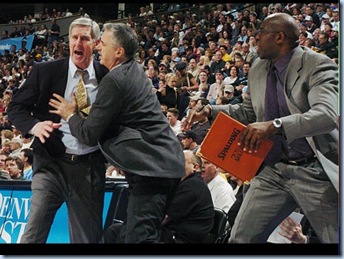
Can I has technical foul?

Sloan is well respected in league circles, though he is consistently regarded as a few notches down from the likes of Phil Jackson, Gregg Popovich, Pat Riley, Don Nelson (who has 3 CoY awards!), Larry Brown, Rudy Tomjanovich, Jeff Van Gundy (who is not currently employed as a coach) and others.

Sloan is well respected, but guys like Bryon Scott, Sam Mitchell, Rick Carlisle, Doc Rivers and Don Chaney have won Coach of the Year Awards. [Opinion Alert: I think that Sloan is a better coach than any of those guys]

Scott is an okay coach, Mitchell is a 5 game loss streak away from being fired, and Doc Rivers was fired as a coach something like 7 times already. Don Chaney has a .406 winning percentage, of if you will allow me, roughly a 60% losing percentage. He has two playoff wins in his career as a coach. He has been a CoY, while Sloan has not.

It's not about Coach of the Year Awards though, as Sloan's top assistant coach (Phil Johnson) was NBA Coach of the Year in 1974-1975. What it is about, though, is understanding why Sloan (for all of his good attributes) seems to be a step behind that first group, and stuck in a situation where former Players with little coaching experience get awards that have so far eluded him. What are the major lacunae in Jerry Sloan's abilities as a coach?

1. Playing Time / Rotation Management:
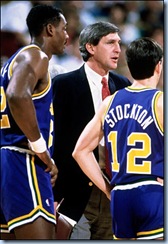
Only John has retained his hair from those days Not pictured: ref awarding Jordan two free throws Jerry Sloan has had the benefit of having John Stockton QB his teams since Jerry Sloan first became the Head Coach in '88. Stockton has always heeded Jerry's command (like any good soldier), and as such, he was at the mercy of Sloan during the most important 12 games of John Stockton's career -- the NBA Finals in 1996-1997 and 1997-1998. Jer' has coached John for quite a while, so you'd think Jerry knew how important these games were to John's career and future legacy.
Photographed by Andrew D. Bernstein/NBAE via Getty Images    

But one of Jerry Sloan's major flaws was expressed in those 12 games. Sloan likes to stick to a rotation, which may or may not have contributed to prolonging the careers of his players at the expense of wins. Malone and Stockton both played up to the age of 40 -- but a few seasons before they'd reach those milestones they were in the NBA Finals. In those years Sloan's regimented playing time and rotation scheme called for Stockton to exit the game at the 6 min mark of every first quarter -- regardless of any other circumstances in the game (who was on the floor, were the Jazz on a run, who had fouls, who were they playing against, what the score was, etc). Sure, this may have saved John for the playoffs -- but when the Jazz finally got to the finals, why did he continue to hold John back?

Stockton was easily the best and most consistent player during those finals runs, and it would be pure folly to imply that the Jazz weren't a better Jazz team with Stockton on the floor (no matter how very adequate, and sometimes amazing Howard Eisley actually was during those same years -- you know, like having your back-up PG go coast to coast to hit game winning threes with the audacity to not call a time out, or pass to a starter). The fact that the Jazz were better is not debatable. While there are many factors which influence a win (especially in the NBA Finals), in the games that the Jazz won against the Bulls over those two seasons had John Stockton averaging 37.0 mpg. What about in the Jazz losses? John was anchored to the bench for 33.8 mpg. Correlation does not always translate to causation -- but really Jerry, what were you saving Stockton for when you had him playing 31 mins and 33 mins in game 4 and 6 in the 1998 Finals -- games where the Jazz lost by a COMBINED 5 points, were you saving him for the next round after that, or the off-season? Now, I'm not saying that if Jerry played Stockton more that we would have won the title, no one can say that. What I am saying is that perhaps if he was on the floor more (like to end the 1st quarter, so the Jazz wouldn't start the 2nd quarter already behind and have to fight their way back into every game), the Jazz would have had a better shot to win more games.

  1996-1997       1997-1998    
Finals Game # Stockton's
Minutes Played
Outcome Difference   Stockton's
Minutes Played
Outcome Difference
Game 1 38 Loss -2   35 Win +3
Game 2 39 Loss -12   31 Loss -5
Game 3 37 Win +11   26 Loss -42
Game 4 38 Win +5   31 Loss -4
Game 5 36 Loss -2   38 Win +2
Game 6 37 Loss -4   33 Loss -1

Stockton's MPG in Wins: 37.0 mpg -- Stockton's MPG in Losses: 33.8 mpg.

Current examples of Jerry Sloan's crazy substitution pattern exist in the whole Matt Harpring / Andrei Kirilenko dynamic (where Harpring's mins have been cut a bit, but he still gets way more burn than he needs in the face of evidence that Andrei's magic number is 37 mpg, any less, and he's not amazing). And let's not even get into the whole "younger player" issue (you know, like playing Deron Williams so little as a rookie, and at that, playing him at Shooting Guard instead of Point Guard, and so forth -- but more on that below).

Jerry's use (or disuse) of Stockton at a very critical time is probably the best example of him being bull-headed and sticking to his system against evidence that suggests that it may be okay to run the horses a bit. Then again, this was the Jazz Sloan who used to play Adam Keefe 27.5 mpg or something insane like that.  

2. Very slow to adapt to changes in the game:

Do you ever watch games on TV and when one team goes on a run, to stop the momentum and regroup, the other team's coach may call a time out? Yeah, Jerry Sloan hardly ever does that. Jerry Sloan hoards time outs and possibly thinks that they are like roll-over minutes with his cell phone plan. Unfortunately they are not.

Some coaches can get away with not calling a time out, like Phil Jackson, but that's only because he has some heady vets on his team (like Kobe and Fisher, who have played in a few NBA Finals games) -- Sloan could get away with this back when the average age of the team was 33 and everyone was battle tested in the playoffs like in those Finals teams.

That's not the case with this team -- he should probably use time outs a bit more. Especially when other teams go on their 2nd quarter runs.
Jerry Sloan calls Time out by accident
  Photographed by unknown, NBAE/Getty Images

That's just one thing though . . . adaptation is the key to survival -- in nature and in the NBA. (unless you have tenure, like Sloan does) Sloan does an okay job making game-to-game adjustments as I've already mentioned . . . but he loves his game plan. He will go into a game with one plan, and one plan alone. If the plan does not work, he will continue with that plan just to prove a point or because he is stubborn, or maybe, because he honestly did not believe than an alternative plan was even needed. (As he sits dumbfounded with his mouth agape as the Jazz get blown out in the finals by 42 points in one game) If another guy is really hot, how often do we see any defensive scheme changes to counter this? Jerry Sloan's idea of changing things up defensively seems to just mean shuffling around who defends a particular player. (Hmmm, Tim Duncan is killing Memo one on one, let's put Boozer on him . . . hmmmm . . . Tim Duncan is killing Boozer one on one, let's put Jarron on him . . . . hmmmm . . . Tim Duncan is killing Jarron one on one, let's put Hoffa on him . . .  ad nauseam)

3. His Personal Pet Peeves hamstring the teams he coaches:

You ever wonder why some players just go off on the Jazz? It's partly because of the whole inability to make in-game changes. The other, probably more chronic, issue is the fact that Jerry Sloan has a very diverse and particular set of pet peeves. No, I'm not talking about everyone having to have their shirt tucked in, or no head bands or whatever . . . I'm talking about the fact that he'd rather kiss Phil Jackson's ass than actually set up a defensive scheme that calls for double teaming someone. Do you guys remember that game where LeBron James had his first 50+ point game of his career? The game where it was basically Devon Brown, Matt Harpring and Andrei Kirilenko guarding him one on one for 48 minutes? [just watch that video, each one of his baskets is made by being defended one on one, even after he had scored 39 points, Sloan keeps the Jazz in single, man to man defense] I know LeBron is good, Jerry should too by now. I know he can win a game by scoring 50+ points -- I'd rather go with him passing it up to Anderson Varejao or Eric Snow (who was on the team back then) and have them try to beat us instead.
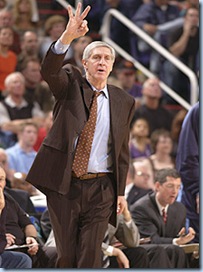
Sloan asks the ref what this symbol means, and why the other team has the ability to make open jumpers . . . while Scott Layden attempts to eat his blue highlighter Forget the scrubs, if there is anywhere that the Jerry Sloan Jazz want you to beat them from it is from the outside. Utah has always seemed like they just wanted to dare other teams into taking outside shots. This strategy may be a remnant from the Sloan's Dick Motta inspired playbook that was created back when teams did not really shoot often from deep, nor did they have players who were good at that. Times have changed and today's NBA features many teams that not only like to take open three point shots, but have multiple threats from downtown. For example, just look at the LA Lakers who have tons of outside shooters (Kobe, Fisher, Sasha, Vlad-Rad, Farmar, Walton, Ariza and even Odom can knock down jumpers), is it any wonder why we lost to them?

Sloan: oh noes! Teams that can make wide open jumpers when no one is even close to defending the open man -- my ONE weakness . . . how did you know?
Photographed by Barry Gossage, NBAE/Getty Images  

The whole three point line thing seems to be just an under-explored and confusing aspect of the game for Sloan (like the concept of the female orgasm in good, old fashioned, 1950's America). Local heartthrob Kyle Korver admits that the Jazz do not have plays in the playbook for a last second three -- or any plays that really have the three point shot in mind at all. (Which explains why our last offensive play of the 2007-2008 season was a sequence of bricked shots, or why Matt Harpring was taking awkward looking, last second mid-range jumpers for us in previous seasons when we needed a bucket.) 

So he doesn't like to double team, which allows for the other teams' best offensive player to go to work and score a lot of points. He also doesn't like the outside shot -- and that would work great if there was a specific code of honor that all coaches lived by: 'I won't use the three point line, and you don't use it either, deal?' Jerry, other teams will take what you give them, and if you give them open looks from deep, they will take those shots and burry us with them. (And have been for seasons) Anything else?

He is pretty old school, and that old-school-ness can work for some players and be absolutely horrible for others. Greg Ostertag was a flawed player, but I have no doubt that if Ostertag had a more touchy-feely coach that he could have been no lesser than a Luc Longley (who was a solid starter), rather than a guy who was dunked on slightly less than Shawn Bradley.

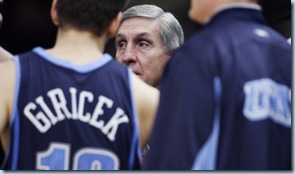
His major pet peeve is perceived effort. Which probably explains why guys like Adam Keefe and Matt Harpring get burn over the more talented, yet apparently less hard working guys like Chris Morris and Gordan Giricek (when he was here). [Btw, look at Giri's career stats, he wasn't a bad player at all, neither was Morris . . . yet look at how they were used in our system. Were they bad players, or just used poorly?] I understand the meritocracy involved in rewarding hard working players with playing time, but what about wins?  Giricek and Sloan never saw eye to eye
  Photographed by Matthias B. Krause/Icon SMI

Chris Morris and Giricek would absolutely smoke Harpring and Keefe in a game of 2-on-2. They were better players, even if Sloan did not treat them as such. Which brings us to how Jerry Sloan . . .

4. Revels in Power Distance:

Jerry Sloan is the boss. His staff knows it. The owner of the team knows it. The media knows it. And most importantly, his players know it. And as far as being the boss, he's far from the most approachable, understanding, and cooperative one around. He takes issue with star player and scrub alike -- he admitted that if you could freeze time during that moment when Stockton got the defensive rebound and threw the football hail marry pass to Malone in the finals for a key bucket in the 4th quarter that he would have liked to strangle Stockton while the ball was in the air. (Really, who says these things, even if they are true?) The issues that he has with players can stem from a lot of root causes: perceived self-worth (Carlos Arroyo), consistent effort (Greg Ostertag), sexual orientation (John Amaechi), degree of free will and autonomy (Gordan Giricek), inability to read minds and/or complete objectives that are never fully explained or consistent from game to game (Andrei Kirilenko).
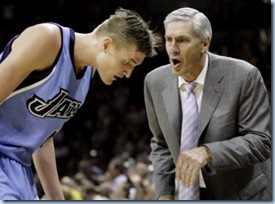
How many times do I have to tell you Andrei? You're only allowed to touch the ball on defense when you get weakside blocked shots because Memo and Booz don't play defense! I freely admit that I'm kind of an AK-47 homer. He used to be 'The Man' and has had to adjust to different roles on the fly -- while getting none of the credit that he deserves from Sloan. One season, he's the Point Forward and earns a trip to the All-Star game. The next, he's a leper. The next, he starts off as a leper, but due to injuries, his role is expanded. (Guess what, he started to play better!) His role has oscillated like a yo-yo for the last couple of seasons depending on roster moves and injuries to other guys. (as has his playing time) He can do everything from get a triple double or 5x5 to play point guard in the Western Conference Playoffs against Baron Davis. It is insane to think that he's not the most versatile and over-all talented player on the team.
Photographed by Matt Slocum, AP Photo  

Deron is the best player, and most consistent. This is not up for debate. Neither should be the fact that Andrei is paid on a scale that only makes sense based on his talent and ability -- and not how he is used or applied. (Who chooses how he is used again? The Head Coach.) As good as Andrei is the last few seasons with Jerry Sloan have pretty much ruined him. It would not surprise me to see Andrei leave the NBA for good after his contract is over and return to his native Russia a hero. Why am I blaming Jerry Sloan?

I'm blaming Sloan because he's the one who should be the guy who helps manage players -- especially players who have changing roles and need to make transitions. Probably no transition is harder to make than from being 'The Man' to being the 5th option on offense, yet the thankless workhorse on defense. Phil Jackson, for all of his smarmy-ness and douche-baggery , has been able to coax nutcases like Dennis Rodman, Bison Dele, Ron Harper, J.R. Rider and others to perform at a high level. Sloan and AK have worked together for 8 or so years now, why does AK still not know what he's supposed to be doing?

Maybe it happens to be because Sloan keeps changing his expectations of him, and due to his power distance, AK is the only one who gets the blame when things go wrong. Other players have long since gotten the boot for getting 'sideways' with Jerry Sloan. (Sloan just knows that AK's defense is so valuable that he can't completely kick him off the team) Personality is a big part of communication, and when you give someone so much power it's hard for their sense of 'right' to not come out in their personality. The psychological aspects of motivation are just as puzzling to Jerry Sloan as the three point shot appears to be. I guess in his hard headed universe (you know, the kind where there is no back up plan for any given game) there is only one way to motivate -- by yelling, swearing and saying mean things. This is probably a contributing factor as to why when AK is taken out of the game he sits as far away from Sloan as possible -- Sloan is just an impossible guy sometimes.

5. Makes mistakes, admits to making mistakes, does not change so mistakes can continue to be made in the future:

Jerry Sloan can be 'like' an abusive spouse in his consistent merry-go-round of making mistakes, admitting to making mistakes, suggesting that changes will be made, but actually no real changes are made, and mistakes continue to occur. How many times do we hear (after a season is over) that "I probably should have played __________ (insert breakout player's name here, some recent examples include Mehmet Okur, Deron Williams, and Ronnie Brewer) more during the season"? Pretty much every season. Memo had a break out year, and Sloan said that it was a mistake to not have played him more. The next season they draft Deron -- and again, Sloan does not play him as much as he should -- only to say that he should have, after the fact. What happens the next season? Ronnie Brewer doesn't play, and after his 2nd season Sloan basically says "My bad" again. And we just eat it up -- our neutral reaction to his maladaptive behavior reinforces his psychopathology.

Sloan is an old dog, and he does not want to learn new tricks. He has shown some improvement over time (that probably only I have noticed), he allows guys like Memo to shoot threes, and is not completely against a guy throwing an alley-oop now and then. (He still may not like it, but he's not going to bench a guy for getting an assist) Unfortunately, the majority of his change seems to occur over a span of 10 games. I don't want to belabor the point but part of the whole AK situation is that Andrei will complain because of how he is used, Sloan and him will talk and Sloan will agree to make changes, the next few games things are better and AK is more productive, then after 10 games or so, things will revert back to normal and the cycle will start again. (Part of the reason why this Sloan/AK deal is less resolved than it should be happens to be because it is never really resolved fully.)
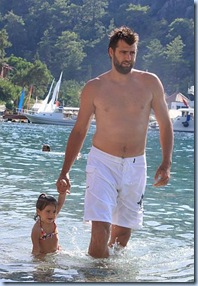
Don't talk to me about Coach Sloan right now, I'm on vacation How many coaches would make a habit of pissing off their best players by not giving them the playing time that their skills deserve? Deron Williams will never fully heal, and while he respects Sloan as a coach (and his Boss), he still isn't shy about admitting that he knows he should have played more as a rookie (you know, the season where everyone was all about Chris Paul, and no one mentioned Deron because he wasn't playing?). I don't know if Memo cares about how he was treated, but the younger guys probably do care (like Brewer, and likely, C.J.). For the record, Deron, Ronnie, Andrei and Memo comprise 80% of the starting line-up. Those are all guys that Sloan has made significant impressions (first or most recent in the case of Andrei) on as 'the guy who is going to be a dick and not play you, even though you are better than the guys who get playing time'. One wonders who the 'next' guy he'll come out and suggest he should have played more will be? My money is on Fesenko, after next season when he starts off averaging 4.3 mpg with the Jazz only to end up being better than Jarron Collins and finally usurp his mpg.
Photo from memo13.com  

Sloan is old school and I appreciate and respect the fact that when he is wrong he is really okay with saying it like it is. He will admit to being wrong in the instances where he understands that he is wrong. (Unlike a guy like Phil Jackson who will make an infinite number of excuses for anything bad that happens, like blaming the physical play of the other team, their fans, injuries, etc) I would appreciate Sloan even more if he actually stuck to fixing the mistakes, even if that would prevent him from admitting to making them in the first place.

Conclusion:

Wow, if you add it all up these 5 errors truly are epic. This is pretty much a negative review of the only coach my team has had for the last 20 seasons . . . so I'm sure it will have to write a piece about the 5 great things that Sloan does. (And there are at least 5 of them) I don't hate Sloan, but that does not mean that I'm blind to the faults that he does have. I try to be objective on this regard. I think that there is room for improvement (and his staff helps out with this), and I do not know which coach I'd rather have take over my team if you gave me the choice to do so this moment. (Maybe years down the line after Phil Johnson says 'no thanks' I'd be okay with Ty stepping up) All coaches have their flaws, I'm just more intimately aware of Sloan's because I've been an obsessive Jazz fan for the over 60% of my life.

Tuesday, September 2, 2008

Depth Perception: Power Forwards Poll Results

A long time ago, in a galaxy far, far away I wrote about the state of the Power Forward position in the NBA. From that article I chose six crews (one for each division) who were the best in the NBA at covering the 4 spot. I asked you (the readers) to vote, and this is how it turned out:

Team Players         % of votes
det_50px_080328  Rasheed Wallace Jason Maxiell Antonio McDyess Amir Johnson Walter Herrmann 10%
lal_50px_080328  Pau Gasol Lamar Odom Vladimir Radmanovic Luke Walton Josh Powell 11%
mia_50px_080328  Shawn Marion Udonis Haslem Michael Beasley Joel Anthony David Padgett 1%
sas_50px_080328  Tim Duncan Kurt Thomas Matt Bonner Ian Mahinmi Anthony Tolliver 0%
tor_50px_080328  Chris Bosh Jermaine O'Neal Andrea Bargnani Kris Humphries Nathan Jawai 28%
uta_50px_080328  Carlos Boozer Mehmet Okur Andrei Kirilenko Paul Millsap Kosta Koufos 48%

Frankly I'm surprised that Utah got so many votes while Miami and San Antonio got so few. (Isn't Duncan the best PF of all time, according to some? And isn't Beasley supposed to be super awesome?) I think Detroit should have gotten more votes than the Lakers as well. Toronto is very solid, but in the end, I'm happy that Utah won. After all, they are the only squad who has 3 (at some point) All-Stars to throw at the 4 -- and then bring a guy like Millsap in the mix after that.

Also -- if you don't like my low resolution team logo images then make a suggestion on where to get better ones that don't break copywrite laws!