Showing posts with label Mark Eaton. Show all posts

Saturday, July 18, 2009

These aren’t John Hollinger’s dad’s statistics

Okay, I love direct observational research as much as the other guy, but as someone firmly rooted in the sciences (aka. wasting my life in college and beyond), I love quantifiable results. As a result, I find that statistics are vital towards observing, categorizing and understanding the environment that we inhabit (and share with other organisms). Stats are awesome, and I love them (I got 98% in stats in university) . Though, I know that stats can be manipulated and abused – furthermore, statistics do not fully explain the entire situation, nor do sufficient statistics exist that can approach a full knowledge of a hybrid (not just numerical) system.

We can attempt to use statistics to better understand basketball – and as a fan, and non-paid analyst, I’m not alone in this point of view (just check out the Wages of Wins sometime). That said, the statistics that we currently have in basketball are not complete. No current stats exist to fully describe all possible positive actions on the court (e.g. there’s no stat for a defender breaking / slipping a screen and staying on his man, despite the set play run by the offense). Also, some stats that would be useful are just not recorded in the NBA (e.g. in the Adriatic league their stats also include things like how many times a player has their shot blocked, or how many times a player draws a foul – don’t you want to know how many times Dirk gets stuffed, or how many fouls Shaq drew per game during his peak?).

Right now there aren’t enough stats to fully map out good play, and some of the stats that we do have appear to mean more than they actually do! A steal means that a defender has disrupted the offense to the point that a turnover has occurred – many guards and swingmen get steals. The bigman analog has always been blocks, but the most important part of the steal (aka, the change of actual possession of the ball) is lost in a block. Often a blocked shot prevents a made basket, but does not always give possession back to the defending side. In effect, a blocked shot that still gives the ball back to the offense is no better than a defender causing a deflection of a pass where the ball goes out of bounds – and the offensive team retains possession.

Deflections are the most important stat that continues to not be officially counted by the NBA; on one hand it would be difficult to adjudicate (when is it a block? when is it a deflection?), but on the other hand, deflections often lead to other stats. The guy who picks up a ball that’s deflected out of the hand of the ball carrier is rewarded with a steal – but the guy who got the ball out of the ball carrier’s hand (the deflector) doesn’t get credited for causing the play. I think that’s kind of unfair.

In fact the guy who defends well frequently gets jobbed out of a good stat. For years I’ve seen a solid defensive play in the paint by a center (straight up single coverage that results in his man taking a shot – and missing) be recorded as a GREAT defensive board by the power forward (who wasn’t defending anyone, he just happened to get the rebound off of someone else's good defense). I’ve seen this happen on all levels of play. If anything, it prove the limitations of stats, and the limitations of the stats to accurately reward defense.

It’s no secret that defense is way harder to grade by using stats alone. Firstly, there are not enough defensive stats (like the guy who can navigate through a number screens and gets back in time to contest/change a shot gets the same amount of stats as another play who doesn’t even go through the screens and lets his man take an open jumper), and secondly, the stats that do exist do not always mean great defense. A very quick guy like Allen Iverson spent years on the court playing in the passing lanes. This is him gambling on defense to get steals. It’s exciting when a guy does get those break away steals in the game – but it’s not sound, fundamental man defense. Really, this play is sorely discouraged in the case where there isn’t a big shot blocker in the paint to clean up any mess that an unguarded PG getting into the paint can cause.

I know – I’ve seen John Stockton make these same type of ‘Defensive Back’ style steals because he had big Mark Eaton (two time defensive player of the year – once had close to 500 blocks in a season) watching his back. Iverson had the same with Theo Ratliff and Dikembe Mutombo. Chris Paul is another player who benefits from being backed up by shot blocking force of nature Tyson Chandler. If guys like Stockton, Iverson and Paul had Mehmet Okur and Jarron Collins laying down the law in the paint behind them you can be sure that the head coach would have told them to defend their man more, and gamble on defense less.

Over the years I’ve been lucky enough to coach some basketball on the youth developmental level. We tried to go past the lack of collected stats on defense in order to quantify good play on both sides of the ball. An attempt was made to count the number of times the player defending a shooter resulted in that shooter missing. Other times we tried to record good traps on the ball carrier, or how many times the defender harassed the ball handler into turning the ball over. These types of things can be recorded but by far the best defense I’ve ever seen on any level is that where the man being defended does not ever get the ball, entry passes are denied, position is denied, and when he does get the ball – he’s in such a disadvantageous point that he cannot positively help his team when he has the ball. You know what kind of stats that guy gets – for playing the best defense? He gets nothing for it. There is no reward for him that shows up on the boxcore – and this is a failure in terms of statistics being used to categorize and enumerate good play in a game. But if he manages to tip an errantly passed ball that he forces the guy he’s defending into attempting(because he can’t shoot it where he is), the team mate who picks up the ball gets credited for a steal.

Oh yeah, that’s basically it for defense in the NBA, I talked about the fallacy that defensive boards is akin to good defense, I talked about how blocks may stop a shot, but do not give you possession of the ball all that time, and I talked about how steals can be indicative of poor defense, not good defense. (Of course, exceptions to these rules always exist – it is good defense to control a tough defensive rebound that’s contested, or to block a shot to a team mate, or to single handedly strip a guy that  you are defending. But let’s not forget that these instances of good defense are counted just as much as the same stats that are products of situational defense. A ball that rolls do you on defense counts just like a ball that you fought for.)

The long and short of it is that we need more stats – especially on defense. If you’ve read this far down then you are awesome . . . because I’ve tried to make some ‘new’ stats. Some people are good enough for simple points, rebounds, assists, steals and blocks. That’s fine for a casual fantasy basketball league . . . but not good enough if you really watch the game like your life depends on it. I wish there were more stats, and more ways to reward good play – but right now the NBA does not appear to give us things like that (instead the +/- stat is thrown to us, like it means anything). Anyway, I’ve tried to make some new stats and here are five calculations that you can even do at home (studio audience of old ladies says ‘ooooohh’, already put in a receptive mood because of the deal that they got on that juicer they just purchased):

1. Defensive Gambling (DG): This stat is pretty easy – I try to recognize that some of the stats that people get on defense are related to gambling on some level. (Gambling in a passing lane, gambling by leaving your man to get a weak side shot block, gambling by trying to strip a man when the ref is right there, and so forth) We already had blocks and steals . . . but they exist in a world without accumulated risks. The risk here, of course, exists as a foul being called – another stat that we already have. The fun part is balancing the risks vs. the rewards.

The Foul is the base for this equation – as it means that you tried a risky move and you got burned. Not only do you have a penalty against you, but it directly benefits the offensive team. A steal, on the other hand, is a situation where a player takes a risk, is rewarded – and the offensive team is directly disadvantaged. When a team misses a three pointer and the opposing team gets the ball and scores a layup that is a 5 point swing. A steal does not directly mean you gain points, but you directly prevent the chance of points – it’s not a 5 point swing, but it’s a possession swing. I say that this is worth 1.5 fouls, in terms of risk/reward. A block does not guarantee such a similar swing in terms of possession (it does sometimes though), but while a steal only prevents the potential of a shot being taken, a block directly affects shots that are taken. (It’s a shame there’s no stat for shots changed, because a good shot blocker has an aura that surrounds him that changes many shots – for example when players started to scout Kirilenko his blocks went way down . . . but he was changing the same number of net shots as guys changed their shots to avoid getting blocked by him) A block, then, is not as good as a steal, but it’s still good – a block is equal to 1.3 fouls. The full equation for Defensive Gambling is as follows:

Stat Formula -- Defensive Gambling
Clean block on Kobe - the Ultimate Risk vs Reward

Example: In 2003-2004 Andrei Kirilekno was healthy (at this point in his career, he had played in 240 of a total possible 246 games), getting playing time (37.1 mpg), and happy. That season Andrei had 215 blocked shots and 150 steals against 174 fouls. His Defensive Gambling score was astronomical that season.

DG = [ ( 215 * 1.3) + (150 * 1.5) ] / 174

DG = [ 279.5 + 225 ] / 174

DG = 3.002893563

So that means that Andrei was gambling at a very fortuitous rate – he’d get away with gambling three times before he would get burned once. If you extrapolate that to how many fouls he averaged per game that season you can see that he was doing something right with all that time on the court. Because the haters probably want to know, Andrei’s career average DG score is 2.25. For a point of reference, Scottie Pippen’s career DG score is 1.41 – and Pip is the prototypical wing defender who made 10 All-Defensive teams in his career. Pippen had way more steals, but he took way too many poor gambles as well. Pippen has 6 seasons where he’s averaged greater than 3 fouls per game. Andrei has none in his career. So put that in your pipe and smoke it!

Clearly looking at things like blocks and steals on their own gives a skewed view of the world – putting it against a risk/reward system is a better frame of reference that we can use to see which players make smart gambles, and which ones do not. Andrei – for all his faults – has a good Defensive Gambling ability if you ask me.

2. Pure Hustle (PH): Pure hustle builds off of the Defensive Gambling equation, but adds more chances for risks and more chances for rewards. Here we see Blocks, Steals and Offensive Rebounds go against Turnovers and Persona Fouls. The common factor for hustle is a turn over. It’s the most benign result of hustle. Too much hustle can result in a foul – which hurts you and your team. This is why a foul is worth more. On the good side of things, hustle can result in good defense, or a second effort (or third, or fourth) on offense. We all remember Tayshawn Prince robbing Reggie Miller with a game winning block. We should all remember Bird stealing the inbounds from Isiah. And we all know that second chance shots can not only allow you to score from an advantageous position – but also result in scores themselves. This is why I think when it comes to hustle, Offensive Rebounds are worth the most, with Blocks and Steals being on equal footing with fouls.

Stat Formula -- Pure Hustle

Hustle before he went crazy

Example: When people think of hustle they are apt to think of garbage guys who don’t have much skill. That type of scrappy play can result in solid contributions for a team, but I think hustle is more than just effort. Hustle is assisted by skill and psychology. It is a risk/reward equation after all – if you go all out all the time you’re just going to pick up fouls. You have to know when to go all out, and when to hold back. Many people hated him, but no one could deny the Pure Hustle of Dennis Rodman. Rodman has 4329 career Offensive Rebounds, 611 career Steals and 531 career Blocks. They aren’t the best numbers around, but when you input them with his 1481 career turnovers and 2843 career fouls he manages a Pure Hustle rating of 1.80.

This may not look like much, but for a frame of reference, Paul Millsap (what most current Jazz fans think Pure Hustle is all about) has managed a career Pure Hustle value of 1.24. So if Paul Millsap is giving 110% out there, Dennis Rodman is giving 155% out there.

 3. Shooting Worth (SW): This is an easy one, because it already exists on many website by it’s other name “Points per Shot” (PPS). It’s just how many total points you get (including free throws) divided by the number of shots (FGA) you take. Sure, there’s some points that may be unrepresented by FGA (like technical fouls, or being in the bonus), but the fact that the player is involved in those free throws is a benefit that they get for being good shooters. The idea is that if you take a shot it’s worth two points, right? Well, that doesn’t always work out in the PROs, and the league average (or mean for all player data) is 1.22. [Yes, I looked at every shot in the L last year on ESPN.com] So, in effect, you have a positive Shooting Worth if you are better than average, and have a SW greater than 1.22 – of course, you can still be good at your job if you have a lower value; you’d just be below league average. That’s the crux of this statistic – it seems to display individuals who take good shots, and this stat can be used to better differentiate between guys who score a high ppg who take good shots, or the guys who shoot a lot in order to get good stats.

Stat Formula -- Shooting Worth
Superstar or Average shooter?

Example: Allen Iverson has been a phenomenal scorer in his career. He’s averaged over 30 ppg on four separate occasions, and even with his no-show last year his career average is still 27.1 ppg. That’s a really great average, but how does that really stack up against a guy who averages something similar, but shoots much better than 42.5 fg%? Well, when you input Iverson's 23983 total career points over his 19,590 total shots you see that his actual Shooting Worth is 1.22 – which is exactly average. He’s not a “better” scorer than some of his contemporaries, he’s just a volume scorer. Karl Malone only has a career scoring average that’s in the 25 points per game range – but unlike Ivey, Karl was much better than average when it came to the quality of his shots; Karl’s Shooting Worth was 1.41 (better than lots of other known scorers like Kobe, Jerry West and Glen Rice, to name a few). From this we can conclude that a shot by Allen Iverson was, in effect, worth less than a shot by Karl – Karl was taking better shots.

 4. Shot Frequency (SF): Some websites try to find out often a player shoots and they represent it by the number of shots / value of time (usually minutes). I don’t know what 0.282 shots looks like, so that representation means little to me. I would rather look at the same data in another way, namely, how many minutes of burn does a player need before he jacks up a shot. Some guys start shooting the ball as soon as they are on the court, while others spend a lot of time on the court – but don’t shoot the ball. In effect, this stat (Shot Frequency) will be able to identify if a certain player is gun shy to a fault (some would say that John Stockton was) or a pure, unashamed jacker of shots (too many to name). In this case, the lower the number means a higher frequency of shots . . . because the number represented is the time needed on the floor between shots. To find this out we divide the total minutes played by the number of Field Goals attempted (FGA).

Stat Formula -- Shot Frequency
Iverson really shoots a lot

Example: Let’s continue talking about Iverson here. Most of his life he’s been the first option on offense … a guy that the rest of the team made way for. As a result, he spent a lot of his career shooting the ball. How often does he shoot? Well, he’s played in 36719 minutes and taken 19690 total field goal attempts in that time. If you input the data it reveals that Allen Iverson, for his career, will shot the ball once every 1.865 minutes he’s on the floor. To be honest, this is the highest frequency I’ve seen in all my months ‘beta testing’ these statistics. 1.865 minutes is every 1:52 of actual game time. So that means if he plays 35 minutes in a game he’ll shoot the ball nearly 19 times. For a point of reference another Hall of Fame type “point guard” is John Stockton, who shot the ball once every 3.497 minutes (once ever 3:30 of game time). If given the same amount of time (35 minutes), Stockton would shoot the ball 10 times. (Really, 10 times, 10.008 is pretty darn accurate!) That’s almost half as many shots as Iverson . . . and effectively, half as frequent.

This statistic helps us understand which guys really shoot the ball the most, and most likely, are the primary offensive options for any given team. (Though, some anomalies exist, like Matt Harpring who shoots the ball very frequently for a guy with his skills – he shot the ball more often than some guys who started over him during his career)

Gestalt Offense (GO): This is the biggie. I’ve fretted over this for days and days and finally am prepared to release it upon an unwitting population. It’s not perfect, and it seems to only work best with larger sample sizes (a seasons’ worth of data, or a road trip, may look fine – any singular game can break it). It really favors guards and only really works best for players who played in a modern-ish era (one where turnovers, offensive rebounds and other similar statistics were actually recorded). The basis for this was to isolate how much pressure certain players could place on the defense. What a player does on offense (when it comes to stats) can be either one of five things: he can assist on a score, he can get to the foul line, he can take a shot, he can be called for a turn over, or he can grab and offensive rebound. There are no stats for setting solid screens, or anything like the ‘hockey assist’ right now with how the stats are kept. So the statistic is already limited, but I try to do the best with the data that I have. Essentially the GO Rating is the summation of a player’s modified assists, free throw opportunities, offensive rebounding ability, penchant for scoring against their turnovers, all over the number of games a player has played:

Stat Formula -- Gestalt Offense (simple)

Of course, it’s a lot more complicated than that . . .

Stat Formula -- Gestalt Offense (assists)

The first, and most straight forward, part of the equation is assists. This equation not only values assists higher than their normal value ( 2.23 > 1, after all), but it also serves to give a bonus to good passers, and penalize poor passers. (Good or poor depending on if they have a high Assist to Turnover Ratio) The first standard value here is 2.23. Where did this value come from? Well, it’s the true value of an assist when you balance it for the ratio of assisted 2PTFG vs. 3PTFG. (According to the stats on ESPN.com, where all the major stats came from, aside from archived player stats from Basketball-Reference.com) The second standard number is 1.48, this is the mean Assist to Turnover ratio for teams in the NBA. (Room for improvement exists here if I could actually find the mean Assist to Turnover ratio for the players)

As it stands how good you are at passing (vs. turning it over) affects how many total points you get from this category. After all, Tim Hardaway may be able to get you 37 assists on a road trip, but those 37 assists would be better than 37 assists from Alonzo Mourning because Zo would pick up quite a few more turnovers along the way.

Stat Formula -- Gestalt Offense (free throws)

Free throws are simple enough to understand now that we’ve gone through assists. Here we don’t look at how many free throws an individual has made, as the point of the GO rating was to see the type of pressure that an offensive player puts on the defense. Instead the focus is to see how many free throw attempts the player gets. Of course the catch is that value for FGA is modified by how good a shooter you are compared to the league average (which is 77%). A guy like José Manuel Calderón may only go to the line half the time as someone like Shaq – but Shaq is below average and Jose above average to the point that the difference in points from this category are not as large as we would think.

Again, like in assists, it’s a bonus to good shooters and penalty to those who are not so hot from the line. In effect, you want your best free throw shooters at the line, their FTA are then worth more than that of guys who do not go to the line with as much confidence as they do.

Stat Formula -- Gestalt Offense (offensive rebounds)

Rebounding is easy. I figured that in the grand scheme of things, an Offensive Rebound is worth 1.16 points. I based this on how a Turnover is 1.3 points (see below), how an assist is 2.23 points and how points are worth, well, points. This is a modifier.

The second modifier is similar to previous categories. Before we looked at if the player was better than average at Assist to turnover ratio, and then how they fared in FT% against the mean. Here we see that 26.73% of the total rebounds in the NBA were offensive rebounds. If you are a better than average offensive rebounder then you get a bonus here, if you are worse, then you get a negative modifier (as seen as a number less than 1.0, but not a negative number, per se). This part of the equation really seems to get broken if used on Charles Barkley (who, if you look at just one game, would get some crazy number of points in this section because he had 11 offensive rebounds and 5 defensive ones). Thankfully this section self-neuters itself if you have zero offensive rebounds.

Stat Formula -- Gestalt Offense (shooting)

Man, where do I begin with this one? Well, we went over Shot Frequency already. We divide 33.6 (representing 33.6 minutes of action for an elite player) by the player’s own Shot Frequency. This tells us how many shots he will put up if given Starter type of minutes.

The next step is adding 1 to the Effective Field Goal Percentage (eFG%). This is so that we get a positive value with the percentage when multiplied. Why use eFG% instead of just regular FG%? Well, eFG% adds into account three point shots, and the higher degree of difficulty of shooting from that distance. (For more info on eFG% click here) This step tries to even things out a bit.

The third part is how the player’s Shot Worth (also described earlier) rates compared to the league average for Shot Worth (or PPS). If you are Malone-like, you get a nice bonus here, if you are Iverson-like, you don’t get a bonus, and if you are really poor, then you get a penalty.

The last part is the total points scored by the individual, divided by 10. Ten was one of the first numbers I used that seemed to make things work out when I was fiddling around. I don’t know if this last section of the Shooting section is legit or not yet, I remember when I tried this out without the last part that individuals would be getting very little from this part of the equation. At some stage you have to factor in how many points a guys scores, even if you are looking are how well they shoot.

Stat Formula -- Gestalt Offense (turnovers)

Uhhhh, so this is very easy to understand. I’m not going to mention anything more than that this value is subtracted from the rest of the section values in the numerator. Don’t forget to divide everything by the total number of games, ya here!

Man, I’m super duper tired, so I’m just going to go ahead and post this. Give me feedback, tell me I’m crazy and set me straight. I think we need mores stats, and unfortunately, the lack of defensive categories means I can’t make a Defensive GO rating type of stat. I’m open to changing my formulas and re-working things. If you want I can e-mail you the spread sheet that contains the Macro that calculates these new stats. (I got really sick and tired of calculating the GO Rating by hand with pen and paper.)

I will probably make another post on the Go Rating in the future, filled with examples of players, and how they rated. So far I’ve seen that eFG%, Total Points, Assist to turnover ratio and a few other factors really seem to hinder bigmen, while giving guards and other wing players a boost. For the record, Magic Johnson’s GO Rating is 102.241, and he is the gold standard . . . some guys score higher than he does, while others politely fall into place. (Jordan is at 120, Karl Malone at 83, and so forth.)

Tuesday, October 21, 2008

YouTube Tuesdays! Mark Eaton throws it down!

Mark Eaton on Mychal Thompson (1988) [0:49] -- Uploaded by HRE:

The ridiculous part of this whole Stockton / Eaton pick and roll that results in an "and 1" for Mark Eaton is that I remember watching this on TV when it happened way back when.

It happened back in 1987-1988 and man, Stockton could really lead a guy with his passes. Enjoy this facial by Eaton on Mychal Thompson.

What a trip down memory lane. Karl Malone approves.

Things to look for this season: Matt Harpring

Love him or hate him, we can all be pretty secure in the knowledge that when (not "if") Matt gets back off the IR, that he's going to play at least 10 mpg at small forward for the rest of the season [Unless Ceejay levels up a few times while Matty is out and becomes a real NBA Starter, of course, but I'm not going to hold my breath]. I could go on and make this a very short post, but I think Matty deserves better.

Like so many other players (Mark Eaton, Thurl Bailey, Jeff Malone, David Benoit, Donyell Marshall, etc), his best years were playing off of Stockton and Malone -- but those years were almost a lifetime ago. In my mind he is now probably best suited as a 'life coach' for our younger players . . . if they could adopt his work ethic then I think we'll be sitting pretty at the center spot in a few seasons. That said: he is still useful on the court.

Before you leave this website forever let me further explain what I mean.

Harpring is a physical three who rebounds well for his position and doesn't back down from anyone. In recent seasons he's been a thorn in the side of everyone from Carmelo Anthony to Ron Artest. Guys like Korver, Miles and Almond are just not going to be able to make Ron Artest get ejected or take 'Melo out of his game. He's useful in specific situations, especially because we do not have anyone who can replace what he gives on the 'toughness' angle just yet. [I highly recommend this uploaded video by xunlucky17x]

Harpring elevates for his patented missed field goal shot

That does not mean I think he needs to be playing big minutes, but he's a special type of player that is useful in certain situations. He's like your 2nd string fullback in American football -- he may not be the starter, or useful in all situations, but on a 3rd and short he's going to get the job done. If you put Harp out there to muscle up against another physical small forward then he is actually useful.

If the other team isn't using a physical small forward then don't put Harpring in the game. Simple as that. Why? Well, for starters: statistically he is getting worse, his shooting range seems to be positively correlated with my shrinking hair line. Back in the early 2000's Harpring could hit threes and I had a full head of hair. Now Harpring misses layups and I have to comb my hair down. It's a sad time for both of us. You don't want to have Harpring on the floor unless you really need to have him on the floor. (Especially when we're close to a title and need to have our younger guys be developed now rather than later) If you need any other reason why you don't want him on the floor just ask yourself if you think Harpring is quick enough to defend any perimeter small forwards any more. The answer is, of course, no.

Harpring is still one of the few tough guys our team has Matt Harpring Games and Playing time

Harp will not let go of playing time without a fight, just like he wont let go of this ball unless he gets to keep Luke Ridnour's forearm as a prize.

Click on the image to make it bigger

Here's a chart that (tries to) depict how many games Matty has played in each of the 6 seasons that he's been with the Utah Jazz. [This is the dark blue bar] This chart also (tries to) depict how many minutes he plays per game.[This is the light blue bar] As you can see he usually plays over 70 games per season (he has averaged 75.5 games per season in the last four seasons). He played 36.6 minutes per game back in 2003-2004 -- his most as a Jazz player -- but since then there's been quite a decline which corresponds with accumulated injuries and advancing age.

If you've done the math (and I have, if you want I can e-mail you the spread sheet) over the last four seasons (from age 28 to 31) his minutes per game has been going down by (on average) 4.625 mpg in each successive season. [Data: -3.5 between 2002-2003 and 2003-2004; -5.7 between 2003-2004 and 2004-2005; -1.9 between 2004-2005 and 2005-2006; and -7.4 between 2006-2007 and last season, 2007-2008] For you math geeks out there who remember their y=mx +b and slope = y2-y1 / x2-x1 formulas the average rate of declined MPG (in this case, -4.625) is also equal to the slope if you use the points (2, 36.6) and (6, 18.1).

If you extrapolate this to the next season, this current season (2008-2009), then you get 18.1 - 4.625 . . . or 13.475 mpg. I could live with Harpring playing 13.5 mpg this season, I'd be happier with 12, but I'll take what I can get. It remains to be seen if his playing time decline is going to be so linear . . . he may very well just play in under 70 games this season, but in those games play closer to 20 mpg for all I know. All of this gobble-dee-gook aside, what three things can we look for this season from Matt Harpring?

  1. He's not going to be rushed back: The Jazz have enough wings to weather the storm until he comes back to "anchor" the 2nd unit with his veteran play. (Anchor, as in, he brings the play down, check out his +/- stats sometime, 4th worst on the team last season) In as way, his injury has come at a good time when Sloan is more open to trying out different line-ups and open to developing his young talent. We've already seen C.J. Miles take the starting role while AK supplants Harpring and the key bench veteran. Matt Harpring's current injury is the main reason why Jerry Sloan has had to change up the line up this off-season. (Sure, Deron's injury is an acute issue right now, but the line up was changed before he got injured) You can be sure that when he comes back that Jerry Sloan will shuffle things all over again. Right now AK is being put in the veteran off the bench role that our second unit really needs for stability. This is usually Harpring's role, and I can easily see Jerry Sloan immediately revert to putting AK at the 3 in the starting line up after Harpring is back. Though, Jerry does some funny things time to time, like how in 2005-2006 to finish the season Memo was the starting 4, and Carlos was the 5, because Memo had been playing the 4 most of the season while Carlos was on the injured reserve. I can't really predict what's going to happen when Harpring gets back, but I know that he's going to play. He's not going to give up playing time without a fight either. Thankfully, there is no current time table for his return, so we're not going to see him for a while.
  2. Frustrate the fans: Some fans are going to complain that when he comes back that he still plays too many minutes. Some will complain that he's not playing enough and that "we need his _____" (defense, rebounding, toughness, scoring, veteran play, hustle, flops, crew cut, fouls, whiteness ?). Both sides are not going to be placated until he retires from the NBA and joins the Georgia High school Football Hall of Fame. (Apparently there is such a thing, and here's Harpring's high school team's record) He's one of the most divisive players in Utah Jazz history, and part of the reason stems from the fact that many fans would rather develop his eventual replacement instead of keep giving a guy all these minutes as he breaks down every season. (Jazz career average for games played per season: 68.5) He's injured right now, and there's no time table for his return -- so the "sit Harpring" contingent will have an undisclosed amount of time to sit Harpring all they want. To be clear, I think I fall neatly in that contingent as well, but I don't think that it's time to take him out behind the barn and shoot him yet. (That's next season...)
  3. Continue to play physical, smash-mouth basketball: If the Jazz are in the playoffs, he is going to play in them. I don't know when his immune system is going to be back online, but I can empathize with him as I've been a little sick lately. When he does come back, I feel bad for the forwards that'll match up with him when he's finally been given the green light to play at full velocity. (Speed just isn't a strong enough word to describe his game) He only knows how to play the game one way, and you can be sure that he'll be a force to be reckoned with when he's on the court this season. (Just a force for which team, ours or theirs, remains to be seen) If we have to face a team with a physical small forward in the playoffs I can see him getting a lot more burn than 10-14 mpg like he will this regular season. I'm pretty sure that he can rattle a guy like Artest if they face off against each other in the playoffs.

I don't know when he's going to play for us, but it's a safe bet that the Jazz may start off by watching his minutes very closely. This may contribute to continuing a downward trend in minutes played per game for Matt, and as a 32 year old with the knees of a 45 year old, I'm sure his body (if not his mind) will appreciate it. Now only if he can continue to teach the younglings (Kosta and Kyrylo) how to throw their body around and play physical like he has all these years . . .

Sunday, October 5, 2008

Things to look for this season: Kyrylo Fesenko

If the only news you get is from the major news outlets in Salt Lake City you get the impression that NBA MVP Kosta Koufos (tentative) is not only the best draft pick EVAR, but also a lovely boy scout! The articles I read leave me to believe that some reporters are crushing a little bit on him . . . I understand the need and utility of a fluff piece (most of my stuff is just that). But even I can't stand it. That's not to say that I have issue with Kosta Koufos -- it just appears that way because in a preview of Fesenko's next season all I've done in rant about the new guy. It's just that fluff pieces, saying 'sir' and shooting three pointers when you are over 7 feet tall HARDLY qualifies as helping the Jazz out on the glass; with blocks; and with interior defense and intimidation.

How is a 7 foot tall teen with pimples/boy scout/three point shooter who calls everyone 'sir' going to be a force in the paint and help out our anemic defense of our basket? It's almost as if winning the paint is less important than winning some magical award for having 'morally upright' kids on the team who help old ladies cross the street.

Melissa Majchrzak -- now picture yourself floating in water, surrounded by seahorses . . .

That's not going to help us block shots in the playoffs, or play defense against other bigs without fouling them. We don't need another soft guy to come off the bench to replace Boozer or Memo. We need someone hard and mean. Someone who eats old ladies who try to cross the street. Someone -- at this stage -- that I don't think Mr.Polite Koufos is, or will be. Don't get me wrong, I want Kosta to succeed, I want him to be a legit NBA player. I think Kosta is going to be a solid NBA player. I also want the Jazz to have someone come off the bench, and actually play like a 7 footer who bangs, blocks shots and gives hard fouls. You know, things that we don't have on this team right now. I don't think that Kosta fills our greatest need.

Somehow this pictures reminds me of that scene from Napoleon Dynamite where Deb is photographing Uncle Rico . . . audio here  

Alas, no one seems to say anything good about Fesenko, so perhaps he's not going to be that guy either -- which would suck, seeing how at this part of the season, last season, everyone was on the Fes bandwaggon. (How quickly people turn on you . . . not unlike how Boozer was loved then hated, then loved, and now hated again)

So, in a world where we must temper our feelings for Fes, while our projections for Kosta run with wild abandon what do I see Kyrylo doing this season?

  1. Make the best of his time on the floor with the Jazz: Fes isn't going to play in 70 games this season unless something amazing happens (like Jarron Collins goes all Bison Dele on the Jazz, or Fes levels up into an NBA player at some point), so he's going to have to really bring it when he is playing with the big boys. I can imagine how someone who has trouble self-motivating can slack off in the D-league, he still put up good stats (10 ppg, 8 rpg, 2 bpg, 2 apg) for someone they just pulled off of the hard streets of Kiev. His NBA career is only 9 games long, and he's only played more than 10 minutes in any given game on three different occasions. His season averages are horrible because he played three times this season: once in November, then during a stretch of 6 games in December (the worst month of the season for our entire team), and then in a back-to-back set all the way in March. There isn't much continuity there, especially how he'd get into the game for 4 minutes there, or 36 seconds there ... all the while dropping his averages down. If you look at the four games where he played at least 8 minutes you get a chance to see some good in Fes. First of all, when he plays extended minutes the Jazz usually win (3 wins, 1 loss), in addition to that, he seems to play better when he actually has some time to settle down into a game. During those four games (Nov 30 vs. Lakers, a win; Dec 15 vs. Seattle, a win; Dec 17 vs. Atlanta, a loss; Dec 21 vs. Orlando, a win) he averaged 4.3 rpg (2.3 offensive), 0.75 bpg, 0.5 apg and 3.5 fpg in a little over 12 mpg. He also chipped in 2 ppg, but he hardly shoots, and that's not what he's in there for. Fes can be effective, against Bynum he had 7 boards (4 offensive) and threw it down a few times.
  2. Corner the market on a skill: Fes isn't going to be better than Memo or Kosta at jump shooting. He's not going to be better than Jarron at flopping, or knowing the playbook (he hasn't been here for 73 seasons like Jarron has). Fes has to develop that one (or more) skill that sets him apart from the other guys on the roster. He has to be so proficient with it that the Jazz coaches feel good with him on the floor, instead of on the bench. That skill is going to have to be dominating the paint. Fesenko has the size, strength and agility to dispel the common ideas of European bigmen. While he may lack it in the girth department, he does have Shaq-like size. He can run the floor and play physical basketball. He can rebound and block shots. He just needs to keep working on this part of his game to the point where even old man Jer (who always comments on peoples' conditioning . . . hey, Shaq sucked at conditioning Jerry, he has 4 rings and you have none, sometimes talent requires playing time) has to play him. No one needs Fesenko to be David Robinson on offense, just as long as he can catch the ball and dunk it then he'll be okay. (And last time I checked, Fes and catch the ball and dunk it, ask the Lakers about that) Conditioning is good and great, but we're looking for a guy to lumber up and down the floor for 12 mpg as a backup to Memo/Booz (who'll play most of the mins at the 5 this season). I'd rather have the guy who barely makes it through 12 mins, but actually does something in that time than the guy who plays 12, has the conditioning to play 22, but does nothing in that time.
  3. Want it more: Often a big guy gets conscripted into playing basketball just because of his height. (see: Eaton, Mark) After a while he either loves the game and wants to be better, or he's just happy to make money doing something like this. Kyrylo needs to want it more, or at least, show that he does. (He may want it, but may not show it for a variety of reasons, but we don't need to go into psychology here) Who he is, and his future with the jazz may very well boil down to what happens this season, especially in relation to the wunderkid Kosta Koufos. Fesenko has to want it more, as he has an uphill battle against him where he not only has to beat out Koufos, but also a conditioning obsessed Coach (you know, Adam Keefe plays 27 mpg while Chris Morris sits) and a media that idolizes his competition as well.

Friday, September 26, 2008

Flashback Friday: The 1988-1989 Utah Jazz

This 1988-1989 Utah Jazz team is historic for a variety of reasons. First of all, this team was the first in franchise history to win 50 or more games in a season. (They would win 51, a mark that the Jazz have equaled or bested 12 times since then) Second, they featured a 25 year old Karl "The Mailman" Malone who was coming into his own.

Bigger, Stronger, and Faster than Amare Stoudemire

[Tangent Alert: I hate all the hype Amare gets, if dude is so good and a beast why isn't he scoring 30 a game like Karl did? Karl Malone >>>>> Amare Stoudemire. For the record, all Karl did that season was score 29.1 ppg (51.9 fg%), go to the free throw line 11.5 times a game, average 10.7 rpg, 2.7 apg, 1.8 spg and 0.9 bpg. What did the "Beast" Amare do at the age of 25? He got 25.2 ppg, 9.1 rpg, 1.5 apg, 0.8 spg and 2.1 bpg.

Amare didn't even get to the FT line 10 times a game, or ever has in his 6 year career, Malone did it 3 times in his first 6 years alone.

Karl even shot better from the three that season (5-16 [31.3%] to Amare's 5-31 [16.1%])! So aside from blocks, his age 25 stats are owned by Malone at 25. And as for blocks . . . Karl was playing with Mark Eaton who sent back 3.8 shots a game "so yeah . . . think about it!" (read the 3rd one on that page to get this joke)]

Back to that Jazz team . . . aside from Malone becoming a force of nature, he also had some help from Eaton (previously mentioned as blocking 3.8 shots a game, but also getting 10.3 rpg on his own on his way towards being named and All-Star and the Defensive Player of the Year); Thurl Bailey chipped in 19.5 ppg, 5.5 rpg and 1.1 bpg; Griffith kept people honest on defense with his outside shooting (61 3pt made in an era where that would be one of the top totals for any player) . . . and this John Stockton guy had one of his several seasons that are arguably better than Steve Nash's MVP seasons. John would finish up with 1118 assists that season, a pretty average output for him, but still 221 more than Nash's best ever season. [I guess the whole Stockton vs. Nash thing is another tangent altogether . . . so just click here if you want to read an empirical analysis of their recorded effect on the game.] This season was also the last for Frank Layden, who would give the coaching job to Jerry Sloan 17 games into the season.

Goliath? Is that you? Griffith brings the ball up the floor Frank Layden orders three hot dogs and a beer
Mark Eaton blocks one in the All-Star game . . . one of his over 300 blocks that season. Due to Karl's development, 6'11 Thurl was often left posting up on small forwards . . . to the tune of nearly 20 ppg as the 3rd option. Dr.Dunkenstein's career was wrapping up, but he still had enough to average more than Kirilenko or Brewer did last season. Frank Layden was a more fun coach than any coach after him . . . or perhaps before him.

There are many reasons why the 1988-1989 Utah Jazz team could be called historic. There were many good things that happened this season:

  • This team had a coaching change during mid-season, and they were motivated and rejuvenated by having a young coach at the helm
  • They had some very talented players (three All-Stars, Bailey and Griffith) to offset an anemic bench
  • They won the Mighty Midwest Division Title for the first time with this core group (the first time in post-Dantley, post-Maravich era)
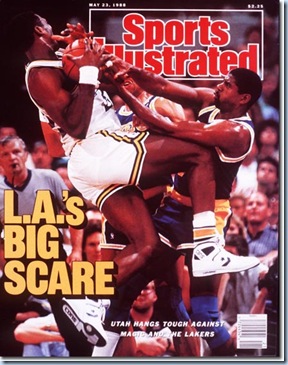
  • Last season they took the NBA Champion LA Lakers to 7 games in the 2nd round of the playoffs -- and scared them good.
  • The sky was the limit for this team that turn into a 'contender'

This is somehow not a foul . . .

That said, there is one reason why I find this team particularly interesting. This team, for all of their successes, took a step back after building so much momentum. Sure, three seasons later they would reach the Western Conference Finals for the first time in franchise history (and reach there 5 times in the 7 successive seasons) -- but during this upswing in success the Jazz fell back down and were swept from the Playoffs in the 1st round. (Thanks Golden State!) This troubles me because right now the current Jazz franchise is experiencing a second upswing and a similarly linear progression . . . and it would really suck to have to go through those bumps and bruises all over again as a fan. (I've been emotionally invested in this team since the 1987 season, and am finally getting over all those 1st round losses)

I am even tempting fate here by even bringing all of this up right now . . . as our beloved Jazz are 'perhaps' (if history repeats itself) primed for a less than stellar playoffs? (After all, we did just play LA in the 2nd round of the playoffs 20 years after the first time it happened) Ultimately you have to look at all of the good things that happened this season and find them to be inconsequential when examined against a 0-3 playoff elimination in the 1st round to an underdog team with no bigs. The 1988-1989 Utah Jazz season was not a good one . . . simply because where they where and where they ended up fell below expectations. This Jazz team is even ahead of the curve because they've already been to the Western Conference Finals (2 seasons ago), while at this point 20 years ago, the Jazz were still three seasons away.

I wish for the best for the Jazz in this, and all seasons; but would really pray against another regression year. After all, there is no guarantee that our current window of opportunity as a contender will stay open for as long as the window we had 20 years ago.

Monday, September 22, 2008

Tangent Alert: sports figures ARE public figures

I received an e-mail from the bloggers @ Hugging Harold Reynolds and they pointed me to their post on Sports Figures at the RNC. (If you don't know what the RNC is then you are just not 'there' enough to deserve to vote) Among those ex-jocks (or current jocks) who spoke was none other than Thurl Bailey. (Who had a great NCAA career and a solid NBA career for our Utah Jazz -- his life outside the game has been quite fulfilling as well for Bailey who is a pastor and member of the LDS, and was part of a great singing bible video where he plays the part of Goliath) This got me thinking . . . aside from how it is super de rigueur now to be politically active (e.g. black athletes saying that they are for Obama . . . riiiiight, because those guys feel the same way about his energy policy or ideas about stem cell research as he does) professional athletes have been relatively mum about issues for quite some time.

Please buy my $hoes . . . i'm not very good as a GM

Perhaps this is due to how these guys don't want to go out of their way and tell the world how they feel for fear of losing money somewhere down the line. LeBron James has a great platform to make some change in the world because of his fame and popularity, though he's been focusing on making money for Nike and Microsoft instead.

(Quite similar to how Jordan was such an icon that he could have done so much more, but instead chose to party it up while selling shoes to make himself independently wealthy -- Julia Roberts gave more money to help with Katrina than he did, and she never sold one sweatshop created shoe in her life)

The opposite happens to be people who talk too much, among this list are guys like Shaq (Kobe, how does my ass taste?), Ron Artest (who is smart, but not wise) and most recently, Josh Howard (who doesn't salute the flag). Sure, some guys like Charles Barkley can say anything he wants without people really being upset anymore as he's a caricature of who he used to be. While others like Rasheed Wallace are known by reputation alone, and his interview responses have been given with the cadence and passion of someone who had just had a full frontal lobotomy -- yet he is vilified in the press for his explosive expressiveness.

That said, behind sports individuals being highly guarded now with what they say and do (thanks John Rocker!) the major issue appears to be a lack of desire to do what previous eras of sports figures were willing to do. Namely, be public figures.

I remember watching those old NBA ads that were public service announcements, you may remember the ad of Mark Eaton talking about child abuse. I remember that one, and that was from back when sports figures were not afraid to actually take stands on things. Older guys, like Dikembe Mutombo, are concerned with the world that they live in and try to use sports as a starting point towards greater things. Few others look at sports as a launching pad, but rather a privilege that they use towards fame and wealth.

Some guys like Kobe (with large conflict diamond in ear) and T-mac have spoken out about Darfur in recent months, though when someone less famous (Ira Newble) tries to actually do something that gets to the root of the problem, he gets the cold shoulder from the ever image conscious NBA. I guess the whole point is to avoid controversy, and in doing so, professional athletes are encouraged to avoid doing anything. That's like cutting off the leg to get rid of an infected toe. Which is a very safe, but ineffectual way to be a public figure.

Sunday, September 7, 2008

Adrian Dantley -- better late than never

No doubt by now we've all heard the good news -- that Adrian Dantley is now, finally, a member of the Basketball Hall of Fame. In one of the great mysteries of the cosmos, he has been overlooked for this honor for quite a long time. In respect for that abnormality I am posting this article about it a few days late (in solidarity of him being in the Hall a few years late). Either that, or I've been busy lately. Anyway, it's pretty ridiculous that AD "was a finalist six times before finally getting at least 18 votes from the 24-member Honors Committee," (Steven Luhm, via the Salt Lake Tribune, 2008). It's ridiculous, but after looking over how generally insane people are with how they vote on sports, it's not far fetched. But just so everyone is up to speed on what he accomplished in his career, let's review:

AD, all of 6'5, does the inside work as Bailey, 6'11, and Eaton, 7'4, watch

* Career averages of 24.3 ppg (54.0 fg%, 8.7 FTA/Game, 81.8 ft%), 5.7 rpg, 3.0 apg, and 1.0 spg
* "Glory years" between 1979-1980 season and 1985-1986 season where he averaged 28.0 ppg, 30.7 ppg, 30.3 ppg, 30.7 ppg, 30.6 ppg, 26.6 ppg and 29.8 ppg in consecutive seasons
* Scored over 23,100 points in his career (23rd best all time)
* Career average of 24.3 ppg (17th best all time)
* Top 5 in PPG 5 different times: #3 (1979-1980), #1 (1980-1981), #3 (1981-1982), #1 (1983-1984), #2 (1985-1986)
* Career average of 54.0 fg% (20th best all time)
* Career True Shooting percentage of 61.7% (4th best all time)
* Made 6832 free throws (6th best all time) out of 8351 takes (11th best all time) in his career
* Career Offensive Rating of 119.3 (8th best all time)
* NBA Rookie of the year in 1976-1977
* 6 time NBA All Star (1979-1980, 1980-1981, 1981-1982, 1983-1984, 1984-1985 and 1985-1986)
* All-NBA 2nd team (1980-1981, 1983-1984)
* 1976 Olympic Men's Basketball Gold Medal
* NCAA AP All-American 1st team (1974-1975, 1975-1976)

Photograph: Deseret Morning News Archives  

So, if you didn't already know, he was a beast. He was "The Man" for those Utah Jazz teams and bridged the gap between those early, pathetic New Orleans Jazz teams and the Stockton and Malone powerhouse Utah Jazz teams of the late 80's and beyond. More than any of his stats, Adrian Dantley brought the wins. Who was The Man on the first Utah Jazz team to win the Midwest Division title? Dantley was. [since then the Jazz have been among the leaders in Midwest and Northwest Division titles] Who was The Man on the first Utah Jazz team to make the playoffs? Dantley was. Who was The Man on the first Utah Jazz team to win a playoff series? Yeah, that's right . . . Adrian Dantley. [Pistol Pete didn't do any of those things] In his later years he did take some time to mentor younger players (this is a 3:48 minute video of his career, btw) like Karl Malone and Joe Dumars, and teach them about, among other things, hard work and discipline. For all his NBA greatness, he was under-appreciated as a player -- and his career has been overlooked for quite some time.

Back in college he was destroying people -- and averaged 28.6 ppg and 10.2 rpg in 1974-1975, and in his last season of NCAA ball he averaged 30.4 ppg and 10.1 rpg. He was named National Player of the Year in 1975-1976. He was a huge part of their program, yet when he was informed that he would finally be making the hall the news hardly caused any ripple at all back there. (In fact, they actually picked up on a news report from the Deseret Morning News for their information. Isn't he an alumni member? Don't they even care for their own?)

After being The Man on a Gold Medal winning team in the Olympics he was the NBA Rookie of the year for the Buffalo Braves. The majority of his best playing days were with the Utah Jazz -- but even they seem to share part of the blame for over looking Dantley. (A crime that not only the Hall of Fame board selection committee is guilty of...)

"It's long, long, long overdue. It's an absolute disgrace that he's had to wait this long. It's terrible. I just think it's a disgrace that it didn't happen long before," said Tom Nissalke, who was Jazz coach when then-general manager Frank Layden traded Spencer Haywood to Los Angeles for Dantley in September 1979, just a few months after the Jazz moved to Salt Lake City and before they played their first game in the old Salt Palace. (T. Nissalke, via the Deseret Morning News, 2008)

Frank Layden adds that "It's long overdue and well-deserved," (Desert Morning News, 2008) but is quick to admit that part of the reason could be because Dantley's number was not even retired by the Jazz up until two years ago. (Probably should have been the 2nd or 3rd retired Jersey, but ended up being the 8th -- and most recent -- retiree in Jazz franchise history) How's that for being overlooked?

Though the Utah contingent of Layden and Nissalke are equally quick to point out that even if Adrian never played a single game in the NBA, that he should have been in the Hall of Fame because of his ridiculously outstanding High School, Collegiate and Olympic career -- and that his status of his jersey being retired is a highly invalid reason for not voting him into the Hall of Fame earlier. (btw, his High School record is 52-7) That said, he was an invaluable part of the Utah Jazz franchise, and we are all glad that he did play in the NBA.

"He carried us, he was the franchise," recalled Mark Eaton. "He was the guy you could count on for 30 [points] every night -- the one bona fide All-Star we had." (Mark Eaton via The Salt Lake Tribune, 2008)

Eaton would know, because Dantley scored enough for the both of them in the early part of Mark's career. AD was much more than just a scorer for the Jazz. The Jazz franchise had just moved to Utah -- and were still in financial trouble. (Which is why they traded their draft rights to Dominique Wilkins to Atlanta for cash back in 1981) They even played an entire season without a location name on their jerseys because there were fears that they would quickly have to move to another city mid-season!

Adrian's
winning ways helped to build a fanbase in Utah -- and if it wasn't for him, perhaps the Jazz would have been playing in Oklahoma City all these years? Who knows . . . What we do know, is that Adrian Dantley is finally a member of the storied Basketball Hall of Fame.

Adrian Dantley and Dominique Wilkins could have been major parts of the Jazz franchise -- just maybe not in Utah
  Photographed by Scott Cunningham for NBAE/Getty Images

To that I say that: It's better late than never.

Thanks but no thanks, voters!

Photographed by Nathaniel S. Butler for NBAE/Getty Images

Friday, September 5, 2008

Flashback Friday: All-Star Game Introduction Rap

This has already made the rounds quite a bit, but well, it's been a long week with few postings . . . maybe next week will be better . . .

It's from the 1988-1989 All-Star Game that was played in Houston. (Karl Malone was the MVP of this game . . .)