Showing posts with label Adrian Dantley. Show all posts

Friday, September 26, 2008

Flashback Friday: The 1988-1989 Utah Jazz

This 1988-1989 Utah Jazz team is historic for a variety of reasons. First of all, this team was the first in franchise history to win 50 or more games in a season. (They would win 51, a mark that the Jazz have equaled or bested 12 times since then) Second, they featured a 25 year old Karl "The Mailman" Malone who was coming into his own.

Bigger, Stronger, and Faster than Amare Stoudemire

[Tangent Alert: I hate all the hype Amare gets, if dude is so good and a beast why isn't he scoring 30 a game like Karl did? Karl Malone >>>>> Amare Stoudemire. For the record, all Karl did that season was score 29.1 ppg (51.9 fg%), go to the free throw line 11.5 times a game, average 10.7 rpg, 2.7 apg, 1.8 spg and 0.9 bpg. What did the "Beast" Amare do at the age of 25? He got 25.2 ppg, 9.1 rpg, 1.5 apg, 0.8 spg and 2.1 bpg.

Amare didn't even get to the FT line 10 times a game, or ever has in his 6 year career, Malone did it 3 times in his first 6 years alone.

Karl even shot better from the three that season (5-16 [31.3%] to Amare's 5-31 [16.1%])! So aside from blocks, his age 25 stats are owned by Malone at 25. And as for blocks . . . Karl was playing with Mark Eaton who sent back 3.8 shots a game "so yeah . . . think about it!" (read the 3rd one on that page to get this joke)]

Back to that Jazz team . . . aside from Malone becoming a force of nature, he also had some help from Eaton (previously mentioned as blocking 3.8 shots a game, but also getting 10.3 rpg on his own on his way towards being named and All-Star and the Defensive Player of the Year); Thurl Bailey chipped in 19.5 ppg, 5.5 rpg and 1.1 bpg; Griffith kept people honest on defense with his outside shooting (61 3pt made in an era where that would be one of the top totals for any player) . . . and this John Stockton guy had one of his several seasons that are arguably better than Steve Nash's MVP seasons. John would finish up with 1118 assists that season, a pretty average output for him, but still 221 more than Nash's best ever season. [I guess the whole Stockton vs. Nash thing is another tangent altogether . . . so just click here if you want to read an empirical analysis of their recorded effect on the game.] This season was also the last for Frank Layden, who would give the coaching job to Jerry Sloan 17 games into the season.

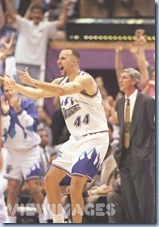
Goliath? Is that you? Griffith brings the ball up the floor Frank Layden orders three hot dogs and a beer
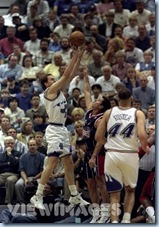
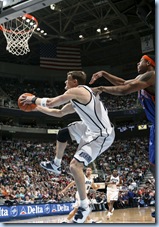
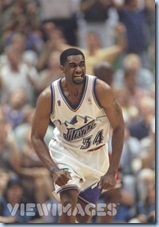
Mark Eaton blocks one in the All-Star game . . . one of his over 300 blocks that season. Due to Karl's development, 6'11 Thurl was often left posting up on small forwards . . . to the tune of nearly 20 ppg as the 3rd option. Dr.Dunkenstein's career was wrapping up, but he still had enough to average more than Kirilenko or Brewer did last season. Frank Layden was a more fun coach than any coach after him . . . or perhaps before him.

There are many reasons why the 1988-1989 Utah Jazz team could be called historic. There were many good things that happened this season:

  • This team had a coaching change during mid-season, and they were motivated and rejuvenated by having a young coach at the helm
  • They had some very talented players (three All-Stars, Bailey and Griffith) to offset an anemic bench
  • They won the Mighty Midwest Division Title for the first time with this core group (the first time in post-Dantley, post-Maravich era)
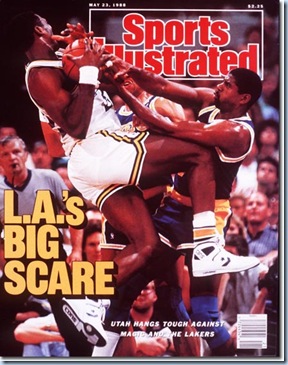
  • Last season they took the NBA Champion LA Lakers to 7 games in the 2nd round of the playoffs -- and scared them good.
  • The sky was the limit for this team that turn into a 'contender'

This is somehow not a foul . . .

That said, there is one reason why I find this team particularly interesting. This team, for all of their successes, took a step back after building so much momentum. Sure, three seasons later they would reach the Western Conference Finals for the first time in franchise history (and reach there 5 times in the 7 successive seasons) -- but during this upswing in success the Jazz fell back down and were swept from the Playoffs in the 1st round. (Thanks Golden State!) This troubles me because right now the current Jazz franchise is experiencing a second upswing and a similarly linear progression . . . and it would really suck to have to go through those bumps and bruises all over again as a fan. (I've been emotionally invested in this team since the 1987 season, and am finally getting over all those 1st round losses)

I am even tempting fate here by even bringing all of this up right now . . . as our beloved Jazz are 'perhaps' (if history repeats itself) primed for a less than stellar playoffs? (After all, we did just play LA in the 2nd round of the playoffs 20 years after the first time it happened) Ultimately you have to look at all of the good things that happened this season and find them to be inconsequential when examined against a 0-3 playoff elimination in the 1st round to an underdog team with no bigs. The 1988-1989 Utah Jazz season was not a good one . . . simply because where they where and where they ended up fell below expectations. This Jazz team is even ahead of the curve because they've already been to the Western Conference Finals (2 seasons ago), while at this point 20 years ago, the Jazz were still three seasons away.

I wish for the best for the Jazz in this, and all seasons; but would really pray against another regression year. After all, there is no guarantee that our current window of opportunity as a contender will stay open for as long as the window we had 20 years ago.

Sunday, September 7, 2008

Adrian Dantley -- better late than never

No doubt by now we've all heard the good news -- that Adrian Dantley is now, finally, a member of the Basketball Hall of Fame. In one of the great mysteries of the cosmos, he has been overlooked for this honor for quite a long time. In respect for that abnormality I am posting this article about it a few days late (in solidarity of him being in the Hall a few years late). Either that, or I've been busy lately. Anyway, it's pretty ridiculous that AD "was a finalist six times before finally getting at least 18 votes from the 24-member Honors Committee," (Steven Luhm, via the Salt Lake Tribune, 2008). It's ridiculous, but after looking over how generally insane people are with how they vote on sports, it's not far fetched. But just so everyone is up to speed on what he accomplished in his career, let's review:

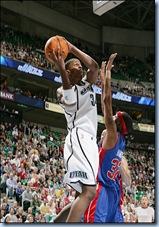
AD, all of 6'5, does the inside work as Bailey, 6'11, and Eaton, 7'4, watch

* Career averages of 24.3 ppg (54.0 fg%, 8.7 FTA/Game, 81.8 ft%), 5.7 rpg, 3.0 apg, and 1.0 spg
* "Glory years" between 1979-1980 season and 1985-1986 season where he averaged 28.0 ppg, 30.7 ppg, 30.3 ppg, 30.7 ppg, 30.6 ppg, 26.6 ppg and 29.8 ppg in consecutive seasons
* Scored over 23,100 points in his career (23rd best all time)
* Career average of 24.3 ppg (17th best all time)
* Top 5 in PPG 5 different times: #3 (1979-1980), #1 (1980-1981), #3 (1981-1982), #1 (1983-1984), #2 (1985-1986)
* Career average of 54.0 fg% (20th best all time)
* Career True Shooting percentage of 61.7% (4th best all time)
* Made 6832 free throws (6th best all time) out of 8351 takes (11th best all time) in his career
* Career Offensive Rating of 119.3 (8th best all time)
* NBA Rookie of the year in 1976-1977
* 6 time NBA All Star (1979-1980, 1980-1981, 1981-1982, 1983-1984, 1984-1985 and 1985-1986)
* All-NBA 2nd team (1980-1981, 1983-1984)
* 1976 Olympic Men's Basketball Gold Medal
* NCAA AP All-American 1st team (1974-1975, 1975-1976)

Photograph: Deseret Morning News Archives  

So, if you didn't already know, he was a beast. He was "The Man" for those Utah Jazz teams and bridged the gap between those early, pathetic New Orleans Jazz teams and the Stockton and Malone powerhouse Utah Jazz teams of the late 80's and beyond. More than any of his stats, Adrian Dantley brought the wins. Who was The Man on the first Utah Jazz team to win the Midwest Division title? Dantley was. [since then the Jazz have been among the leaders in Midwest and Northwest Division titles] Who was The Man on the first Utah Jazz team to make the playoffs? Dantley was. Who was The Man on the first Utah Jazz team to win a playoff series? Yeah, that's right . . . Adrian Dantley. [Pistol Pete didn't do any of those things] In his later years he did take some time to mentor younger players (this is a 3:48 minute video of his career, btw) like Karl Malone and Joe Dumars, and teach them about, among other things, hard work and discipline. For all his NBA greatness, he was under-appreciated as a player -- and his career has been overlooked for quite some time.

Back in college he was destroying people -- and averaged 28.6 ppg and 10.2 rpg in 1974-1975, and in his last season of NCAA ball he averaged 30.4 ppg and 10.1 rpg. He was named National Player of the Year in 1975-1976. He was a huge part of their program, yet when he was informed that he would finally be making the hall the news hardly caused any ripple at all back there. (In fact, they actually picked up on a news report from the Deseret Morning News for their information. Isn't he an alumni member? Don't they even care for their own?)

After being The Man on a Gold Medal winning team in the Olympics he was the NBA Rookie of the year for the Buffalo Braves. The majority of his best playing days were with the Utah Jazz -- but even they seem to share part of the blame for over looking Dantley. (A crime that not only the Hall of Fame board selection committee is guilty of...)

"It's long, long, long overdue. It's an absolute disgrace that he's had to wait this long. It's terrible. I just think it's a disgrace that it didn't happen long before," said Tom Nissalke, who was Jazz coach when then-general manager Frank Layden traded Spencer Haywood to Los Angeles for Dantley in September 1979, just a few months after the Jazz moved to Salt Lake City and before they played their first game in the old Salt Palace. (T. Nissalke, via the Deseret Morning News, 2008)

Frank Layden adds that "It's long overdue and well-deserved," (Desert Morning News, 2008) but is quick to admit that part of the reason could be because Dantley's number was not even retired by the Jazz up until two years ago. (Probably should have been the 2nd or 3rd retired Jersey, but ended up being the 8th -- and most recent -- retiree in Jazz franchise history) How's that for being overlooked?

Though the Utah contingent of Layden and Nissalke are equally quick to point out that even if Adrian never played a single game in the NBA, that he should have been in the Hall of Fame because of his ridiculously outstanding High School, Collegiate and Olympic career -- and that his status of his jersey being retired is a highly invalid reason for not voting him into the Hall of Fame earlier. (btw, his High School record is 52-7) That said, he was an invaluable part of the Utah Jazz franchise, and we are all glad that he did play in the NBA.

"He carried us, he was the franchise," recalled Mark Eaton. "He was the guy you could count on for 30 [points] every night -- the one bona fide All-Star we had." (Mark Eaton via The Salt Lake Tribune, 2008)

Eaton would know, because Dantley scored enough for the both of them in the early part of Mark's career. AD was much more than just a scorer for the Jazz. The Jazz franchise had just moved to Utah -- and were still in financial trouble. (Which is why they traded their draft rights to Dominique Wilkins to Atlanta for cash back in 1981) They even played an entire season without a location name on their jerseys because there were fears that they would quickly have to move to another city mid-season!

Adrian's
winning ways helped to build a fanbase in Utah -- and if it wasn't for him, perhaps the Jazz would have been playing in Oklahoma City all these years? Who knows . . . What we do know, is that Adrian Dantley is finally a member of the storied Basketball Hall of Fame.

Adrian Dantley and Dominique Wilkins could have been major parts of the Jazz franchise -- just maybe not in Utah
  Photographed by Scott Cunningham for NBAE/Getty Images

To that I say that: It's better late than never.

Thanks but no thanks, voters!

Photographed by Nathaniel S. Butler for NBAE/Getty Images

Thursday, August 21, 2008

Paying Homage, or plain being a homer?

I was reminded recently when looking over the wiki article listing the NBA players with retired jerseys list that some teams have a greater history than others. For example, the Lakers franchise celebrates (or will after Shaq retires, as his number is currently out of circulation) 15 people, while the cross town Clippers have nothing going on up in their part of the rafters in Staples Center. Additionally, some players are celebrated even in places that they have no affiliation for -- for example Michael Jordan (who is not from Miami, didn't play college in Florida, and has never played for any franchise down there) has his jersey retired by the Heat. The only thing I can think of that links the two is that Jordan used to kill the Heat and Knicks -- both teams when Pat Riley was the coach there. Well, Jordan is so larger than life that he was playing ball for the Bulls with his #45 while his #23 was up in the rafters -- then later unretired his jersey (paid the small fine) and was balling in that to end his Bulls career. Seriously, what a douche-bag. The list is interesting to look over, did you know that Jim Loscutoff, a Celtics player, actually asked for his number to be free to use by others?

"Loscutoff asked that his legacy be honored by allowing other Celtics to wear his number in the future. It was later retired in honor of [Dave] Cowens. Loscutoff is represented by a square with the letters "LOSCY"."(Wikipedia, 2008)

Look upon our works and despair! jordan_heat
The Celtics keep it pretty simple Does this mean that the Jazz have to retire a Kobe jersey?

Out of all the numbers retired (and some not retired . . .) there has to be some politics involved. Jazz fans know about the whole Adrian Dantley situation. He was a key player for our teams back when he played in Utah (1979-1986), and was 'The Man' when the Jazz first started winning division titles and going to the playoffs. He was a top 3 scorer in the NBA five different times, and was recently inducted into the Basketball Hall of Fame. He left the Jazz under sour terms and his jersey retirement was passed over for many years while the Jazz franchise took care of these franchise icons first: Frank Layden in 1988, Darrell Griffith in 1993, Mark Eaton in 1996, Jeff Hornacek in 2002, John Stockton in 2004, and Karl Malone in 2006. They finally got around to Dantley (who had been retired since 1991, before every one of those guys but Coach Layden) in April of 2007. So getting your jersey retired involves more than just being a good player for a franchise. Just look at Jazz franchise great Pete Maravich.

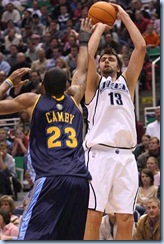
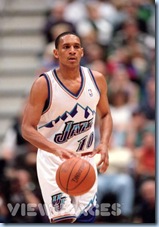
Dantley did his work on the low block and at the foul line -- and was a mentor to a young Karl Malone It's not a lot, but it's more than most teams Hey, at least he played for our franchise
Adrian Dantley All 8 of 'em . . . "Pistol" Pete

Pistol Pete was born in Pennsylvania and played college at LSU. He was drafted by the Atlanta Hawks back in 1969-1970 NBA Draft. He was traded to the expansion New Orleans Jazz franchise (1974-1975 season) for Dean Meminger, Bob Kauffman, two 1st round draft picks and two 2nd round draft picks. It is interesting to note that his years in New Orleans were relatively poor seasons for the team. If New Orleans was so great, why did they have to leave in the first place? If the fans really cared they never would have left. Yeah. The New Orleans fanbase is terrible. The fans have no heart, and don't really care about supporting their basketball franchise -- or at least they didn't back when Pete played there. (compare that to the wild fanbase that the Jazz franchise now is happy to have, it's a great contrast really)

That said, the Charlotte Hornets franchise decided to retire "Pistol" Pete's jersey when they moved to New Orleans. This is stupid, and their franchise is too. Pete was a great player at LSU (basically owning the entire NCAA), and was one of the most spectacular players in the NBA during his peak. But the New Orleans Hornets have no legitimate claim to Pete at all. The Utah Jazz did not retire Moses Malone's jersey -- even though he played for the Utah Stars back in the day. The New Orleans Hornets did not retire Shaquille O'Neal's jersey -- and he was a great player for LSU who also never played for the Charlotte Hornets franchise either. (Seriously, isn't that the qualification to get your jersey retired in New Orleans now-a-days?)

What I see this as is a cheap ploy to drum up interest in a city that has a history of not caring about their basketball team. If the Bulls team moves from Chicago to, lets say, Madrid (in David Stern's world, how far fetched is this in our lifetimes?), and Milwaukee's franchise gets relocated to the Chicago area does this mean that the Bucks franchise can now put up banners proclaiming Michael Jordan as one of their best players in franchise history? (Not that Jordan would care, the more retirements the merrier for him)

Or if the Sacramento Kings get relocated to Seattle, do they get the right to put up Gary Payton and Nate McMillan jerseys before their first home game? It would be one thing for the Charlotte Hornets to pick up the past of a dead franchise upon moving to a new city. (Like how the Toronto Raptors share some history with the Toronto Huskies) But it is an entirely different thing to steal players and history from an existing (and much better) franchise that previously played all of 4.5 seasons there. (as opposed to the 28.5 seasons in Utah)

Seriously Charlotte/New Orleans -- hang up some Muggsy Bogues jerseys instead -- you know, some players who actually played in your pitiful franchise. Rex Chapman isn't doing much now a days, maybe you can sell some more tickets that way. Not that it matters really . . . 19,907 > 14,181. Maybe we can loan you guys Karl Malone too, he played at Louisiana Tech in college and the Utah Jazz in the NBA as well. So that obviously makes him a franchise cornerstone for the Charlotte Hornets. Go knock yourselves out, New Orleans fans.

Friday, August 15, 2008

Returning to the Promised Land

The Jazz brass, coaches and owner have done three things well in the post Stockton-to-Malone era:
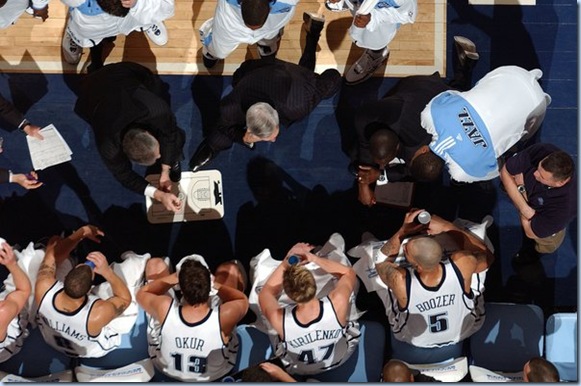
Jerry Sloan is consistently intimidating to his players.
Retuning to the NBA Finals does not occur by chance, but by following out a long term plan.

I. The first thing that the Jazz brass (and co.) has done well is they've established a winning formula, and have enjoyed a consistency that other franchises have lacked. While this has the drawback at some level of inherent stagnancy, the NBA mandated rules changes have kept the Jazz coaches on their toes. One particular rule change which threw a major wrench in the system was the removal of the previous Illegal defense rules. Now Zone Defenses are allowed -- even pseudo-Zones are hard for the Jazz to handle as it's man-to-man defense, but an extra guy to rove around and get in passing lanes -- daring the pound it inside Jazz to shoot from outside. (This was particularly difficult for the Jazz to do during December of that 2007-2008 season, which resulted in many losses)

The Zone Defense friendly NBA forced the hand of the Jazz brass and they have endeavored to start playing 5 on 5 basketball on offense for the first time ever (but more on that later). They needed to avoid Zone defenses in order to properly run their offensive sets. Previous versions of the Jazz would run their forward based offensive sets (Malone, Dantley, Bailey) and involve strong guard play all while the center fell asleep at the top of the key.

This has always been the case as the Jazz used to park Mark Eaton up at the top of the circle while he watched the finesse guys do their thing. Then Greg Ostertag came in and was able to use his height to exploit a high-low passing game inside. If you did that now, no one would follow Mark or Greg outside, and the paint would get clogged very quickly. To counter that the Jazz have further evolved by getting one of the few true bigmen (check out his rebounding games in the playoffs if you don't believe me that he's a bigman) who has a very legit three point shot -- Mehmet Okur. While the NBA has made several rule changes since the Stockton-to-Malone era, the evolution of the Jazz sets has been sped along because of smart roster moves.

The signing of Okur allows for the Jazz to move him farther than Jerry Sloan had ever imagine moving Eaton or Ostertag -- out beyond the three point line. Furthermore, Okur needs to be defended out there -- thus necessitating luring out the guy who defends him (a defensive big), or a smaller guard (causing a miss match somewhere else on the floor). The biggest benefit to this roster quirk is that it retains the floor spacing that is needed for the majority of the Jazz sets: pick and roll with the PG and PF, or finding a cutter in the vacuum left by a vacating center for easy dunks for Andrei and Brewer.

I'm surprised at how well it works, and encouraged by this -- it shows that the coaches are working with the front office to get players that can do good things on the court, and work within a system. You couldn't get away with this offensive set back in the Stockton-to-Malone days . . .
Memo shooting threes = opposing bigman is not in paint + good floor space = easy to score in the paint

II. The second thing that the Jazz brass (particularly the coaches) have done well is that they've tried to learn from their mistakes. Often Stockton was the only guy on the floor who could get the job done; and often, he was the best player on the floor. All too often (save for that elimination game 4th quarter vs. the Rockets where it was Stockton vs. Houston); unfortunately John didn't call his own number enough -- and that hurt the team. What have the Jazz done now? They've got a good passer and floor leader at the point guard -- but someone who is ultimately the most confident in his own abilities. We've had Deron for three seasons now, as we know that when it counts he's not afraid to be 'The Man' -- something Stockton always deferred to Karl (who, honestly, was not as clutch) about.

Another example happens to be expanding the game to involve more people on offense. At their most dangerous the Stockton-to-Malone teams were filled with subordinates like Hornacek and Russell, or Bailey and Griffith. Never did they fully get a chance to have 5 good offensive players on the floor at the same time (thanks, Rony Seikaly -- you could have really helped against Michael Jordan and the Chicago Bulls back then). It's hard to win titles playing 4 on 5.
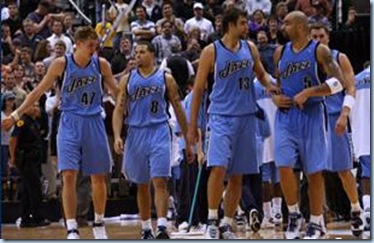
If the point of the game is to score more than the other team, then five guys who can score > four guys who can score This version of the Jazz has the ability to play 5 on 5 on offense for the first time in franchise history -- and this has not come at the expense of needing to change the entire playbook. Once the Jazz secured a good, smart point guard to tandem with their beast of a power forward (acquired as a free agent) it was going to be the pick and roll show all over again. This play used to kill teams back in the illegal defense era. Now people are allowed to zone, and as a result, relying on the pick and roll is harder to do.

In order to prevent the picker getting immediately double teamed by bigmen the Jazz need to lure out a bigman outside. Chicken and egg thing with Point I and Point II -- but that displays how inter-related things are: in order to learn from your mistakes you have to have a winning game plan. Thus, if the Jazz wanted to keep relying on forward based offensive scoring sets from the paint, some tweaks were going to be needed to be made.

III. The final thing that they have done well is that they've been able to key in, identify and get similar types of players on the roster -- attempting for coax lightning to strike twice. The obvious comparisons exist -- Carlos Boozer plays like an older, jump shooting Malone. Deron Williams is an adept passing lead guard who is clutch at the end of games, like Stockton. As always, it's more than just replacing Stockton and Malone.

Then: Now: Difference:
John Stockton Deron Williams

Not better: but more willing to step up in crunch time

Maybe they would have gotten out of the 1st round much more if we saw more of this guy? Deron Williams is 'The Man' for our team

Stockton was the consummate professional and floor leader. Possessing not just physical tools (like good health and excellent stamina), he also had vast amounts of Basketball IQ -- essentially being another coach on the floor. There would be no success without John. Similarly, Deron Williams is the heart of this version of the Jazz. He is adept at passing (had over 10 apg in his 2nd NBA season, John didn't break that barrier until his 4th). He's not the coach on the floor though, but the Quarterback who calls his own plays -- and is much more willing to do it himself. Sadly, the Jazz could have used a more selfish version of John Stockton. They may have the next best thing in Deron Williams.

Jeff Hornacek Kyle Korver

Gives up floor game and passing for a more min/maxed player

Hornacek was much more than a guy who has two Long Distance Shooting trophies at home Korver would do well to add a bit more to his game on offense

Jeff Hornacek, some people forget, was an All-Star for the West. He was the principle piece that the Sixers got back for trading Barkley -- and all he did was put up 19 ppg (.47/.39/.87), 7 apg, and 2 spg in return. Not too shabby. Hornacek had every shot, and was a much more skilled NBA player. His age and lingering injuries prevented him from being a great defender for the Jazz. Kyle Korver, also acquired in a mid-season trade from the Sixers, is more of a specialist. He is statistically a better three point shooter and free throw shooter. Over this last season Kover received shooting training with Hornacek -- and Jeff admits in his 'aw shucks' type of way that Kyle is a really great shooter, maybe better than Jeff. Jeff brought more to the table though and started.

Bryon Russell Andrei Kirilenko

Better: much more creative and a great shot blocker

Ha ha ha (silently: one day I will kill you Michael . . . one day . . . ) Why is Kobe shooting freethrows already, I haven't even checked into the game?

Before being emasculated by Jordan in the finals Russell was a confident and competent forward who was the best defensive stopper on the Jazz who could run, dunk, do whatever was asked of him, and unassumingly hit threes just when the Jazz needed them. Sound like anyone we know? Andrei is more versatile -- playing everything but center in the playoffs for us between 2006-2007 and 2007-2008; though, let's not forget that in 1998-1999 Russell had to guard Chris Webber in the playoffs due to foul trouble. Like Russell, AK-47 always has to guard to other teams' best offensive player and as often as he gets beat, he comes up with a timely deflection, steal, or block at a more critical juncture in the game. His offensive ability is truncated in his role with the Jazz, but is the most talented player on the team.

Karl Malone Carlos Boozer

Worse: but possibly owns more left-handed post moves though

Hmmm, almost time to make more kids . . . Can I has work ethic for defense plz?

Carlos Boozer is a beast by today's standards. (at least in the regular season) If you put Karl Malone at his peak in today's game he would own all of these passive, physical play avoiding bigmen. (Seriously, Amare Stoudemire never step on the same court against Charles Oakley.) Both have (at least in the eyes of jaded Jazz fans) built a reputation for not being able to equal their production in the playoffs. Unfortunately for Boozer, his drop off is so severe that it's pure folly to even talk about these two forwards in the same breath. If you want to really get a picture of how ridiculous the comparison is then read this.

Antoine Carr Paul Millsap

The same: the only difference is age and experience vs. youth

What foul? Veteran savvy FTW! How is this an offensive foul? WTF?!

The "Big Dawg" was taller and at that stage, a very savvy veteran who had all the sneaky, esoteric knowledge on how to get away with fouls. Millsap gets called for a ton of fouls -- though they are essentially the same player. Millsap is younger, has some upside, and has a lot more energy and vigor. Both had surprisingly developed offensive games -- but mostly scored close to the basket, often on put backs / tip ins. Carr was a great bench guy for any playoff team, who defended the paint, got boards and blocked some shots. He even had a 20 point game in the NBA finals once. It's not impossible to see Millsap do that well. 

Howard Eisley Brevin Knight Better: Knight + Price > Eisley + Vaughn
No one remembers how good I was Back up point guard: three point shooting not included

Eisley's career before the Jazz was nothing to write home about, and his NBA career after the Jazz was almost as pathetic as Shandon's was. Because of this many people fail to realize that he was the best back-up point guard the Jazz have ever had since John Stockton was coming off the bench. He could push the ball up the floor, knew all of the sets, was active defensively and was able to shoot the three with deadly accuracy and even hit game winners. That game winner that Deron had vs. the Cavs last season? Well, Eisley used to do that type of thing back for the Jazz in 1998. While there is little chance for Knight to be as good all-around as Howard was for the Jazz, Knight is a very solid veteran who can run a club, never turns the ball over, and is a good steals guy. This looks like another downgrade; however I'd take Knight and Price (basically a younger, more exciting Howard Eisley with less playmaking and more highlight making skills) over Eisley and Jaques Vaughn any day of the week.

Shandon Anderson Ronnie Brewer

Better: by sheer virtue of Brewer being taller and able to play the 1, 2 or 3

 I made a living off of the other team not defending meeeee! . . . and so shall I !!!

Shandon Anderson was a young, athletic, defensive minded player who played within his limitations. He never tried to become an outside bomber. His bread and butter was to sneak around and find an open spot on the floor as the other team was concentrating on the other guys (Stockton, Hornacek and Malone) more than they were on him. He turned hard cuts into layups and dunks. Ronnie Brewer is much the same, being an offensive opportunist using his speed, size and athleticism to get easy dunks as the defense pays him no attention. Both benefited from playing with eager passers (Stockton, Hornacek and Malone for Shandon; Williams, Kirilenko and Boozer for Ronnie). Both are the 2nd member of their families to be part of the NBA (Shandon's older brother, and Ronnie's dad both played). Ronnie is longer, faster and has top 5% NBA athleticism (as seen in the pre-draft combine). His shot is broken, but appears to give more to the Jazz than Shandon did -- for one thing, Ronnie starts.

Greg Foster Mehmet Okur Better: and it's not even close
Yeah! I made an open jumper! I'm the machine! Let's see you try it when you're defended and it's the playoffs . . .

Foster was an occasional starter during the two finals seasons, managing to do so in over 50 games. Okur is our full-time starting center. Both were outside shooting bigmen who were not regarded as big-time rebounders. Memo is a much better rebounder, defender, outside shooter, inside player, and is a serious playoff perform who does all the clutch things you need to win (game winners, or offensive rebounds). Foster was a better dunker -- and both guys are some crappy fight in them. Foster getting into it with the Lakers' Rick Fox, and Memo coming close to throwing down on Juwan Howard among others. Foster was an okay player, but was very annoying in that Sasha Vujacic type of way. Memo has been an All-Star and is a serious upgrade for the Jazz.

Adam Keefe Matt Harpring

Better: and also a better fitting role for this type of player

Must . . . not . . . break . . . rim with shot Must . . . not . . . break . . . knee . . . with landing

I guess we need a frame of reference when bad mouthing our own players. Adam Keefe used to start on one of our NBA Finals teams. (and play 25.6 mpg!!!) How insane is that? Keefe, who may be a better beach volleyball player than basketball player, couldn't shoot, and hardly ever caught passes. At least those are two things that Matt Harpring does (sometimes). They both were solid rebounders from the small forward spot, and both did not have three point range. Both used to get torched on defense -- but at least Harpring occasionally has one of those games where he gets 14 points, 1 steal and 5 rebounds. Keefe didn't even give us that as a starter. Harpring is a good bench guy.

Chris Morris C.J. Miles

Not Better, Not Worse: Anything we do get will be better though

I'm a good player, man . . . just give me some playing time! I'm a good player, man . . . just give me some playing time . . . or like a gameboy for the bench, either is good.

By the time Chris Morris made his way the Utah, he was a serious NBA performer who could put the ball in the basket. After three NBA seasons C.J. Miles is a guy who can't get off the bench, but who could one day be a serious NBA player. Both are taking lesser roles to play here -- Morris was a starter in New Jersey; and C.J. Miles could start for some teams (or at least, get more playing time). Both have legit three point range and can bust out for some nasty jams. Both have had clashes with Jerry Sloan -- especially over their roles. Right now we can only hope that C.J. can one day become the player that Chris Morris was before coming to the Jazz. If not, then whatever, we still have Morris Almond . . .

The Jazz brass has done a more than adequate job of emulating the roster of those Finals teams. Those finals teams sported a good mix of talent -- two Olympians, who were also All-Stars mixed in with another former All-Star and a variety of (mostly older) veteran role players. There were no specialists off the bench save for Foster who could hit an outside jumper better than most centers in that era. This team currently has three Olympians, an All-Star mixed in with two other former All-Stars (and one to be in Deron Williams). The bench is almost exclusively comprised of specialists -- Korver is the shooter, Harpring is the hustle guy, Millsap is the paint terror. There have been improvements on all major archetypes save for the fact that Morris/Miles, Carr/Millsap and Hornacek/Korver are all pretty much washes. Okur is clearly better than Foster and while Stockton is ahead of Williams in career ability, Deron Williams is far from a bad player on any given playoff game. Malone destroys Boozer, but the overall talent is upgraded. Kudos to the Jazz for being able to (at least on paper) recreate their championship contending team. Is that all? Is this team NBA Finals worthy?

One large piece is missing . . . you know, a big (7 feet tall at least), rebounding and shot blocking guy. It's a roughly Greg Ostertag sized hole. A Mark Eaton or Ostertag -- something the Jazz has always had the advantage of having, is just not an archetype that the Jazz Brass has been able to duplicate on this version of the team. Three potential prospects exist though -- one is an American born, 7'0, 19 year old Greek who can block shots, but is more likely to make them; another is a 7'1, skinny Croatian who is far removed from playing in the NBA; and the last is a 7'1 Ukrainian who has a questionable work ethic. The previous Jazz teams had to fight against the passage of time. The limiting reagent in this equation happens to be the salary cap.

Compared to those glory year teams, our current roster is better -- but we are behind in the big defensive galoot department. Does that mean that the one guy who is hated for his play, but loved for his goofiness (Ostertag) is the dividing line between serious championship contender and what the Jazz currently have? Essentially, this appears to be more truth than fiction -- as the only major weakness exists as a lack of a shot blocking presence stationed in the paint. Ideally internal improvement of our young centers will satisfy this component -- we do not need a quantum leap in center ability, we just need to get Kosta or Kyrylo to channel their inner-Ostertag. And then we'll be back in the promised land.