Showing posts with label Carlos Arroyo. Show all posts

Friday, October 31, 2008

Flashback Friday: Some other young Jazz players that got better after their rookie seasons or how I stopped worrying and learned to love the Long Bomb (from Morris Almond)

No doubt by now you've heard that Morris Almond is out, or will be soon. The Jazz did not end up picking up his contract extension. They are planning on trading him, and Almond himself admits that he saw this coming -- basically ever since this happened. It really sucks, because I kind of called it a while ago (read #3) . . . but let's not throw the baby out with the bath water.

Morris Almond is not a finished product, which NBA Rookie is? (Take Karl, for example: he didn't shoot FT's well at all, and surely did not average 30-10 as a rookie) Almond is competitive compared to the 'average' NBA shooting guard. He's only going to get better. I think that he can be a good player, and heck, he knows how to score. He gets to the line.

He would be one of the most talented 5th options out there in the L, if he started. (Is CJ really that much better than him on defense? Really?)

Almond may be spotting up in Detroit or San Antonio soon

Well, Almond isn't the only young Jazz player to be (apparently) shipped off after a very short audition. The startling thing is that so many players (almost all) get better in their 2nd and 3rd seasons in the league. Are we really ready to get rid of him so soon? [Some people are ready to move on already . . . ]

I do not think that Almond is at Stocktons level . . . but getting rid of him after one season forces our hand, we will never know for sure now

What if we got rid of John Stockton after his rookie year? In his rookie season he shot 18% from three, a low 70% from the FT line and a solid 47 fg%. He played quite a bit though, 18 mpg and had a very impressive 5 ppg and 5 apg. The next year after that he upped his playing time and got 7 and 7. He still shot 13% from deep that year. The year after that he averaged 7 and 8. Hmmm, has his reached his plateau? (5 and 5, 7 and 7, 7 and 8)

If there was no space for John then I guess the current Jazz brass would have gotten rid of him, try to trade him away for a roster spot . . . or, well, do what they actually did. They gave him the minutes and he went from 7 and 8 one season to 14 and 14 the next. It would have been a shame to give up on John after three seasons, as his 4th was the charm.

Almond doesn't have to become a super star in order to be useful though . . . look at Kris Humphries.

We all hated that guy, but he's become a solid rotation guy for the Toronto Raptors. Last season he ended up averaging 6 ppg and 4 rpg. He played in Utah for two seasons, but he was just too young to be any good in the league, he did not have any NBA experience (same with Almond, btw) and when he played -- he only played with players worse than him (also like Almond, btw).

Is Humphries a guy who deserved to be picked in the lotto? Based on what people thought of him back then the answer is yes. Has his NBA career backed that up? No. Is he better than Jarron Collins [1.7 ppg, 1.7 rpg] -- a guy who we continue to pay as he gets worse every season since his Rookie year -- and could a guy like Humphries be useful to us, as our current back up centers all suck? The answer better be yes, or you are lying to yourself.

Even if Almond never becomes awesome he can still be a great rotation guy on any contending team . . . how great at defense is Eddie House? All he did was sub in the game and shoot threes.

Not great . . . but better than Collins

Probably the best case (because Stockton didn't have 2 guys ahead of him) is Mo Williams.

Mo did not suck

He plays for the Cavs now, and looks a little lost, but as a rookie for the Jazz he got to play 13.5 mpg (for the record, Almond only played 4 mpg as a rookie). That was enough for Mo Williams to get 5 ppg and 1.3 apg. Nothing too great, much worse than Stockton got . . . but unlike the 3 year internship Stockton got, Mo got the boot after 1 year. Since then he's put up seasons of 10 ppg and 6 apg and 17 ppg and 6 apg -- twice. Sure, I'm happy that we got Deron Williams running things now instead of Mo Williams -- but there's no causality in there that prevented us from getting Deron. We could have just as easily sucked with Mo being there as Andrei and Boozer both got injured that season before Deron.

Is Morris Almond a Stockton to CJ's Green? Or is he more a Mo Williams to Arroyo and Lopez? I love Brewer, but I don't think that he can become a complete player for a two guard, as I fail to see him ever being able to consistently (40%) knock down the three. CJ has all the potential in the world, but he's still developing an NBA body and this is his 4th season in the NBA -- he's not very consistent either, even from quarter to quarter. Almond, on the other hand, seems like he can be a complete player (though he suffers from Boozer-itis on defense), and he is consistent. Brewer is the guy now, and he is the most exciting and athletic. CJ is young and has shown flashes of brilliance. I do think that out of the three, though, the one who is most likely to be a prime time contributor in the playoffs on a contending team would have to be Almond -- once people figure out a role for him, let him do what he's good at, and then give him minutes.

And that's the crux of this argument . . . there just does not seem to be any minutes for him. There were minutes for Stockton AFTER FOUR YEARS WITH THE TEAM, and he got a chance to produce. There were minutes for Humphries in the two years he was here, but he did not produce -- though he has developed into a rotation player (he was 19 with the Jazz, btw, and has no brain) in the years he's had outside of Utah. Mo Williams was dropped after only one season, and out of the guys he was dropped in favor of, he's currently the only one who is any good. Unlike those three guys, Almond did not even get a chance to play 5 mpg with the Jazz -- he did entirely destroy the NBA-DL, and set their scoring records on fire. It's a dirty damn shame that the Jazz are just taking the easy way out and not working him into the lineup (or future plans) . . .  Almond has to go while Harpring stays. With that type of thinking then I guess Johnny boy is going to move into the White House while Obama looks for a new job. For the record, I don't like either candidate -- but I like Almond over Harpring anyday. At least Almond is healthy and can learn to play better defense. Harpring is just physiologically incapable of it.

Friday, September 19, 2008

Flashback Friday: First 20 games of previous seasons

As the trees change colors and all the snotty kids begin to learn their locker combinations at school the seasonal dynamics take another turn -- a turn towards the return of the NBA. Before you know it, it'll be opening night. The NBA schedule makers usually have to give the Jazz the short end of the stick (because our owner doesn't fancy home games on Sunday), and our last month of the season (April) the last few seasons have been absolutely brutal. That said, the Jazz usually start off strong in the first handful of games before taking a mid-season nose dive in December.

Stockton and Malone's last stand In the 2002-2003 season Utah went 12-8 in the first 20 games of the season. Some of the boxscores were just flat out nutty on that team. For example, the first game of the season (a 100-75 loss to the New Orleans Hornets) had Malone lead the team with 20 points, had Mark Jackson lead the team in rebounds with 7, and Malone and Stockton led the team with assists with only 4 each. Malone led the team in scoring 11 times, Kirilenko 3 times, Harpring 4 times, Stockton 2 times and Ostertag 1 time. (The next few games were even crazier, including increasingly less scoring from Malone, and more from Kirilenko and Harpring, who would lead the scoring for the Jazz in 9 of the next 10 games.) Clearly it was a season of transition. By the start of January Malone had broken 30 points in a game once, and Harpring and Kirilenko did it a combined three times. That team finished the season 47 - 35 and was bounced from the playoffs in the first round by Sacramento in 5, Stockton and Malone's last game together.
Karl left for LA this season, but he did teach Andrei some things in the time they shared together The next season (2003-2004) was the first season without John Stockton on our team since the early 80's. The Jazz started the season 11-9 and were led by the likes of Arroyo, Kirilenko, Harpring, Stevenson, Bell and Lopez. A mid-season trade for Gordan Giricek proved to be a smart move immediately as he helped the team with his scoring (24 points in a win against Detroit, 21 points in a win against the Lakers, 33 points in a win against Phoenix on the road, 25 in a loss to the Raptors, 19 in a win against New Orleans, 22 in a loss to the Spurs, 25 in a win against Memphis and 23 in a win against Houston -- all in the last two months of the season) on the way to a 42-40 final record. The Jazz barely missed the playoffs and this special shooting guard seemed to be a big part of that. (I wonder what happened to this guy who could go off for 20+ points on any given night?) Andrei was an All-Star this season, if I remember correctly.
Carlos Boozer's first few seasons in Utah were a bit East/West, and not North/South in terms of progression That off season the Jazz front office had a free agent coup by signing Carlos Boozer (FA), and Mehmet Okur (RFA) to big money deals. The results of the first 20 games of 2004-2005 speak for themselves though: the Jazz went 9-11. This was the first time they were below .500 to start the season in quite a long time. The future looked bright for the Jazz as Boozer was scoring quite a bit (27 in the 1st game of the season, and win against the Lakers; quickly followed by games of 30, 34, 27, 25, 27, 36, 29 and so on) and Andrei was doing his all around thing . . . but both went down and did not finish the season. The Jazz finished with a 26-56 record, and a date with the ping-pong balls.
Okur became a 19-9 man for the Jazz

The very next season Carlos Boozer got injured in the pre-season and the 2005-2006 season was beginning to look a lot like Deja Vu for Jazz fans. Utah limped to a 8-12 record to start the season, some wins relying on Matt Harpring scoring 30 points and Jarron Collins getting 10 boards. Utah finished the season 41-41, just baring missing the playoffs again! This season finished with the starting lineup of Deron Williams, Andrei Kirilenko (at the 2), Matt Harpring, Mehmet Okur (at the 4) and Carlos Boozer (at the 5). For those who forgot, the Jazz won 7 of their last 10 games (2 of those losses were to the Spurs though).

Deron Williams showed everyone why he was picked ahead of Chris Paul this season Utah finally makes the playoffs in 2006-2007, winning the Northwest Division title and breaks 50 wins in a season for the first time in what seems like eternity. The Jazz go 51-31 off of some strong performances by Boozer, Okur and Williams, after an amazing 15-5 start! Everyone was finally healthy and a 2nd year Deron Williams powered the team as Memo and Booz were honored to be part of the Western Conference All-Star team.
Utah 2 - Denver 0 Last season (2007-2008) the Jazz improved on their win total and end the season with a 54-28 record. How did they start? They started the season 13-7 -- which is less than the previous season, but they ended up winning more games. They ended up trading Gordan Giricek for Kyle Korver and won their 2nd straight Northwest Division title (sorry AI and the rest of the Denver Media Hype Bandwagon).

Here is a recap of the past 6 seasons:

Season 1st 20 games Season Record Playoffs? Won Division?
2002-2003 12-8 47-35 Yes  
2003-2004 11-9 42-40    
2004-2005 9-11 26-56    
2005-2006 8-12 41-41    
2006-2007 15-5 51-31 Yes Yes
2007-2008 13-7 54-28 Yes Yes

So we can clearly see that starting off well is very important to the Jazz actually making the playoffs. Every season where we've won at least 12 of the first 20 games has us making the playoffs and being close to a 50 win team. It's probably something to watch then as winning games early and making the playoffs seem to share some common factors, if not are correlated to one another.

What do our first 20 games look like this season?

Game vs.   Game vs.  
1 Denver 1-0 11 Phoenix 8-3
2 LA Clippers 2-0 12 Milwaukee 9-3
3 @ LA Clippers 3-0 13 @ San Antonio 9-4
4 Portland 4-0 14 @ Memphis 10-4
5 Oklahoma City 5-0 15 Chicago 11-4
6 @ NY Knicks 6-0 16 Memphis 12-4
7 @ Philadelphia 6-1 17 Sacramento 13-4
8 @ Washington 7-1 18 New Jersey 14-4
9 @ Charlotte 8-1 19 @ Sacramento 14-5
10 @ Cleveland 8-2 20 Miami 15-5

Sure, that's with the homer hat on, but I think that we will finally beat the Knicks in NY, and drop games against the Cavs on the road, and against the Suns, Spurs and Kings (in Sactown). This may be a conservative estimate, but after the first 20 games we very well should have around 15 wins!

Thursday, September 11, 2008

The Five Epic Errors of Jerry Eugene Sloan

I like Jerry Sloan and respect him for what he has done for the NBA, and what he has brought to the game. He and his staff (Phil Johnson, and any combination of Ty Corbin, Gordon Chiesa, Kenny Natt, Scott Layden, etc) are undervalued developers of talent and teachers of the game. For example, DeShawn Stevenson was not an NBA player when he joined the league -- 4 years learning in Utah made him a player. For one, they completely broke down his shot, and rebuilt it like the $6 Million Dollar man over those 4 years as he worked with Hornacek for quite a bit -- now he's a capable three point shooter, not an athletic Desmond Mason type with ugly mechanics and no outside shot. Another thing that is undervalued is the fact that Jerry Sloan (and staff) is quite good at making game to game adjustments. (Some will argue that he doesn't make meaningful adjustments -- but those are in-game adjustments, which I readily agree he is poor at -- his game to game adjustments are among the best in the league. For proof watch the NBA playoffs)
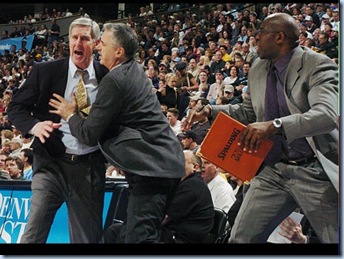
Can I has technical foul?

Sloan is well respected in league circles, though he is consistently regarded as a few notches down from the likes of Phil Jackson, Gregg Popovich, Pat Riley, Don Nelson (who has 3 CoY awards!), Larry Brown, Rudy Tomjanovich, Jeff Van Gundy (who is not currently employed as a coach) and others.

Sloan is well respected, but guys like Bryon Scott, Sam Mitchell, Rick Carlisle, Doc Rivers and Don Chaney have won Coach of the Year Awards. [Opinion Alert: I think that Sloan is a better coach than any of those guys]

Scott is an okay coach, Mitchell is a 5 game loss streak away from being fired, and Doc Rivers was fired as a coach something like 7 times already. Don Chaney has a .406 winning percentage, of if you will allow me, roughly a 60% losing percentage. He has two playoff wins in his career as a coach. He has been a CoY, while Sloan has not.

It's not about Coach of the Year Awards though, as Sloan's top assistant coach (Phil Johnson) was NBA Coach of the Year in 1974-1975. What it is about, though, is understanding why Sloan (for all of his good attributes) seems to be a step behind that first group, and stuck in a situation where former Players with little coaching experience get awards that have so far eluded him. What are the major lacunae in Jerry Sloan's abilities as a coach?

1. Playing Time / Rotation Management:
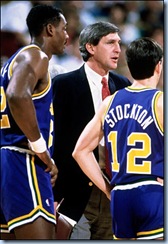
Only John has retained his hair from those days Not pictured: ref awarding Jordan two free throws Jerry Sloan has had the benefit of having John Stockton QB his teams since Jerry Sloan first became the Head Coach in '88. Stockton has always heeded Jerry's command (like any good soldier), and as such, he was at the mercy of Sloan during the most important 12 games of John Stockton's career -- the NBA Finals in 1996-1997 and 1997-1998. Jer' has coached John for quite a while, so you'd think Jerry knew how important these games were to John's career and future legacy.
Photographed by Andrew D. Bernstein/NBAE via Getty Images    

But one of Jerry Sloan's major flaws was expressed in those 12 games. Sloan likes to stick to a rotation, which may or may not have contributed to prolonging the careers of his players at the expense of wins. Malone and Stockton both played up to the age of 40 -- but a few seasons before they'd reach those milestones they were in the NBA Finals. In those years Sloan's regimented playing time and rotation scheme called for Stockton to exit the game at the 6 min mark of every first quarter -- regardless of any other circumstances in the game (who was on the floor, were the Jazz on a run, who had fouls, who were they playing against, what the score was, etc). Sure, this may have saved John for the playoffs -- but when the Jazz finally got to the finals, why did he continue to hold John back?

Stockton was easily the best and most consistent player during those finals runs, and it would be pure folly to imply that the Jazz weren't a better Jazz team with Stockton on the floor (no matter how very adequate, and sometimes amazing Howard Eisley actually was during those same years -- you know, like having your back-up PG go coast to coast to hit game winning threes with the audacity to not call a time out, or pass to a starter). The fact that the Jazz were better is not debatable. While there are many factors which influence a win (especially in the NBA Finals), in the games that the Jazz won against the Bulls over those two seasons had John Stockton averaging 37.0 mpg. What about in the Jazz losses? John was anchored to the bench for 33.8 mpg. Correlation does not always translate to causation -- but really Jerry, what were you saving Stockton for when you had him playing 31 mins and 33 mins in game 4 and 6 in the 1998 Finals -- games where the Jazz lost by a COMBINED 5 points, were you saving him for the next round after that, or the off-season? Now, I'm not saying that if Jerry played Stockton more that we would have won the title, no one can say that. What I am saying is that perhaps if he was on the floor more (like to end the 1st quarter, so the Jazz wouldn't start the 2nd quarter already behind and have to fight their way back into every game), the Jazz would have had a better shot to win more games.

  1996-1997       1997-1998    
Finals Game # Stockton's
Minutes Played
Outcome Difference   Stockton's
Minutes Played
Outcome Difference
Game 1 38 Loss -2   35 Win +3
Game 2 39 Loss -12   31 Loss -5
Game 3 37 Win +11   26 Loss -42
Game 4 38 Win +5   31 Loss -4
Game 5 36 Loss -2   38 Win +2
Game 6 37 Loss -4   33 Loss -1

Stockton's MPG in Wins: 37.0 mpg -- Stockton's MPG in Losses: 33.8 mpg.

Current examples of Jerry Sloan's crazy substitution pattern exist in the whole Matt Harpring / Andrei Kirilenko dynamic (where Harpring's mins have been cut a bit, but he still gets way more burn than he needs in the face of evidence that Andrei's magic number is 37 mpg, any less, and he's not amazing). And let's not even get into the whole "younger player" issue (you know, like playing Deron Williams so little as a rookie, and at that, playing him at Shooting Guard instead of Point Guard, and so forth -- but more on that below).

Jerry's use (or disuse) of Stockton at a very critical time is probably the best example of him being bull-headed and sticking to his system against evidence that suggests that it may be okay to run the horses a bit. Then again, this was the Jazz Sloan who used to play Adam Keefe 27.5 mpg or something insane like that.  

2. Very slow to adapt to changes in the game:

Do you ever watch games on TV and when one team goes on a run, to stop the momentum and regroup, the other team's coach may call a time out? Yeah, Jerry Sloan hardly ever does that. Jerry Sloan hoards time outs and possibly thinks that they are like roll-over minutes with his cell phone plan. Unfortunately they are not.

Some coaches can get away with not calling a time out, like Phil Jackson, but that's only because he has some heady vets on his team (like Kobe and Fisher, who have played in a few NBA Finals games) -- Sloan could get away with this back when the average age of the team was 33 and everyone was battle tested in the playoffs like in those Finals teams.

That's not the case with this team -- he should probably use time outs a bit more. Especially when other teams go on their 2nd quarter runs.
Jerry Sloan calls Time out by accident
  Photographed by unknown, NBAE/Getty Images

That's just one thing though . . . adaptation is the key to survival -- in nature and in the NBA. (unless you have tenure, like Sloan does) Sloan does an okay job making game-to-game adjustments as I've already mentioned . . . but he loves his game plan. He will go into a game with one plan, and one plan alone. If the plan does not work, he will continue with that plan just to prove a point or because he is stubborn, or maybe, because he honestly did not believe than an alternative plan was even needed. (As he sits dumbfounded with his mouth agape as the Jazz get blown out in the finals by 42 points in one game) If another guy is really hot, how often do we see any defensive scheme changes to counter this? Jerry Sloan's idea of changing things up defensively seems to just mean shuffling around who defends a particular player. (Hmmm, Tim Duncan is killing Memo one on one, let's put Boozer on him . . . hmmmm . . . Tim Duncan is killing Boozer one on one, let's put Jarron on him . . . . hmmmm . . . Tim Duncan is killing Jarron one on one, let's put Hoffa on him . . .  ad nauseam)

3. His Personal Pet Peeves hamstring the teams he coaches:

You ever wonder why some players just go off on the Jazz? It's partly because of the whole inability to make in-game changes. The other, probably more chronic, issue is the fact that Jerry Sloan has a very diverse and particular set of pet peeves. No, I'm not talking about everyone having to have their shirt tucked in, or no head bands or whatever . . . I'm talking about the fact that he'd rather kiss Phil Jackson's ass than actually set up a defensive scheme that calls for double teaming someone. Do you guys remember that game where LeBron James had his first 50+ point game of his career? The game where it was basically Devon Brown, Matt Harpring and Andrei Kirilenko guarding him one on one for 48 minutes? [just watch that video, each one of his baskets is made by being defended one on one, even after he had scored 39 points, Sloan keeps the Jazz in single, man to man defense] I know LeBron is good, Jerry should too by now. I know he can win a game by scoring 50+ points -- I'd rather go with him passing it up to Anderson Varejao or Eric Snow (who was on the team back then) and have them try to beat us instead.
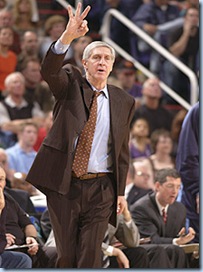
Sloan asks the ref what this symbol means, and why the other team has the ability to make open jumpers . . . while Scott Layden attempts to eat his blue highlighter Forget the scrubs, if there is anywhere that the Jerry Sloan Jazz want you to beat them from it is from the outside. Utah has always seemed like they just wanted to dare other teams into taking outside shots. This strategy may be a remnant from the Sloan's Dick Motta inspired playbook that was created back when teams did not really shoot often from deep, nor did they have players who were good at that. Times have changed and today's NBA features many teams that not only like to take open three point shots, but have multiple threats from downtown. For example, just look at the LA Lakers who have tons of outside shooters (Kobe, Fisher, Sasha, Vlad-Rad, Farmar, Walton, Ariza and even Odom can knock down jumpers), is it any wonder why we lost to them?

Sloan: oh noes! Teams that can make wide open jumpers when no one is even close to defending the open man -- my ONE weakness . . . how did you know?
Photographed by Barry Gossage, NBAE/Getty Images  

The whole three point line thing seems to be just an under-explored and confusing aspect of the game for Sloan (like the concept of the female orgasm in good, old fashioned, 1950's America). Local heartthrob Kyle Korver admits that the Jazz do not have plays in the playbook for a last second three -- or any plays that really have the three point shot in mind at all. (Which explains why our last offensive play of the 2007-2008 season was a sequence of bricked shots, or why Matt Harpring was taking awkward looking, last second mid-range jumpers for us in previous seasons when we needed a bucket.) 

So he doesn't like to double team, which allows for the other teams' best offensive player to go to work and score a lot of points. He also doesn't like the outside shot -- and that would work great if there was a specific code of honor that all coaches lived by: 'I won't use the three point line, and you don't use it either, deal?' Jerry, other teams will take what you give them, and if you give them open looks from deep, they will take those shots and burry us with them. (And have been for seasons) Anything else?

He is pretty old school, and that old-school-ness can work for some players and be absolutely horrible for others. Greg Ostertag was a flawed player, but I have no doubt that if Ostertag had a more touchy-feely coach that he could have been no lesser than a Luc Longley (who was a solid starter), rather than a guy who was dunked on slightly less than Shawn Bradley.

His major pet peeve is perceived effort. Which probably explains why guys like Adam Keefe and Matt Harpring get burn over the more talented, yet apparently less hard working guys like Chris Morris and Gordan Giricek (when he was here). [Btw, look at Giri's career stats, he wasn't a bad player at all, neither was Morris . . . yet look at how they were used in our system. Were they bad players, or just used poorly?] I understand the meritocracy involved in rewarding hard working players with playing time, but what about wins?  Giricek and Sloan never saw eye to eye
  Photographed by Matthias B. Krause/Icon SMI

Chris Morris and Giricek would absolutely smoke Harpring and Keefe in a game of 2-on-2. They were better players, even if Sloan did not treat them as such. Which brings us to how Jerry Sloan . . .

4. Revels in Power Distance:

Jerry Sloan is the boss. His staff knows it. The owner of the team knows it. The media knows it. And most importantly, his players know it. And as far as being the boss, he's far from the most approachable, understanding, and cooperative one around. He takes issue with star player and scrub alike -- he admitted that if you could freeze time during that moment when Stockton got the defensive rebound and threw the football hail marry pass to Malone in the finals for a key bucket in the 4th quarter that he would have liked to strangle Stockton while the ball was in the air. (Really, who says these things, even if they are true?) The issues that he has with players can stem from a lot of root causes: perceived self-worth (Carlos Arroyo), consistent effort (Greg Ostertag), sexual orientation (John Amaechi), degree of free will and autonomy (Gordan Giricek), inability to read minds and/or complete objectives that are never fully explained or consistent from game to game (Andrei Kirilenko).
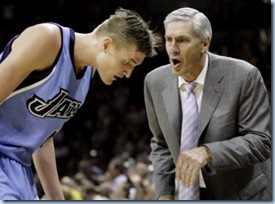
How many times do I have to tell you Andrei? You're only allowed to touch the ball on defense when you get weakside blocked shots because Memo and Booz don't play defense! I freely admit that I'm kind of an AK-47 homer. He used to be 'The Man' and has had to adjust to different roles on the fly -- while getting none of the credit that he deserves from Sloan. One season, he's the Point Forward and earns a trip to the All-Star game. The next, he's a leper. The next, he starts off as a leper, but due to injuries, his role is expanded. (Guess what, he started to play better!) His role has oscillated like a yo-yo for the last couple of seasons depending on roster moves and injuries to other guys. (as has his playing time) He can do everything from get a triple double or 5x5 to play point guard in the Western Conference Playoffs against Baron Davis. It is insane to think that he's not the most versatile and over-all talented player on the team.
Photographed by Matt Slocum, AP Photo  

Deron is the best player, and most consistent. This is not up for debate. Neither should be the fact that Andrei is paid on a scale that only makes sense based on his talent and ability -- and not how he is used or applied. (Who chooses how he is used again? The Head Coach.) As good as Andrei is the last few seasons with Jerry Sloan have pretty much ruined him. It would not surprise me to see Andrei leave the NBA for good after his contract is over and return to his native Russia a hero. Why am I blaming Jerry Sloan?

I'm blaming Sloan because he's the one who should be the guy who helps manage players -- especially players who have changing roles and need to make transitions. Probably no transition is harder to make than from being 'The Man' to being the 5th option on offense, yet the thankless workhorse on defense. Phil Jackson, for all of his smarmy-ness and douche-baggery , has been able to coax nutcases like Dennis Rodman, Bison Dele, Ron Harper, J.R. Rider and others to perform at a high level. Sloan and AK have worked together for 8 or so years now, why does AK still not know what he's supposed to be doing?

Maybe it happens to be because Sloan keeps changing his expectations of him, and due to his power distance, AK is the only one who gets the blame when things go wrong. Other players have long since gotten the boot for getting 'sideways' with Jerry Sloan. (Sloan just knows that AK's defense is so valuable that he can't completely kick him off the team) Personality is a big part of communication, and when you give someone so much power it's hard for their sense of 'right' to not come out in their personality. The psychological aspects of motivation are just as puzzling to Jerry Sloan as the three point shot appears to be. I guess in his hard headed universe (you know, the kind where there is no back up plan for any given game) there is only one way to motivate -- by yelling, swearing and saying mean things. This is probably a contributing factor as to why when AK is taken out of the game he sits as far away from Sloan as possible -- Sloan is just an impossible guy sometimes.

5. Makes mistakes, admits to making mistakes, does not change so mistakes can continue to be made in the future:

Jerry Sloan can be 'like' an abusive spouse in his consistent merry-go-round of making mistakes, admitting to making mistakes, suggesting that changes will be made, but actually no real changes are made, and mistakes continue to occur. How many times do we hear (after a season is over) that "I probably should have played __________ (insert breakout player's name here, some recent examples include Mehmet Okur, Deron Williams, and Ronnie Brewer) more during the season"? Pretty much every season. Memo had a break out year, and Sloan said that it was a mistake to not have played him more. The next season they draft Deron -- and again, Sloan does not play him as much as he should -- only to say that he should have, after the fact. What happens the next season? Ronnie Brewer doesn't play, and after his 2nd season Sloan basically says "My bad" again. And we just eat it up -- our neutral reaction to his maladaptive behavior reinforces his psychopathology.

Sloan is an old dog, and he does not want to learn new tricks. He has shown some improvement over time (that probably only I have noticed), he allows guys like Memo to shoot threes, and is not completely against a guy throwing an alley-oop now and then. (He still may not like it, but he's not going to bench a guy for getting an assist) Unfortunately, the majority of his change seems to occur over a span of 10 games. I don't want to belabor the point but part of the whole AK situation is that Andrei will complain because of how he is used, Sloan and him will talk and Sloan will agree to make changes, the next few games things are better and AK is more productive, then after 10 games or so, things will revert back to normal and the cycle will start again. (Part of the reason why this Sloan/AK deal is less resolved than it should be happens to be because it is never really resolved fully.)
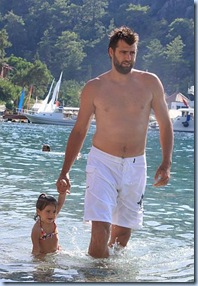
Don't talk to me about Coach Sloan right now, I'm on vacation How many coaches would make a habit of pissing off their best players by not giving them the playing time that their skills deserve? Deron Williams will never fully heal, and while he respects Sloan as a coach (and his Boss), he still isn't shy about admitting that he knows he should have played more as a rookie (you know, the season where everyone was all about Chris Paul, and no one mentioned Deron because he wasn't playing?). I don't know if Memo cares about how he was treated, but the younger guys probably do care (like Brewer, and likely, C.J.). For the record, Deron, Ronnie, Andrei and Memo comprise 80% of the starting line-up. Those are all guys that Sloan has made significant impressions (first or most recent in the case of Andrei) on as 'the guy who is going to be a dick and not play you, even though you are better than the guys who get playing time'. One wonders who the 'next' guy he'll come out and suggest he should have played more will be? My money is on Fesenko, after next season when he starts off averaging 4.3 mpg with the Jazz only to end up being better than Jarron Collins and finally usurp his mpg.
Photo from memo13.com  

Sloan is old school and I appreciate and respect the fact that when he is wrong he is really okay with saying it like it is. He will admit to being wrong in the instances where he understands that he is wrong. (Unlike a guy like Phil Jackson who will make an infinite number of excuses for anything bad that happens, like blaming the physical play of the other team, their fans, injuries, etc) I would appreciate Sloan even more if he actually stuck to fixing the mistakes, even if that would prevent him from admitting to making them in the first place.

Conclusion:

Wow, if you add it all up these 5 errors truly are epic. This is pretty much a negative review of the only coach my team has had for the last 20 seasons . . . so I'm sure it will have to write a piece about the 5 great things that Sloan does. (And there are at least 5 of them) I don't hate Sloan, but that does not mean that I'm blind to the faults that he does have. I try to be objective on this regard. I think that there is room for improvement (and his staff helps out with this), and I do not know which coach I'd rather have take over my team if you gave me the choice to do so this moment. (Maybe years down the line after Phil Johnson says 'no thanks' I'd be okay with Ty stepping up) All coaches have their flaws, I'm just more intimately aware of Sloan's because I've been an obsessive Jazz fan for the over 60% of my life.

Sunday, August 31, 2008

79.2% of people are absolutely insane

ESPN.COM recently asked their 25 member NBA staff to rank the teams from top to bottom in each conference. The Jazz managed to snag the 4th over-all spot and are predicted to win 51 games next season. If this was a prediction for 2006-2007 that would be spot on. How accurate is this as a prediction for 2008-2009? Probably highly inaccurate at best as the Jazz were an absolutely horrible road team last season, were very flawed, and still managed to win 54 games. Furthermore, the vast majority of ESPN's Sportsnation (they allow you to vote on these things, you see) believes that this prediction (51 wins) is either on the money or too high. How many people is this? I don't know, but only 20.8% of people think that 51 wins is too low for the Jazz.

So basically the Utah Jazz are going to regress after being a year older and wiser, and getting a great backup PG (for the price of Jason Hart), and a few young 7 footers -- either that, or ESPN, their "Experts" and 79.2% of their Sportsnation are flat out insane.

Anyway, here is just as a short refresher course on the Jazz' recent history:

* 2004-2005 (26 wins) -- AK and Boozer are injured for the majority of the season, the Jazz end up paying guys like Curtis Borchardt, Randy Livingston, Ben Handlogten and Aleksandar Radojevic money to fill out a roster for a team that is lead (in total points) by Matt Harpring for a season. Among other crazy stats that season the Jazz had 5 different point guards start at least one game: Keith McLeod (47 games), Carlos Arroyo (16 games), Raul Lopez (15 games), Randy Livingston (4 games) and Howard Eisley (1 game).

* 2005-2006 (41 wins) -- Boozer misses yet another season while the resurgent Utah Jazz miss the playoffs by 1 win as they are lead by Mehmet Okur (18.0 ppg, 9.1 rpg) and the outstanding Andrei Kirilenko (15.3 ppg, 8.0 rpg, 4.3 apg, 3.2 bpg, 1.5 spg). Over the summer the Jazz traded up in the NBA Draft and selected Deron Williams with the #3 pick, yet Keith McLeod and Milt Palacio still manage to start a combined 50 games this season.

* 2006-2007 (51 wins) -- The Utah Jazz remain mostly healthy this season and win the division and end up winning 9 playoff games in their first trip back to the post season since the Stockton and Malone days. Carlos Boozer had a great season (20.9 ppg, 56.1 fg%, 11.7 rpg) while Andrei has a stinker (8.3 ppg, 4.7 rpg, 2.9 apg, 2.1 bpg, 1.1 spg) when compared to this production (as a point forward) the previous season. Deron Williams also breaks out for 16.2 ppg and 9.3 apg -- second best in the league that season.

* 2007-2008 (54 wins) -- This past season had the Jazz dominating teams at home, and losing to some absolutely crappy teams on the road -- but still increased their season win total from last season to 54 wins and won another division title. This team finally got rid of Gordan Giricek (good player, wrong fit for this team) and tweaked the line-up a bit as Ronnie Brewer (in his 2nd season) became the full time starter at the two and responded with 12.0 ppg (55.8 fg%) while chipping in 2.9 rpg, 1.8 apg and 1.7 spg in less than 28 mpg. The Jazz lost to the eventual Western Conference Champions in a tough 6 game series in the second round of the playoffs.

Unless ESPN has some sort of parabola idea (i.e. the season after the 51 wins we go back down to 41 wins, and then 26), then this makes little sense. You don't have to be John Hollinger to understand how to read this. How do we go back down to 51?

So . . . it's obvious that the Jazz are going to win less games this season, even though every season the Jazz get more experienced and play better while the roster improves. None of our starters are 30, and we added Brevin Knight (who never turns the ball over) to be a part of our 2nd unit. None of that matters because of Ron Artest now plays in Houston, and uh, Chris Paul has dreamy eyes! Therefore, the Jazz will not win, at least, as many games as last season. We have made few headline breaking moves this season. Also, apparently, none of our young players will get better, if Deron Williams can go from being a 2nd year player to a guy who averages a double double in the NBA Playoffs then that obviously indicates that the Jazz draft players who do not project to improve -- hence, Ronnie Brewer will not improve from what he has become after 2 seasons in the NBA. Same deal with Paul Millsap (who could start for a lot of teams), C.J. Miles, Morris Almond, Kosta Koufos and Kyrylo Fesenko.

Woe is us . . . back down to 51 wins this season. Right ESPN? Either that, or fire your "Experts"

Round One: Fight!!! ESPN.com's "expert" picks for the 1st round of the 2006-2007 NBA playoffs -- Utah won the series in 7 games.
Round 2: Fight!!! ESPN.com's "expert" picks for the 2nd round of the 2006-2007 NBA playoffs -- Utah won the series in 5 games.

A special shout-out to the fan who created those images and posted them on the Internet! Thanks!

Wednesday, July 30, 2008

Point for Point

The Utah Jazz have been lucky in some ways, and unlucky in others. One of the greatest examples of this is how they have had some pretty good point guard play over the years. Perhaps luck has nothing to do with it, and it's rather the scouting department and player development that has much to do with the apparent success of Ricky Green, John Stockton and now, Deron Williams. Of course there were some lean years along the way, specifically the capable though unspectacular trio of Carlos "Pride of Puerto Rico" Arroyo; Raul "The Hispanic Heartthrob"Lopez; and Maurice "Mo" Williams -- but those days are now gone.

Ricky Green was the reason why Stockton didn't start until his 3rd year in the League Stockton is, probably, the best player in franchise history Raul Lopez quickly became a pariah Success went to Carlos Arroyo's head Mo Williams now plays in Milwaukee Deron Williams is the most dangerous point guard the Jazz have ever had

Recently, as recent as last week, the Utah Jazz front office was able to trade Jason Hart for Brevin Knight. This type of trade may have no overt impact in the short term -- though this trade may resonate within the consciousness of fans for generations to come -- like the trade that brought Ostertag back to Utah. Or maybe not. That said, this position for the Jazz has not been this secure since the days of Stockton, Eisley and Vaughn.

Point for point -- Brevin Knight is the superior player out of the two traded. Through this measure, Kevin O'Connor won the trade. It doesn't hurt that Knight makes less money and is pretty talented for a 3rd stringer. It's also good to know that Knight is just too damn short, and not a good enough shooter for Jerry Sloan to go crazy, and contemplate starting -- like he did with that Deron Williams / Derek Fisher starting lineup in the 2006-2007 season. Neither are perfect . . . Hart was to bring defense and veteran leadership, but ended the season deep on the bench while Ronnie Price made fans and the media go wow! Brevin is good at taking care of the ball, but has made only 16 career three pointers. That is a ridiculously low number which makes me cringe at the thought of him being in the game, and the other team immediately clogging the paint and passing lanes with a super-duper zone defense.

Brevin Knight better not take Morris Almond's #22 Hart returns to the Clippers! Success!

Photo by NBAE / Getty Images

Photo by NBAE / Getty Images

At the risk of repeating myself, Knight is a solid 3rd stringer because he is frequently unable to stay healthy for any long period of time, is very short, and can't shoot. All of our sets that we run rely on the point guard being able to, at the very least, keep the defense honest. Outside shooting is a key component of the NBA today -- when Portland found out that the Jazz had spotty shooting from deep (before the Korver trade) they just zoned us and laughed. I don't want a repeat of that horrible December, 2007.

Knight is also great insurance. Sometimes players get tired. And tired players who play long minutes are at risk of getting injured. John Stockton played in the Olympics in the summer of '92 and again in '96. Each season after the Olympics he had relatively 'down' seasons in the NBA (scoring and assists went down from 1991-1992 to 1992-1993, and again in 1995-1996 to 1996-1997). [For those keeping track at home, the Jazz went to the Western Conference Finals in 1991-1992, then the next season were bounced from the 1st round of the Playoffs. In 1995-1996 the Jazz were again defeated in the Western Conference Finals, and in the next season lost in the NBA Finals.] The Jazz Brass want to make sure that if Deron needs more time during the regular season to rest that they can afford to let him have it.

"I'm happy to be coming to a winning team with very good players and a Hall of Fame coach . . . How can I be upset with that? I'm also looking forward to hearing the cheers and not the boos from Jazz fans. I see my role as being a veteran guy there to do whatever is necessary to help the team win. I'll more know about that when I get to down." (Knight, 2008, via. The Salt Lake Tribune)

It's a solid deal for the Jazz, may have had some influence on the C.J. Miles re-signing and could be good for us down the road. Great move Kevin O'Connor!