Showing posts with label Western Conference Finals. Show all posts

Tuesday, October 21, 2008

ESPN's Chad Ford likes him some Utah Jazz

In a recent ESPN Podcast (click on that if you want to listen to it) Ford talks for about 2 minutes about how gosh darn awesome the Jazz are. He starts by suggesting (what a lot of people thought, including himself) that the Jazz success in the 80's and 90's were primarily due to John Stockton and Karl Malone; however, he now sees that the influence of the system and Jerry Sloan had a lot to do with it. Case in point: this version of the Jazz who are pretty strong -- partly due to the system, and partly because of shrewd roster moves by GM Kevin O'Connor.

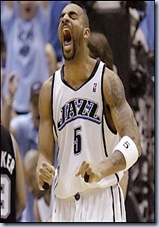
Furthermore, success in the Jazz system is predicated upon strong point guard play -- and none of this recent success would be possible without Deron Williams. Who Ford "thinks is one of the top 3 point guards in the NBA" (Chad Ford, 2008, via ESPN Podcast). He goes on about how dominant he is.

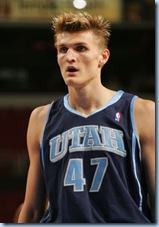
Next Ford talks about Boozer being an anchor in the paint; mentions AK-47 as a talented role player whose true contributions do not always show up on the box score; and that Mehmet Okur stretches the defense and had an amazing second half of the season for us. Surprisingly he gets himself a good seat on the Ronnie Brewer bandwagon and talks about his athleticism, his ability to play the passing lanes, he's potentially a ball hawk, and really is what the Jazz team are missing. Basically he's suggesting that he's going to be that athletic perimeter defender that we haven't had since, well, uh, Blue Edwards? (Jazz history isn't rife with great athletic shooting guard lore) Over-all the Utah Jazz's depth, head coach and system are hard to ignore. Such that:

ESPN Chad Ford

"I think that if anybody is going to be able to stop the Lakers this year it's the Utah Jazz -- they're great at home, they are getting [increasingly] confident, they have a great mixture of youth and veterans, and I think at the end of the day, if there's a team that is going to surprise us in the West, it's going to be the Utah Jazz." (Chad Ford, 2008, via ESPN Podcast)

Chad Ford, ESPN  

I haven't heard any of his other team podcasts, but I doubt he's going to be really critical (well, maybe the Pacers and Bobcats...) in any of them. If you want, you can listen to them all here. Over all, I agree with him -- our bench is under rated, our system works, and we have some athletic young talent for once. NBA Finals here we come!

Friday, September 26, 2008

Flashback Friday: The 1988-1989 Utah Jazz

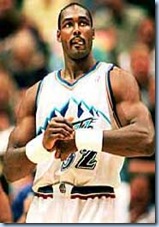
This 1988-1989 Utah Jazz team is historic for a variety of reasons. First of all, this team was the first in franchise history to win 50 or more games in a season. (They would win 51, a mark that the Jazz have equaled or bested 12 times since then) Second, they featured a 25 year old Karl "The Mailman" Malone who was coming into his own.

Bigger, Stronger, and Faster than Amare Stoudemire

[Tangent Alert: I hate all the hype Amare gets, if dude is so good and a beast why isn't he scoring 30 a game like Karl did? Karl Malone >>>>> Amare Stoudemire. For the record, all Karl did that season was score 29.1 ppg (51.9 fg%), go to the free throw line 11.5 times a game, average 10.7 rpg, 2.7 apg, 1.8 spg and 0.9 bpg. What did the "Beast" Amare do at the age of 25? He got 25.2 ppg, 9.1 rpg, 1.5 apg, 0.8 spg and 2.1 bpg.

Amare didn't even get to the FT line 10 times a game, or ever has in his 6 year career, Malone did it 3 times in his first 6 years alone.

Karl even shot better from the three that season (5-16 [31.3%] to Amare's 5-31 [16.1%])! So aside from blocks, his age 25 stats are owned by Malone at 25. And as for blocks . . . Karl was playing with Mark Eaton who sent back 3.8 shots a game "so yeah . . . think about it!" (read the 3rd one on that page to get this joke)]

Back to that Jazz team . . . aside from Malone becoming a force of nature, he also had some help from Eaton (previously mentioned as blocking 3.8 shots a game, but also getting 10.3 rpg on his own on his way towards being named and All-Star and the Defensive Player of the Year); Thurl Bailey chipped in 19.5 ppg, 5.5 rpg and 1.1 bpg; Griffith kept people honest on defense with his outside shooting (61 3pt made in an era where that would be one of the top totals for any player) . . . and this John Stockton guy had one of his several seasons that are arguably better than Steve Nash's MVP seasons. John would finish up with 1118 assists that season, a pretty average output for him, but still 221 more than Nash's best ever season. [I guess the whole Stockton vs. Nash thing is another tangent altogether . . . so just click here if you want to read an empirical analysis of their recorded effect on the game.] This season was also the last for Frank Layden, who would give the coaching job to Jerry Sloan 17 games into the season.

Goliath? Is that you? Griffith brings the ball up the floor Frank Layden orders three hot dogs and a beer
Mark Eaton blocks one in the All-Star game . . . one of his over 300 blocks that season. Due to Karl's development, 6'11 Thurl was often left posting up on small forwards . . . to the tune of nearly 20 ppg as the 3rd option. Dr.Dunkenstein's career was wrapping up, but he still had enough to average more than Kirilenko or Brewer did last season. Frank Layden was a more fun coach than any coach after him . . . or perhaps before him.

There are many reasons why the 1988-1989 Utah Jazz team could be called historic. There were many good things that happened this season:

  • This team had a coaching change during mid-season, and they were motivated and rejuvenated by having a young coach at the helm
  • They had some very talented players (three All-Stars, Bailey and Griffith) to offset an anemic bench
  • They won the Mighty Midwest Division Title for the first time with this core group (the first time in post-Dantley, post-Maravich era)
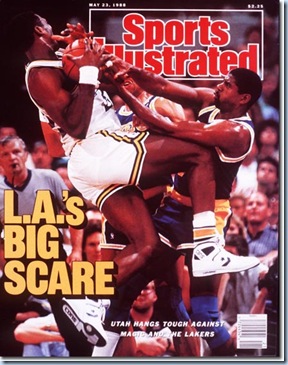
  • Last season they took the NBA Champion LA Lakers to 7 games in the 2nd round of the playoffs -- and scared them good.
  • The sky was the limit for this team that turn into a 'contender'

This is somehow not a foul . . .

That said, there is one reason why I find this team particularly interesting. This team, for all of their successes, took a step back after building so much momentum. Sure, three seasons later they would reach the Western Conference Finals for the first time in franchise history (and reach there 5 times in the 7 successive seasons) -- but during this upswing in success the Jazz fell back down and were swept from the Playoffs in the 1st round. (Thanks Golden State!) This troubles me because right now the current Jazz franchise is experiencing a second upswing and a similarly linear progression . . . and it would really suck to have to go through those bumps and bruises all over again as a fan. (I've been emotionally invested in this team since the 1987 season, and am finally getting over all those 1st round losses)

I am even tempting fate here by even bringing all of this up right now . . . as our beloved Jazz are 'perhaps' (if history repeats itself) primed for a less than stellar playoffs? (After all, we did just play LA in the 2nd round of the playoffs 20 years after the first time it happened) Ultimately you have to look at all of the good things that happened this season and find them to be inconsequential when examined against a 0-3 playoff elimination in the 1st round to an underdog team with no bigs. The 1988-1989 Utah Jazz season was not a good one . . . simply because where they where and where they ended up fell below expectations. This Jazz team is even ahead of the curve because they've already been to the Western Conference Finals (2 seasons ago), while at this point 20 years ago, the Jazz were still three seasons away.

I wish for the best for the Jazz in this, and all seasons; but would really pray against another regression year. After all, there is no guarantee that our current window of opportunity as a contender will stay open for as long as the window we had 20 years ago.

Sunday, August 31, 2008

79.2% of people are absolutely insane

ESPN.COM recently asked their 25 member NBA staff to rank the teams from top to bottom in each conference. The Jazz managed to snag the 4th over-all spot and are predicted to win 51 games next season. If this was a prediction for 2006-2007 that would be spot on. How accurate is this as a prediction for 2008-2009? Probably highly inaccurate at best as the Jazz were an absolutely horrible road team last season, were very flawed, and still managed to win 54 games. Furthermore, the vast majority of ESPN's Sportsnation (they allow you to vote on these things, you see) believes that this prediction (51 wins) is either on the money or too high. How many people is this? I don't know, but only 20.8% of people think that 51 wins is too low for the Jazz.

So basically the Utah Jazz are going to regress after being a year older and wiser, and getting a great backup PG (for the price of Jason Hart), and a few young 7 footers -- either that, or ESPN, their "Experts" and 79.2% of their Sportsnation are flat out insane.

Anyway, here is just as a short refresher course on the Jazz' recent history:

* 2004-2005 (26 wins) -- AK and Boozer are injured for the majority of the season, the Jazz end up paying guys like Curtis Borchardt, Randy Livingston, Ben Handlogten and Aleksandar Radojevic money to fill out a roster for a team that is lead (in total points) by Matt Harpring for a season. Among other crazy stats that season the Jazz had 5 different point guards start at least one game: Keith McLeod (47 games), Carlos Arroyo (16 games), Raul Lopez (15 games), Randy Livingston (4 games) and Howard Eisley (1 game).

* 2005-2006 (41 wins) -- Boozer misses yet another season while the resurgent Utah Jazz miss the playoffs by 1 win as they are lead by Mehmet Okur (18.0 ppg, 9.1 rpg) and the outstanding Andrei Kirilenko (15.3 ppg, 8.0 rpg, 4.3 apg, 3.2 bpg, 1.5 spg). Over the summer the Jazz traded up in the NBA Draft and selected Deron Williams with the #3 pick, yet Keith McLeod and Milt Palacio still manage to start a combined 50 games this season.

* 2006-2007 (51 wins) -- The Utah Jazz remain mostly healthy this season and win the division and end up winning 9 playoff games in their first trip back to the post season since the Stockton and Malone days. Carlos Boozer had a great season (20.9 ppg, 56.1 fg%, 11.7 rpg) while Andrei has a stinker (8.3 ppg, 4.7 rpg, 2.9 apg, 2.1 bpg, 1.1 spg) when compared to this production (as a point forward) the previous season. Deron Williams also breaks out for 16.2 ppg and 9.3 apg -- second best in the league that season.

* 2007-2008 (54 wins) -- This past season had the Jazz dominating teams at home, and losing to some absolutely crappy teams on the road -- but still increased their season win total from last season to 54 wins and won another division title. This team finally got rid of Gordan Giricek (good player, wrong fit for this team) and tweaked the line-up a bit as Ronnie Brewer (in his 2nd season) became the full time starter at the two and responded with 12.0 ppg (55.8 fg%) while chipping in 2.9 rpg, 1.8 apg and 1.7 spg in less than 28 mpg. The Jazz lost to the eventual Western Conference Champions in a tough 6 game series in the second round of the playoffs.

Unless ESPN has some sort of parabola idea (i.e. the season after the 51 wins we go back down to 41 wins, and then 26), then this makes little sense. You don't have to be John Hollinger to understand how to read this. How do we go back down to 51?

So . . . it's obvious that the Jazz are going to win less games this season, even though every season the Jazz get more experienced and play better while the roster improves. None of our starters are 30, and we added Brevin Knight (who never turns the ball over) to be a part of our 2nd unit. None of that matters because of Ron Artest now plays in Houston, and uh, Chris Paul has dreamy eyes! Therefore, the Jazz will not win, at least, as many games as last season. We have made few headline breaking moves this season. Also, apparently, none of our young players will get better, if Deron Williams can go from being a 2nd year player to a guy who averages a double double in the NBA Playoffs then that obviously indicates that the Jazz draft players who do not project to improve -- hence, Ronnie Brewer will not improve from what he has become after 2 seasons in the NBA. Same deal with Paul Millsap (who could start for a lot of teams), C.J. Miles, Morris Almond, Kosta Koufos and Kyrylo Fesenko.

Woe is us . . . back down to 51 wins this season. Right ESPN? Either that, or fire your "Experts"

Round One: Fight!!! ESPN.com's "expert" picks for the 1st round of the 2006-2007 NBA playoffs -- Utah won the series in 7 games.
Round 2: Fight!!! ESPN.com's "expert" picks for the 2nd round of the 2006-2007 NBA playoffs -- Utah won the series in 5 games.

A special shout-out to the fan who created those images and posted them on the Internet! Thanks!

Friday, August 29, 2008

Flashback Friday: Remembering Duckworth


This last week we lost another large part of my youth as a basketball fan to the passage of time.

On Monday Kevin Duckworth passed due to complications of congestive heart failure. How old was he? Rather, how young was he? He died at the age of 44 -- which we all can agree, is just too soon to go.

Many bloggers have already discussed the event, their reactions to it, along with their memories of Duck.

Now I throw my hat in the ring as well.

  Kevin Duckworth Tribute [3:54] The best picture is the one with the deer. Such a gentle man, sad to see him taken from us so soon.

As a die hard Utah Jazz fan there are several franchises out there they I find it very hard to root for / feel sorry for when bad things happen to them. The first one would have to be the Los Angeles Lakers -- as they have (so far) book ended my career as a Jazz fan with 2nd round defeats (first a 7 Game series back in 1987-1988 and most recently in 2007-2008). The second team would have to be the Chicago Bulls -- as they defeated Utah in the finals twice -- partly due to some dubious calls (Game 6 of the Finals in '98 for example). The last one would be the Portland Trailblazers (though the Denver Nuggets and Charlotte New Orleans Hornets are getting up there). [Additionally the San Antonio Spurs have earned their own personal layer of hell in my heart, and don't fit into this equation.]

I still vividly remember the Jazz getting eaten up by Clyde Drexler, Terry Porter, Buck Williams and crew back in the 1990-1991 season, and how the Jazz lost in the West Finals to that Portland team (a team that featured Kevin Duckworth) again the next season in 1991-1992. Then Portland took the Jazz out a few seasons later in 1998-1999 -- and ended Jeff Hornacek's career in the 2nd round.

That said, losing Kevin Duckworth cannot make anyone, save for the greatest Portland hater happy.

I watched him play for many seasons and he just looked, moved and acted differently than other members of the Jailblazers Franchise. He was a starter on some very good teams and while he never averaged a double double in his career (that was over a decade long), he was an All-Star twice. He did average over 20 and 10 in the playoffs one season (1987-1988) though. As the Blazers continued to get better, and gather better talent, he appeared to be the weak link in their starting lineup. (Terry Porter, Clyde Drexler, Jerome Kersey, Buck Williams and Duck) Eventually he became a pariah and was not always loved by the fans (which conflicts with the revised story that they apparently always loved him, which came out after he died). I seemed like a really nice, Type B personality guy who for whatever reason, ended up playing basketball as well as he could -- but that was hardly good enough for some people. In that regard he reminds me of how fans, coaches and players treated Greg Ostertag. He was doing his best, but giving your all wasn't good enough sometimes.

Duckworth throws it down!

One great moment in time that I look back at happened on some TV game back in the early 90's. The Blazers were well on their way to winning the game. Their coach (Rick Adleman) was taking out the starters in slow waves and the home crowd gave each a healthy applause. The TV crew working the game (including Bill Walton and Steve Snapper Jones) concluded that he was leaving Duckworth for last because he had been playing spectacularly well -- and deserved the positive ego boost of hearing the crowd cheering him for his good work.

It was a grand gesture that would have made Duckworth happy -- and even though I hated the Blazers, the thought of him -- the underdog -- getting his day in the sun, made me happy.

Unfortunately there would be no happy ending, as after all the starters (save Duckworth) were on the bench and the celebrations started Adleman called a time-out, and Duckworth was substituted out in this manner -- he never got a chance to hear his name called over the arena PA system, he never got his applause, he never got the love that he deserved. And that really sucks.

The only other great Duckworth memory that I have was back when my brother and I would play video games together. We happened to be playing NBA Live '95 on the computer. He was using the keyboard, and I was playing with the mouse (which you can imagine was very hard to do). We were the Washington Bullets and playing against a much better team. It was a close game and many people had fouled out. I controlled Kevin Duckworth with the mouse, and as time was ticking down was able to push the computer's ball handler out of bounds (without a foul being called), thus giving us a final chance to win the game. (Which we did with a Rex Chapman buzzer beating three)

Anyway, Duckworth had career averages of 11.8 ppg (46.8 fg%, 73.6 ft%) and 5.8 rpg. His best seasons were between 1987-1988 and 1990-1991 where he scored at least 16 ppg every year and played around 30 mpg. He was an important cog in several NBA Final's teams, and did a great deal for the community after his death. I am sad to see him go. Why couldn't God have taken Bonzi Wells instead?


R.I.P. Kevin Duckworth.

Friday, August 15, 2008

Returning to the Promised Land

The Jazz brass, coaches and owner have done three things well in the post Stockton-to-Malone era:
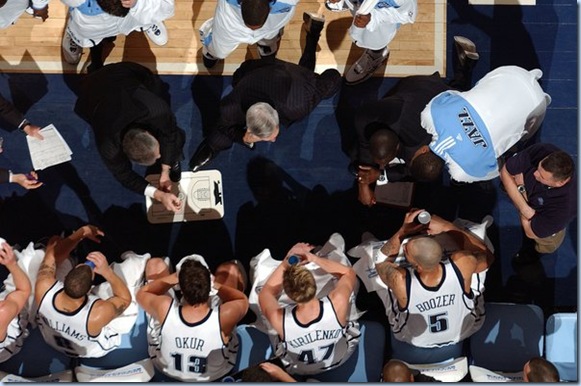
Jerry Sloan is consistently intimidating to his players.
Retuning to the NBA Finals does not occur by chance, but by following out a long term plan.

I. The first thing that the Jazz brass (and co.) has done well is they've established a winning formula, and have enjoyed a consistency that other franchises have lacked. While this has the drawback at some level of inherent stagnancy, the NBA mandated rules changes have kept the Jazz coaches on their toes. One particular rule change which threw a major wrench in the system was the removal of the previous Illegal defense rules. Now Zone Defenses are allowed -- even pseudo-Zones are hard for the Jazz to handle as it's man-to-man defense, but an extra guy to rove around and get in passing lanes -- daring the pound it inside Jazz to shoot from outside. (This was particularly difficult for the Jazz to do during December of that 2007-2008 season, which resulted in many losses)

The Zone Defense friendly NBA forced the hand of the Jazz brass and they have endeavored to start playing 5 on 5 basketball on offense for the first time ever (but more on that later). They needed to avoid Zone defenses in order to properly run their offensive sets. Previous versions of the Jazz would run their forward based offensive sets (Malone, Dantley, Bailey) and involve strong guard play all while the center fell asleep at the top of the key.

This has always been the case as the Jazz used to park Mark Eaton up at the top of the circle while he watched the finesse guys do their thing. Then Greg Ostertag came in and was able to use his height to exploit a high-low passing game inside. If you did that now, no one would follow Mark or Greg outside, and the paint would get clogged very quickly. To counter that the Jazz have further evolved by getting one of the few true bigmen (check out his rebounding games in the playoffs if you don't believe me that he's a bigman) who has a very legit three point shot -- Mehmet Okur. While the NBA has made several rule changes since the Stockton-to-Malone era, the evolution of the Jazz sets has been sped along because of smart roster moves.

The signing of Okur allows for the Jazz to move him farther than Jerry Sloan had ever imagine moving Eaton or Ostertag -- out beyond the three point line. Furthermore, Okur needs to be defended out there -- thus necessitating luring out the guy who defends him (a defensive big), or a smaller guard (causing a miss match somewhere else on the floor). The biggest benefit to this roster quirk is that it retains the floor spacing that is needed for the majority of the Jazz sets: pick and roll with the PG and PF, or finding a cutter in the vacuum left by a vacating center for easy dunks for Andrei and Brewer.

I'm surprised at how well it works, and encouraged by this -- it shows that the coaches are working with the front office to get players that can do good things on the court, and work within a system. You couldn't get away with this offensive set back in the Stockton-to-Malone days . . .
Memo shooting threes = opposing bigman is not in paint + good floor space = easy to score in the paint

II. The second thing that the Jazz brass (particularly the coaches) have done well is that they've tried to learn from their mistakes. Often Stockton was the only guy on the floor who could get the job done; and often, he was the best player on the floor. All too often (save for that elimination game 4th quarter vs. the Rockets where it was Stockton vs. Houston); unfortunately John didn't call his own number enough -- and that hurt the team. What have the Jazz done now? They've got a good passer and floor leader at the point guard -- but someone who is ultimately the most confident in his own abilities. We've had Deron for three seasons now, as we know that when it counts he's not afraid to be 'The Man' -- something Stockton always deferred to Karl (who, honestly, was not as clutch) about.

Another example happens to be expanding the game to involve more people on offense. At their most dangerous the Stockton-to-Malone teams were filled with subordinates like Hornacek and Russell, or Bailey and Griffith. Never did they fully get a chance to have 5 good offensive players on the floor at the same time (thanks, Rony Seikaly -- you could have really helped against Michael Jordan and the Chicago Bulls back then). It's hard to win titles playing 4 on 5.
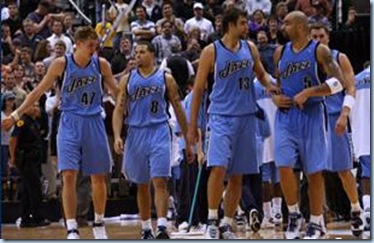
If the point of the game is to score more than the other team, then five guys who can score > four guys who can score This version of the Jazz has the ability to play 5 on 5 on offense for the first time in franchise history -- and this has not come at the expense of needing to change the entire playbook. Once the Jazz secured a good, smart point guard to tandem with their beast of a power forward (acquired as a free agent) it was going to be the pick and roll show all over again. This play used to kill teams back in the illegal defense era. Now people are allowed to zone, and as a result, relying on the pick and roll is harder to do.

In order to prevent the picker getting immediately double teamed by bigmen the Jazz need to lure out a bigman outside. Chicken and egg thing with Point I and Point II -- but that displays how inter-related things are: in order to learn from your mistakes you have to have a winning game plan. Thus, if the Jazz wanted to keep relying on forward based offensive scoring sets from the paint, some tweaks were going to be needed to be made.

III. The final thing that they have done well is that they've been able to key in, identify and get similar types of players on the roster -- attempting for coax lightning to strike twice. The obvious comparisons exist -- Carlos Boozer plays like an older, jump shooting Malone. Deron Williams is an adept passing lead guard who is clutch at the end of games, like Stockton. As always, it's more than just replacing Stockton and Malone.

Then: Now: Difference:
John Stockton Deron Williams

Not better: but more willing to step up in crunch time

Maybe they would have gotten out of the 1st round much more if we saw more of this guy? Deron Williams is 'The Man' for our team

Stockton was the consummate professional and floor leader. Possessing not just physical tools (like good health and excellent stamina), he also had vast amounts of Basketball IQ -- essentially being another coach on the floor. There would be no success without John. Similarly, Deron Williams is the heart of this version of the Jazz. He is adept at passing (had over 10 apg in his 2nd NBA season, John didn't break that barrier until his 4th). He's not the coach on the floor though, but the Quarterback who calls his own plays -- and is much more willing to do it himself. Sadly, the Jazz could have used a more selfish version of John Stockton. They may have the next best thing in Deron Williams.

Jeff Hornacek Kyle Korver

Gives up floor game and passing for a more min/maxed player

Hornacek was much more than a guy who has two Long Distance Shooting trophies at home Korver would do well to add a bit more to his game on offense

Jeff Hornacek, some people forget, was an All-Star for the West. He was the principle piece that the Sixers got back for trading Barkley -- and all he did was put up 19 ppg (.47/.39/.87), 7 apg, and 2 spg in return. Not too shabby. Hornacek had every shot, and was a much more skilled NBA player. His age and lingering injuries prevented him from being a great defender for the Jazz. Kyle Korver, also acquired in a mid-season trade from the Sixers, is more of a specialist. He is statistically a better three point shooter and free throw shooter. Over this last season Kover received shooting training with Hornacek -- and Jeff admits in his 'aw shucks' type of way that Kyle is a really great shooter, maybe better than Jeff. Jeff brought more to the table though and started.

Bryon Russell Andrei Kirilenko

Better: much more creative and a great shot blocker

Ha ha ha (silently: one day I will kill you Michael . . . one day . . . ) Why is Kobe shooting freethrows already, I haven't even checked into the game?

Before being emasculated by Jordan in the finals Russell was a confident and competent forward who was the best defensive stopper on the Jazz who could run, dunk, do whatever was asked of him, and unassumingly hit threes just when the Jazz needed them. Sound like anyone we know? Andrei is more versatile -- playing everything but center in the playoffs for us between 2006-2007 and 2007-2008; though, let's not forget that in 1998-1999 Russell had to guard Chris Webber in the playoffs due to foul trouble. Like Russell, AK-47 always has to guard to other teams' best offensive player and as often as he gets beat, he comes up with a timely deflection, steal, or block at a more critical juncture in the game. His offensive ability is truncated in his role with the Jazz, but is the most talented player on the team.

Karl Malone Carlos Boozer

Worse: but possibly owns more left-handed post moves though

Hmmm, almost time to make more kids . . . Can I has work ethic for defense plz?

Carlos Boozer is a beast by today's standards. (at least in the regular season) If you put Karl Malone at his peak in today's game he would own all of these passive, physical play avoiding bigmen. (Seriously, Amare Stoudemire never step on the same court against Charles Oakley.) Both have (at least in the eyes of jaded Jazz fans) built a reputation for not being able to equal their production in the playoffs. Unfortunately for Boozer, his drop off is so severe that it's pure folly to even talk about these two forwards in the same breath. If you want to really get a picture of how ridiculous the comparison is then read this.

Antoine Carr Paul Millsap

The same: the only difference is age and experience vs. youth

What foul? Veteran savvy FTW! How is this an offensive foul? WTF?!

The "Big Dawg" was taller and at that stage, a very savvy veteran who had all the sneaky, esoteric knowledge on how to get away with fouls. Millsap gets called for a ton of fouls -- though they are essentially the same player. Millsap is younger, has some upside, and has a lot more energy and vigor. Both had surprisingly developed offensive games -- but mostly scored close to the basket, often on put backs / tip ins. Carr was a great bench guy for any playoff team, who defended the paint, got boards and blocked some shots. He even had a 20 point game in the NBA finals once. It's not impossible to see Millsap do that well. 

Howard Eisley Brevin Knight Better: Knight + Price > Eisley + Vaughn
No one remembers how good I was Back up point guard: three point shooting not included

Eisley's career before the Jazz was nothing to write home about, and his NBA career after the Jazz was almost as pathetic as Shandon's was. Because of this many people fail to realize that he was the best back-up point guard the Jazz have ever had since John Stockton was coming off the bench. He could push the ball up the floor, knew all of the sets, was active defensively and was able to shoot the three with deadly accuracy and even hit game winners. That game winner that Deron had vs. the Cavs last season? Well, Eisley used to do that type of thing back for the Jazz in 1998. While there is little chance for Knight to be as good all-around as Howard was for the Jazz, Knight is a very solid veteran who can run a club, never turns the ball over, and is a good steals guy. This looks like another downgrade; however I'd take Knight and Price (basically a younger, more exciting Howard Eisley with less playmaking and more highlight making skills) over Eisley and Jaques Vaughn any day of the week.

Shandon Anderson Ronnie Brewer

Better: by sheer virtue of Brewer being taller and able to play the 1, 2 or 3

 I made a living off of the other team not defending meeeee! . . . and so shall I !!!

Shandon Anderson was a young, athletic, defensive minded player who played within his limitations. He never tried to become an outside bomber. His bread and butter was to sneak around and find an open spot on the floor as the other team was concentrating on the other guys (Stockton, Hornacek and Malone) more than they were on him. He turned hard cuts into layups and dunks. Ronnie Brewer is much the same, being an offensive opportunist using his speed, size and athleticism to get easy dunks as the defense pays him no attention. Both benefited from playing with eager passers (Stockton, Hornacek and Malone for Shandon; Williams, Kirilenko and Boozer for Ronnie). Both are the 2nd member of their families to be part of the NBA (Shandon's older brother, and Ronnie's dad both played). Ronnie is longer, faster and has top 5% NBA athleticism (as seen in the pre-draft combine). His shot is broken, but appears to give more to the Jazz than Shandon did -- for one thing, Ronnie starts.

Greg Foster Mehmet Okur Better: and it's not even close
Yeah! I made an open jumper! I'm the machine! Let's see you try it when you're defended and it's the playoffs . . .

Foster was an occasional starter during the two finals seasons, managing to do so in over 50 games. Okur is our full-time starting center. Both were outside shooting bigmen who were not regarded as big-time rebounders. Memo is a much better rebounder, defender, outside shooter, inside player, and is a serious playoff perform who does all the clutch things you need to win (game winners, or offensive rebounds). Foster was a better dunker -- and both guys are some crappy fight in them. Foster getting into it with the Lakers' Rick Fox, and Memo coming close to throwing down on Juwan Howard among others. Foster was an okay player, but was very annoying in that Sasha Vujacic type of way. Memo has been an All-Star and is a serious upgrade for the Jazz.

Adam Keefe Matt Harpring

Better: and also a better fitting role for this type of player

Must . . . not . . . break . . . rim with shot Must . . . not . . . break . . . knee . . . with landing

I guess we need a frame of reference when bad mouthing our own players. Adam Keefe used to start on one of our NBA Finals teams. (and play 25.6 mpg!!!) How insane is that? Keefe, who may be a better beach volleyball player than basketball player, couldn't shoot, and hardly ever caught passes. At least those are two things that Matt Harpring does (sometimes). They both were solid rebounders from the small forward spot, and both did not have three point range. Both used to get torched on defense -- but at least Harpring occasionally has one of those games where he gets 14 points, 1 steal and 5 rebounds. Keefe didn't even give us that as a starter. Harpring is a good bench guy.

Chris Morris C.J. Miles

Not Better, Not Worse: Anything we do get will be better though

I'm a good player, man . . . just give me some playing time! I'm a good player, man . . . just give me some playing time . . . or like a gameboy for the bench, either is good.

By the time Chris Morris made his way the Utah, he was a serious NBA performer who could put the ball in the basket. After three NBA seasons C.J. Miles is a guy who can't get off the bench, but who could one day be a serious NBA player. Both are taking lesser roles to play here -- Morris was a starter in New Jersey; and C.J. Miles could start for some teams (or at least, get more playing time). Both have legit three point range and can bust out for some nasty jams. Both have had clashes with Jerry Sloan -- especially over their roles. Right now we can only hope that C.J. can one day become the player that Chris Morris was before coming to the Jazz. If not, then whatever, we still have Morris Almond . . .

The Jazz brass has done a more than adequate job of emulating the roster of those Finals teams. Those finals teams sported a good mix of talent -- two Olympians, who were also All-Stars mixed in with another former All-Star and a variety of (mostly older) veteran role players. There were no specialists off the bench save for Foster who could hit an outside jumper better than most centers in that era. This team currently has three Olympians, an All-Star mixed in with two other former All-Stars (and one to be in Deron Williams). The bench is almost exclusively comprised of specialists -- Korver is the shooter, Harpring is the hustle guy, Millsap is the paint terror. There have been improvements on all major archetypes save for the fact that Morris/Miles, Carr/Millsap and Hornacek/Korver are all pretty much washes. Okur is clearly better than Foster and while Stockton is ahead of Williams in career ability, Deron Williams is far from a bad player on any given playoff game. Malone destroys Boozer, but the overall talent is upgraded. Kudos to the Jazz for being able to (at least on paper) recreate their championship contending team. Is that all? Is this team NBA Finals worthy?

One large piece is missing . . . you know, a big (7 feet tall at least), rebounding and shot blocking guy. It's a roughly Greg Ostertag sized hole. A Mark Eaton or Ostertag -- something the Jazz has always had the advantage of having, is just not an archetype that the Jazz Brass has been able to duplicate on this version of the team. Three potential prospects exist though -- one is an American born, 7'0, 19 year old Greek who can block shots, but is more likely to make them; another is a 7'1, skinny Croatian who is far removed from playing in the NBA; and the last is a 7'1 Ukrainian who has a questionable work ethic. The previous Jazz teams had to fight against the passage of time. The limiting reagent in this equation happens to be the salary cap.

Compared to those glory year teams, our current roster is better -- but we are behind in the big defensive galoot department. Does that mean that the one guy who is hated for his play, but loved for his goofiness (Ostertag) is the dividing line between serious championship contender and what the Jazz currently have? Essentially, this appears to be more truth than fiction -- as the only major weakness exists as a lack of a shot blocking presence stationed in the paint. Ideally internal improvement of our young centers will satisfy this component -- we do not need a quantum leap in center ability, we just need to get Kosta or Kyrylo to channel their inner-Ostertag. And then we'll be back in the promised land.

Friday, August 8, 2008

Flashback Friday: David Benoit

For most Jazz fans David Benoit is/was/will always be remembered as a pariah. I grew up watching Jazz put out front lines of Malone and Bailey, and then Malone and Corbin . . . when Malone and Benoit came around I had seen plenty of Jazz sets that ran Stockton, Eaton, two inside scoring forwards and a shooting guard (e.g. Griffith, or Jeff Malone).

David Benoit throws it down hard!

David Benoit was a hard dunking small forward who was long and athletic. Unfortunately for him, his game half translated to how the NBA game was changing. Back in the 80s and very early 90s you could get away with being a small forward with no outside shot. Things were changing in the mid 90s, where everyone from Pippen to Grant Hill to Dan Majerle became more proficient on the outside. Even the fabled Dominique Wilkins had to start making threes in those days. David Benoit was part of that dying breed of non-proficient outside shooting small forwards. Had he come into the league in the 70s he would have probably hung around for longer than he did in the 90s.It behooves me to recount his career arc, but according to the Unofficial David Benoit site, after being undrafted at the end of his collegiate career he went on to play in Malaga, Spain and won the ACB (the name of the league, Raul Lopez fans may be familiar with it) Rookie of the year. After that he signed with the Jazz and played hard.

He quickly impressed the Jazz brass and became our starting small forward.

Another assist for Stockton
Benoit doin' that thing he do. YouTube video "I Love This Game: Are You Ready to Fly (NBA commercial)" [0:30] uploaded by onceuponatimeinnba

Benoit's best years playing for the Jazz included being part of the 1993 All-Star Weekend Dunk contest (which took play in Salt Lake City); finishing that 1992-1993 season strong by averaging 12.7 ppg and 6.5 rpg; and in 1994-1995 he had his best year leading the Jazz in 3 pointers made (in the playoffs) and averaging 10.4 ppg (48.7%/33.0%/84.1%) and 5.2 rpg. It's important to note that his three point shooting was particularly impressive for him (and up to that point, any Utah Jazz forward).

Unfortunately for him, the team, and the fans, his strong regular season outside shooting did not carry over to the post season. The Jazz were ousted in 5 games (back then the 1st round of the playoffs was best of 5, kids) by the eventual champions, the Hakeem Olajuwon, Clyde Drexler led Houston Rockets. In the decisive 5th game the Rockets won 95 - 91 to on the Delta Center floor. Hakeem and Clyde, like they had for most of the series, did all the scoring for the Rockets. Hakeem had 33 and Clyde with 31, with no one else scoring more than 8. On the Jazz side Karl Malone had a mighty 35, Jeff Hornacek knocked down 4 threes on his way to 19 and Stockton chipped in with 12 points. What about David?

Well, David Benoit was a key element to this game. The Rockets were aware of his shaky shooting from deep, and left him open during a decisive sequence of the 2nd half when the Rockets were climbing back and eventually took the lead. David finished with 8 points, but shot quite poorly (3 for 9), and went 2 for 8 from deep. For a point of reference, Karl Malone went 1 for 2 from deep in that game. David shot the ball 6 more times from three than Karl did, and only made 1 more three than he did. It's easy to point to this as empirical evidence that Benoit *cost* the Jazz that game, and that series -- but there are always other factors at play. His NBA career was all downhill from there.

Benoit played in Europe before they started to pay well . . . David Benoit jokes around with DeShawn Stevenson in 2000 Benoit dunks it for the Sunrockers! David Benoit dominated the Japanese BJ-League playing for Saitama

Italy

Rocky Mountain Review, Utah, 2000

Benoit is huge in Japan

His last jersey

Benoit's other notable blips on my selective memory radar include that one time that one of John Stockton's kids broke his arm trying to 'dunk it like Benoit' on a kiddie hoop; and of having a poor season ending exit interview with Jazz Brass one season -- which lead to him parlaying his trade in New Jersey (and later Orlando as a part of an astonishing trade that surrounded Yinka Dare for Rony Seikaly). During his career he played all over the world: Spain (Mayoral Marists in Malaga); Italy (Roseto Sharks); Israel (Maccabi Tel-Aviv); he came back to the Jazz for that 2000-2001 season for a bit; China (Shanghai Sharks alongside Yao Ming); and in Japan (Hitachi Sunrockers, Saitama Broncos). He played till he was 38 years old and was still an integral part of his teams -- especially in leagues where he could thrive as an inside player; never having become a serious outside threat. Today he remains a coach (in some capacity) with the Broncos. (or at least he did, back in 2007-2008)

Wednesday, July 30, 2008

Point for Point

The Utah Jazz have been lucky in some ways, and unlucky in others. One of the greatest examples of this is how they have had some pretty good point guard play over the years. Perhaps luck has nothing to do with it, and it's rather the scouting department and player development that has much to do with the apparent success of Ricky Green, John Stockton and now, Deron Williams. Of course there were some lean years along the way, specifically the capable though unspectacular trio of Carlos "Pride of Puerto Rico" Arroyo; Raul "The Hispanic Heartthrob"Lopez; and Maurice "Mo" Williams -- but those days are now gone.

Ricky Green was the reason why Stockton didn't start until his 3rd year in the League Stockton is, probably, the best player in franchise history Raul Lopez quickly became a pariah Success went to Carlos Arroyo's head Mo Williams now plays in Milwaukee Deron Williams is the most dangerous point guard the Jazz have ever had

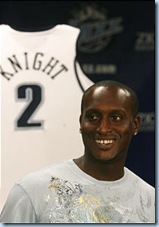
Recently, as recent as last week, the Utah Jazz front office was able to trade Jason Hart for Brevin Knight. This type of trade may have no overt impact in the short term -- though this trade may resonate within the consciousness of fans for generations to come -- like the trade that brought Ostertag back to Utah. Or maybe not. That said, this position for the Jazz has not been this secure since the days of Stockton, Eisley and Vaughn.

Point for point -- Brevin Knight is the superior player out of the two traded. Through this measure, Kevin O'Connor won the trade. It doesn't hurt that Knight makes less money and is pretty talented for a 3rd stringer. It's also good to know that Knight is just too damn short, and not a good enough shooter for Jerry Sloan to go crazy, and contemplate starting -- like he did with that Deron Williams / Derek Fisher starting lineup in the 2006-2007 season. Neither are perfect . . . Hart was to bring defense and veteran leadership, but ended the season deep on the bench while Ronnie Price made fans and the media go wow! Brevin is good at taking care of the ball, but has made only 16 career three pointers. That is a ridiculously low number which makes me cringe at the thought of him being in the game, and the other team immediately clogging the paint and passing lanes with a super-duper zone defense.

Brevin Knight better not take Morris Almond's #22 Hart returns to the Clippers! Success!

Photo by NBAE / Getty Images

Photo by NBAE / Getty Images

At the risk of repeating myself, Knight is a solid 3rd stringer because he is frequently unable to stay healthy for any long period of time, is very short, and can't shoot. All of our sets that we run rely on the point guard being able to, at the very least, keep the defense honest. Outside shooting is a key component of the NBA today -- when Portland found out that the Jazz had spotty shooting from deep (before the Korver trade) they just zoned us and laughed. I don't want a repeat of that horrible December, 2007.

Knight is also great insurance. Sometimes players get tired. And tired players who play long minutes are at risk of getting injured. John Stockton played in the Olympics in the summer of '92 and again in '96. Each season after the Olympics he had relatively 'down' seasons in the NBA (scoring and assists went down from 1991-1992 to 1992-1993, and again in 1995-1996 to 1996-1997). [For those keeping track at home, the Jazz went to the Western Conference Finals in 1991-1992, then the next season were bounced from the 1st round of the Playoffs. In 1995-1996 the Jazz were again defeated in the Western Conference Finals, and in the next season lost in the NBA Finals.] The Jazz Brass want to make sure that if Deron needs more time during the regular season to rest that they can afford to let him have it.

"I'm happy to be coming to a winning team with very good players and a Hall of Fame coach . . . How can I be upset with that? I'm also looking forward to hearing the cheers and not the boos from Jazz fans. I see my role as being a veteran guy there to do whatever is necessary to help the team win. I'll more know about that when I get to down." (Knight, 2008, via. The Salt Lake Tribune)

It's a solid deal for the Jazz, may have had some influence on the C.J. Miles re-signing and could be good for us down the road. Great move Kevin O'Connor!

Saturday, July 19, 2008

Face of the Franchi$e

While this post may be slightly late, it's getting here just in time -- similar to Deron Williams' signing with the Utah Jazz. (Which he did at 4 pm Eastern Time, on July 18th, 2008)

Deron signs as Jerry smiles and Kevin throws up gang signs

Photographed by Tom Smart, Deseret News

Deron Williams stands to become a very rich man in his time playing for the Jazz. His new contract extension follows the script for franchise players on other teams (LeBron James, Dwyane Wade, Chris Bosh, Carmelo Anthony, Chris Paul, Dwight Howard, etc); Deron's being identical in some primary terms to the deal that Chris Paul received. It runs for three years, plus a 4th year as a player's option for the max.

"Williams said he talked to Carmelo Anthony (four years plus an option) and LeBron James (three years plus an option) about their extensions and went back and forth before going with his gut feeling for the three-year deal plus an option," (Siler, The Salt Lake Tribune, 2008).

Understandably, the end of the 3rd year will coincide with the the end of Deron's 7th year in the league. At this stage of seniority he is eligible for a raise that would be worth 30% of the total NBA Salary cap at that point in time -- as opposed to what he's currently earning, somewhere between 20 and 25 %. How much money are we talking here? Next season (2008-2009) is the last year of his original Rookie deal, after that it balloons up significantly:

2008/09 2009/10 2010/11 2011/12 2012/13
$5,069,449 $13,758,000 $15,202,590 $16,647,180 $18,091,770

This data is an approximation derived from massive sleuth work from the good people at ShamSports.com, and while not being 100% accurate, probably a lot more accurate than Diebold machines. The last season (2012-2013) is a player's option that Deron will probably opt out on for, potentially, his last really large contract in his career. As it currently stands, Deron will never be the top earning player on the Jazz until 2012-2013, as Andrei is another max player who will earn a whopping $17,823,000 in 2010-2011, and Carlos Boozer and/or Mehmet Okur will probably rake in the most in 2011-2012.

Not only is Deron finally being paid his value, but the franchise is bound to acquiesce with his roster demands. This issue seems obvious, especially since the Jazz Brass is giving him free reign to assist and influence how things are run in this organization:

"Williams trusts O'Connor to keep surrounding him with talent, and he's also willing to play point guard on and off the floor - whether that means persuading forward Carlos Boozer to stay beyond next season, advising O'Connor about players around the league when asked and helping to attract free agents," (Kragthorpe, The Salt Lake Tribune, 2008).

"I think I can do a good job of recruiting guys . . . try to get 'em here, try to get over that stereotype that Utah's not a great place to live." (Deron Williams, via the Salt Lake Tribune, 2008)

However, the Jazz are not always in the mood to appease star players -- Utah never put out a roster full of other Duke players, or Russians or Turkish basketball talent. University of Illinois team mates on Deron's NCAA Finalist team did not last long in Utah -- Dee Brown lasted two Rocky Mountain Reviews; Roger Powell Jr. only one for the Jazz.

Deron, Dee and Roger . . .

Deron Williams, Dee Brown and Roger Powell Jr.

That said, lately Deron has called for more defense, and for the coaches to give deserving players more time. The Jazz recently drafted Ohio State center Kosta Koufos -- a player probably known more for his ability to hit 18 foot jumpers than for being a inside defensive force. Deron suggests that:

"He just needs to rebound, and defend, and block shots. That's what we really need." (Deron Williams, via the Deseret News, 2008)

This isn't the first time Deron has been vocal about these matters -- the first big experience with this type of leadership occurred after the Jazz were defeated in 5 games in the Western Conference Finals by the eventual champion San Antonio Spurs in 2006-2007. During those playoffs Deron also suggested that older players (perhaps Harpring and Kirilenko) should have played less while younger ones (Brewer and Millsap) should have been on the court for a bit more.

Deron Williams and reserve Paul Millsap in the 2006-2007 NBA Playoffs C.J. Miles and Deron Williams at Andrei Kirilenko's New Year's party on December 31st, 2007

C.J. Miles, a noted fried of Williams, may be on his way out. To this Deron has said:

"I want him back here in the baddest way. I think he can be a great player for us if he gets the opportunity. I don't think he's ever been really given an opportunity to come in and prove himself," (Deron Williams, via the Salt Lake Tribune, 2008).

Deron has shown Utah that he takes them seriously -- he's gone on record to say that he "loves it [in Utah], and lives there full-time," (Deron Williams, via 1320 K-Fan, 2008). Now it is time for Kevin O'Connor, Jerry Sloan and the rest of the Jazz brass to show Deron that they feel the same about the new face of their franchi$e.