Showing posts with label Utah Jazz. Show all posts

Tuesday, July 28, 2009

Deron Williams / Ronnie Brewer 6th best Backcourt in NBA ?

There are some really good tandems out there in the NBA right now. Kobe Bryant and Derek Fisher, Tony Parker and Emanuel Ginobili along with Rajon Rondo and Ray Allen obviously comprise championship caliber backcourts. Mike Bibby paired up with Joe Johnson causes all kinds of trouble for defenders – similarly Steve Nash and Jason Richardson can flat out make defenders look silly. Even hypothetically amazing backcourts will assemble this season, like in Portland with Andre Miller and Brandon Roy, and down in Orlando with Jameer Nelson and Vince Carter. These are all great backcourts in paper, but just where does Deron Williams and Ronnie Brewer rank among them? Justin DeFeo, of Sir Charles in Charge, states that the Jazz tandem is clearly a Top 10 backcourt in the league – 6th specifically – and one where both players “compliment each other well,” (DeFeo, 2009, ¶13). He continues to say that:

No rookie, look where I'm pointing
Photographed by Melissa Majchrzak for NBAE/Getty Images

Williams is the do it all point guard and has the ball in his hands often, so he needs to be paired with a shooting guard who can do other things (defend, rebound) and create opportunities for himself without the ball (steals, loose balls, offensive rebounds) and thats (sic) the type of game Brewer has.

This is high praise, and I fully appreciate someone else noticing that while Deron isn’t a classic point guard, and Brewer surely is not a classic shooting guard (isn’t he just a SF who defends the other teams’ best perimeter scorer?), that together they are a pretty good team. Let’s go over some of the ways in which they do compliment each other:

Offense:

Deron dominates the ball on offense. Some teams have some sort of ball-sharing provision between the PG and the SG (like how Brandon Roy basically had to do everything himself in Portland). This has never been the case in Utah, not in Stockton’s time, and not now. Deron has a very solid handle on the ball and is able to maneuver himself into the lane with or without help from screens. Williams does this not with simple blinding speed, or a series of picks from teammates, he uses power and finesse to go from point A to point B, going over any and all terrain in the process. He has all the moves, and can get into the lane whenever he wants. (Essentially, he’s a swashbuckler with a basketball in his hands) He’s not just a PG who will bring the ball up the floor, hang out at the three point line, and pass the ball to someone to start a play. Deron’s penetration allows for defenders to shift their attention from the man they are guarding to Deron Williams (who is a scoring threat in the lane). This shifted attention allows for guys who move well without the ball to find open spots (often in their defender’s blindspots) and be in scoring position. If Deron Williams is daring swashbuckler who can move with a quickness and body control that belie his physique then Ronnie Brewer is the stealthy assassin who moves in the shadows, unaccounted for, with muscles tensed up for a finishing strike. It happens again, and again and again. Ideally, a drive and dish PG would be paired with a guy who had a reliable outside shot – but at best, a three pointer is a 40% success rate, while dunks are, generally speaking, much, much more effective.

Deron is a capable three point shooter – though his percentage has been a roller coaster his entire NBA career (42%, then 32%, then 40%, then 31%), and if he’s the only one of the two with an outside shot you can clearly see a deficiency in that department for this backcourt tandem. (By comparison, LA, Orlando, Atlanta and a few other teams on DeFeo’s list are replete with guys who can absolutely bomb from outside)

This group is just as adept in halfcourt sets as they are on the break. Utah produces a lot of deflections and Brewer starts as many breaks (with his natural quickness and 6’11 wingspan) as he is capable of finishing (with his 42” vertical). Deron hardly ever makes the wrong decision on who to pass to, and the two (naturally) hook up for Alley-Oops more frequently than any Utah tandem since Mark Jackson played here. Offensively, the two are nearly a match made in heaven.

Defense:

If Deron is the leader on Offense, Ronnie is the leader on Defense. Brewer starts the game off checking the other teams’ best scoring wing – regardless if he is a shooter or slasher or whatever. Ronnie gets the call until AK gets off the bench. If the last few playoffs are an indication – few players play better man defense (without fouling) on Kobe Bryant than Brewer does. In no way am I suggesting that Brewer shuts Kobe down, I’m just saying that he plays good man defense. Many times I’ve seen Kobe take shots that absolutely could not have been defended better without the aid of being allowed to do Bruce Bowen style fouling, and still make them over Ronnie. Kobe just makes amazing shots – and he’s had quite a few against Brewer. Brewer is more than just a speed bump on defense. His long arms, quickness and penchant for playing the passing lanes made him one of the league leaders in steals last season. He’s long enough, with good enough hops that I would expect him to get more ‘from behind’ LeBron style blocks this season though. While Brewer is a physical freak, his defensive instincts lead the way – and that’s usually towards pressuring the other team into making a mistake.

Deron does not get all the flashy steals that Brewer does, but he is quick enough on defense to stay with faster ball handlers, and just big and physical enough to discourage them from driving too much. (Just look at how the, honestly, best PG in the NBA, Chris Paul, is so taken out of his game whenever he plays Deron. CP3 owns everyone, and he is rightfully the best PG in the league right now. Deron is just the perfect storm on defense to give him trouble, and good enough on offense to tire him out there) If the first foundation for team defense is to slow down the other team’s ball handler / forward progression, then it’s obvious that Deron Williams is a very solid defender.

Together they comprise a physical, long defensive backcourt. Brewer is 6’7 with the previously mentioned 6’11 wingspan and the quickness of a man much smaller than he. Deron is a 6’3 point guard who was a wrestler in high school and deceptively quick. (check out his draft combine scores, you’ll be surprised) If anything, I think that they are better on defense than they are on offense!

What do the Stats Say:

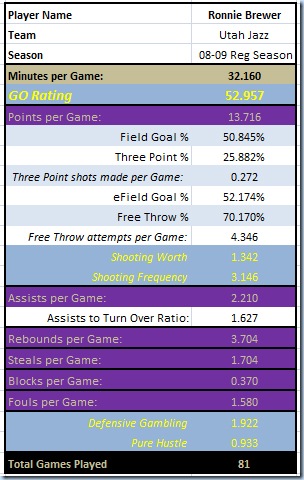
I’m a stats junkie. So this is important to me. Also, I guess I’m debuting my new stats format. If you want to know about what some of these things are, you can always read my treatise on my own created stats. If you don’t want to, just wait for the analysis that will appear below.

Deron Williams Ronnie Brewer
Oct 9 2008 [Melissa Majchrzak NBAE Getty] Nov 26 2008 [AP Photo] Brewer throws it down
click for original image click for original image

First of all, for those of you following along at home, I have changed the GO Rating, and expect a new post about the New formula shortly. What you need to know about it is what these scores mean. The GO Rating incorporates all possible statistically tracked outcomes on offense, hence the full name of “Gestalt Offense”. The GO Rating is in light blue, all the things in the light blue cell background are my own invented stats. I think they better round out what you see. Anyway . . . what is a good GO Rating? I depends on what you are looking for. If you are a point guard it’s hard to be upset if you get a rating in the 130’s. Magic Johnson’s regular season career totals calculate to a GO Rating of 138.784. Allen Iverson’s GO Rating for the same category (career regular season stats) is 134.883. Deron gets 135.701 for his work last season – though shortened by injury, arguably his best season ever. As a further point of reference, Gary Payton’s career GO Rating is 88.882, that’s almost 50 points lower than Deron. Brewer’s rating is much lower, but that’s due to a few major factors. Firstly, wing players who do not take many shots (see shooting frequency, the higher the number the more time it takes to get a shot off) hardly ever do well. Scottie Pippen’s GO Rating for his career regular season stats stands at only 71.431. As solid as Pip was offensively, Brewer is nearly there in his 3rd season in the NBA. That’s not too shabby.

Again, the stats don’t lie when they show how poorly they are as a team when it comes to three point shooting. They make up for it with stellar eField Goal percentages (which I think are more important than just FG% and 3PT%). They both shoot better than average, when it comes to their shooting worth (average being 1.2). Offensively they are very competent getting to the line a combined 10 times a game and averaging over 30 points between the two, while dishing the ball with a good Assists to Turn over ratio. Offensively they put up quite solid stats, and I feel like they are even better defensively. Of course, defensive stats are pretty much useless, so take these with a grain of salt. (if you want more on that rant, read my treatise, linked above)

These guys don’t usually get called for fouls, so that’s pretty good. What is even better is that both of them come out on the positive side of their defensive gambling – Brewer especially makes very smart gambles on defense: effectively getting 2 steals for each fouls he commits. If he was to gamble defensively at that rate he would foul out with nearly 8 steals a game. (For those watching him closely know that he got 6 steals in a recent USA Select team scrimmage) Deron still manages over a steal per game as well, and his primary duty is to man up on his guy, and not actually go for steals. Neither of them block worth a damn – though Brewer should get more in my opinion. Both of their pure hustle ratings clearly fall below that of the Dream Team members, but exist within an acceptable range for starters in today’s NBA. These defensive statistics are not overwhelming – but I don’t put much stock in defensive stats at all. The best defense causes no effect on an individual’s boxscore; if you defend a guy so well that he takes shot he can’t make then you get nothing, except the satisfaction of playing good defense. These two guys are good defensive players – but Brewer gambles more and gets more steals – and it shows.

Conclusion:

Some statistics are worth more than others, and I’d put my money on the offensive ones actually relating to actually being good at playing. That said, Deron and Ronnie are a better defensive tandem than offensively, where their weaknesses are more exposed. (Weaknesses being that neither of them shot over 35% from three last year; as a unit they do not produce much from deep per game; they both do not jack up shots frequently (jacking up shots gives you a better Shooting Frequency and GO Rating for some reason); and so forth) Other guard tandems will score more points per game, and probably get to the free throw line more times per game. There will always be a better offensive tandem around. Collectively Ronnie and Deron make up a better defensive force, and have the talent and ability to get better (they are both closer to 20 than 30 – guys like Kobe, Fish, Vince, Nash, J-Kidd and others are getting up there and aren’t going to be as good in the next few seasons). They can be a Top 5 starting backcourt in the NBA, but they just aren’t quite there yet. I agree with DeFeo’s rankings and thank him for posting this in the first place!

P.S. Thanks to J.E.Skeets for the Ball Don’t Lie link directing me to DeFeo’s post!

Sunday, July 26, 2009

USA Basketball scrimmage pictures! Woo!

Here are some of the (jazz related) pictures from the scrimmage featuring Kyle Korver, Paul Mil$ap and Ronnie Brewer (and coach Ty Corbin too!). All the pictures were photographed by Andrew D. Bernstien for NBAE/Getty Images.

Team Photo

Here is the team picture (L to R): Bottom row is Paul Millsap; Top row is Kyle Korver, Ronnie Brewer and Tyrone Corbin.

Thad

Kyle is on offense, and at half court here. Great job Kyle!

A. Randolph

Here Millsap watches Anthony Randolph throw it down

Jokes

Kyle jokes with Thad Young and business casual friday guy.

Dont want to make you look bad so I will pass

Here Kyle defends Ronnie Brewer, uh-oh, Kyle is on you . . . you better look to pass!

rest

Brewer and Millsap take a breather

Mic

Durant talks while Brewer mentally constructs new ways to defend him

Thad

What does this picture have to do with the Jazz? Oh yeah, Kyle is in it waaaay in the back. Great job Kyle! Keep it up!

Air Brewer

Brewer makes airspace to dunk on Durant

Love me tender

Kevin Love dunks on Millsap

Love me true

Here the two are going for the same rebound . . . but obviously looking at two different things. I wonder who got the rebound . . .

Air Brewer again

Brewer skies in for two more!

Kyle in stealth mode

Okay Amar, now really! What does this have to do with the Jazz? Ah yes, Korver is behind Westbrook (foreground) in the center of the picture, in stealth mode.

Ty does not care for your conversation

And Tyrone is over near a cheerleader on the right hand side.

That's one tall kid, if Kyle is 6'7

It was business as usual after the game for Kyle, who seems to be moving into the Kevin Costner period of his career.

I'm open . . . for the love of God I'm open

Thad Young is trapped behind the basket and Millsap is looking for a pass -- ‘Sap, that pass isn’t going to come, Young is going to shoot this. It was that kind of camp for Millsap – it seems.

the juice

Let’s finish this with some OJ going up and over some Korver defense! You can do it! Go JAZZ!

Tuesday, July 14, 2009

So . . . I was right about Ronnie Price

If you aren’t on twitter, then this is news: the Jazz are going to be bringing back Ronnie Price. (also confirmed by 1320 KFAN by txt message and via Twitter and the PR department of the Utah Jazz, via Twitter) Of course, this was a mere formality after Sloan was talking about Price in post draft interviews about Eric Maynor. But really, you didn’t need that either – you just needed to listen to me all along. So, last off-season the Jazz traded Hart for Knight, and by doing so, put themselves in a position where they would end up evaluating two guys for one spot all season long – with the final prize being a contract. I’m sure it must have been a crazy year for both Ronnie Price and Brevin Knight, playing against each other all season long fighting for playing time, both in the last year of expiring contracts.

Wednesday, October 15, 2008 (an excerpt)

Things to look for this season: Brevin Knight

Posted by Amar at 1:30 PM

“. . . More playing time at PG than Ronnie Price: That doesn't mean that Price isn't going to get playing time this season -- he may very well beat out Knight as the season goes on -- but over all Knight is going to get more playing time at the PG than Price will . . . ”

Thursday, October 16, 2008 (an excerpt)

Things to look for this season: Ronnie Price

Posted by Amar at 11:58 PM

“. . . If you haven't been following Ronnie Price's career, this is pretty much his own version of Sisyphus' challenge. His entire career he's had to make a living by beating other guys out for playing time. He did it two years ago in Sacramento (beating Jason Hart out). He did it last year in Utah (again beating Jason Hart out). And he's basically going to have to do it a 3rd year in a row, having to attempt to beat out Jason Hart the guy they traded Jason Hart for (Brevin Knight). Brevin also being in a contract year makes this even 'better', in terms of entertainment value. They are in direct competition with each other for this season -- and the next ones too! The only way to make things a little bit harder for Price would be if his coach decides 'just for fun' (in that exaggerated East Indian accent that Russell Peters has sometimes) to stop playing him at point guard -- and have him fight for playing time against 4 shooting guards (Brewer, Korver, Miles and Almond). Sounds dumb, right? Sounds even better from Jerry's own mouth [Interview, around the 1:54 to 4:13 mark, via 1320 KFAN]. For the record though, he does compliment Price as well during that answer, and suggests that his versatility allows him to play alongside Knight for a really small, quick line-up.

Basically, then, all Ronnie Price has to do is beat out Knight, and his future here in Utah will be secure, well it should be, right Mo Williams? Price has some advantages though, as he's been here last season, won the job, and played in every playoff game. Furthermore, he's a popular guy (in that younger crew with Millsap, Brewer and Miles) and the Jazz went 43-18 in games that he played in. That's winning 70.5 % of those games -- good enough for a 58 win season over 82 games. Here are three things to look out for this season from Ronnie Price:


  • Hustle every minute on the floor: Deron Williams plays so much point guard that there is very little time remaining for the other guys. There's going to be 8-12 minutes per game available by my estimation, and that's not nearly enough to play all three guys every game. What Price will do is hustle and play very hard in whatever time he has. Brevin Knight isn't going to jump up there and slam down alley-oops, or run back and block guys on fast breaks. Those are the types of plays that'll help get Price another contract with the Jazz -- especially if he plays within the offense and runs the team well.
  •  

  • Be available (and healthy) to play in 80+ games: Knight gets injured every year. He's never played over 80 games and whatever slim window of playing time exists has to be maximized by Price. Price needs to be available every game to go in and give Deron a breather. Especially in the cases where Knight is going to be injured and unavailable to play. It sounds simple, but it makes sense. One easy way to distinguish himself from his competition is be healthy. Coach is going to go with the guys on the roster who can play. Sometimes it doesn't have to be complicated. Knight averages 59 games played a season over his career. There is a window of opportunity for Price here, even if it's not wide open.
  •  

  • Eventually beat out Brevin Knight: I'm going to come out and say it -- there are going to be some situations all year where one of the two guys is going to get to play, and the other guy will sit. There will be situations where one guy is favored to play over the other (match-ups, etc). Also, there could be some times on the court where they both play at the same time. Out of all of those situations I think that the veteran leadership of Brevin Knight is going to be a stabilizing force for our team. I just can't bet against Ronnie Price. He's a smaller, scrappy guard who has three point range and has been in this situation before. Knight is smaller, scrappier, and much better than Jason Hart (the guy Price used to beat out each of those previous times), but I think Price has more fight in him. If Knight gets decked by Turiaf I see him on the floor for a while. Price got decked and was ready to fight. It's probably this fight that's going to win him the job sometime after the All-Star Break. . .”
  • The Price is right

    Price eventually did win out, it appears, but thanks to Brevin Knight for being there. He was instrumental in our team starting the seasons on a 5-0 run, but just did not get it going after that. It’s a shame really, because I think we all expected more out of him. Alas, he’ll be looking to play somewhere else next season.

    Kevin O’Connor (GM): “Keeping Ronnie on our roster was important to us. He is someone who knows our system and has proven capable of stepping in whenever called upon. Over the last two seasons he has shown a commitment to working hard and improving his game, and as a result, we expect his growth to continue.”

    Randy Rigby (Utah Jazz President):Ronnie Price is the consummate professional. He is always prepared when Coach Sloan calls on him and we are looking forward to his energy and toughness next season.”

    “The Utah Jazz announced today that the team has re-signed guard Ronnie Price.  Per team policy, terms of the deal were not released.” (The Utah Jazz, July 14, 2009)

    If you don’t recall, Price did not get a chance to play massive minutes in the playoffs this season, which is in stark contrast to last season’s playoffs. But in the time that he did play, he played with energy, hustle, fire and without fear. That’s the type of player I want on the court when we’re on the wrong side of an elimination game. And that’s exactly the type of player the Jazz have in Price.

    Wooooo! One Year Old!

    Happy Birthday AllThatJazz, you’ve been online clogging up the internets for one whole year now. Sure, you really fizzled down the stretch (like the Jazz), but you were really active in the off-season. Guess what? It’s the off-season again. Oh, the things you have seen in your first year of life . . .

    • Fesenko had blond hair
    • The Salt Lake City media couldn’t get enough of it
    • Morris Almond was killing it in the summer league
    • Deron got injured
    • remember that game in Philly where no one was active to play, and we won?
    • Boozer got injured
    • eventually everyone got injured
    • The team owner died
    • Utah went from 1st in the division to 3rd
    • we just squeaked into the playoffs and were unceremoniously ousted by the eventual champions, the Lakers
    • somehow, over the course of the season, 5 new Jazz blogs came into being

    And since then so many things have changed, this season the Jazz look to a new coach and general manager to right this ship, as Deron Williams will be looking to set up all new team mates in the quest for . . . wait what? REALLY? Okay, scratch that, the Jazz will go into this next season with, pretty much, the exact same team, coach and front office and expect better results. Memo, Boozer and Korver all opted into their final years of their contract. Two low draft picks were added, Millsap is a RFA and hopefully the Jazz are healthier next season.

    So that much hasn’t changed from last year to this year . . . but let’s look at some blogging highlights from the past year! (and no, there are NOT all the blog posts I did all year long, jerks!)

    Hopefully this next season is better for the Jazz *and* All That Jazz (and no, I don’t mean the section of the Utah Jazz Official Website that stole my name, and is featured at the bottom of their page, seriously, that’s a total rip off job) as well. I learned a lot in this last year, and hope to use it by continuing to blog! (Be it here, or elsewhere in some other place)

    Monday, May 18, 2009

    Who else is sick with the Great Hype surrounding Andrew “Bust”num?

    Rehab aint easy . . . If you’ve ever wandered onto an LA Lakers blog, message board, or listened to a nationally broadcasted game by Mike “Fellatio for the Lakers 24/7” Tirico then you’ll know, with complete certainty, that Andrew Bynum is one of the best centers in the league, and will without giving any prior notice, become the next best center in the league and join the pantheon of great bigmen. He will rightfully sit alongside Wilt, Russell and Kareem while using Ewing, Robinson and O’Neal as foot rests. The third footrest will be necessary because of how great and grand his male organ must be – as he has been photographed at the Playboy mansion (who cares) and is curiously linked to Rihanna right now. (who? exactly.)

    As impressive as his potential appears, and as great as his off-court life may or may not be (I’d rather hang out at the Acharya mansion any day of the week) – I’m less than impressed with him as a player. I’m even less impressed when I actually look at his accomplishments as a player in the playoffs (aka. when it counts). Furthermore, I’m pretty much sick to death by the hype that he has received from casual fans, homer fans, and the media alike. Now, this isn’t meant to trash the hopes of the future of the Lakers at all – I strive to temper the expectations of him a little bit. For his sake, and ours.

    My brother is the most rational Lakers fan I know, he is passionate, but not completely under the spell that countless others are on the internet. He’s more concerned with consistent play, rebounding and solid defense from all of the Lakers and does not have the time to worry about if Bynum is going to be the next Kareem – he’s worried about right now. If I was a Lakers fan I wouldn’t be worried about right now – you guys will trounce Denver on your way to the NBA Finals (where anything can happen). I would, on the other hand, be worried about the past – specifically Bynum’s past.

    He’s 21 years old right now and was drafted as a 17 year old. What do we know about him that should really count? How about the fact that he had an injury ruined high school career (leg/knee injury), and in the NBA has had two more leg/knee injuries in his young career. He’s tall, but not nearly as super athletic and fit as freaks like Dwight Howard or Amare Stoudemire are – I don’t expect him to be physically made of the same stuff as those guys are. When you get over 7 feet tall, any injuries to your lower body seriously limit how reliable you can be, regardless of how much work one may put on their upper bodies. (You’re only as strong as your base is – look at Yao Ming, who has just a storied lower body injury history as Bynum, he misses lots of games every year, and is never 100% due to the strain his body puts on his lower body) Amare had two career ending (had this been the 80’s/90’s) knee injuries, but has come back due to a great work ethic. Bynum puts women on his shoulders during rehab. I wouldn’t be making a huge leap by suggesting that Bynum may have a career that features a number of injuries to his lower body, not unlike Yao Ming – as opposed to being virtual injury free like Dwight Howard. But I have no crystal ball, I’m just going on the fact that he’s a big guy with a history of lower body injuries who was injury prone as a teen and only looks to put an increasingly large strain on those same joints as his ages and increases mass.

    That’s not very empirical though, it’s just an assumed health arc based on his body type, job, apparent work ethic, how healthy other big guys his size have been and medical history. What is empirical, on the other hand, is to dig deep and look at stats. I love stats. Stats are flawed, as I’ve explained on this blog before, but they still give a pretty good indication of on court production. (After all, that’s what counts, points, rebounds, blocks, assists, steals, turn overs and fouls, right?)

    After this last game against the Houston Rockets the total number of playoff games that Bynum has participated in stands at 18. These 18 games have taken him from 2005-2006 till now to amass. In that time he has been brought along slowly – thanks to the fact that he doesn’t need to be useful when he’s so far down the pecking order behind at least 4 other guys. That said, his production does not appear to be indicative of him joining the pantheon of great bigmen any decade soon. I want to look at his stats in the playoffs and see the promise that appears to be there (and only appears in regular season games against bad teams sandwiched between injuries). As a point of reference I looked at Patrick Ewing’s first 19 games (why not 18? wanted to complete that one series to make it an even number of playoff off series for the two) in the playoffs. Ewing was a great center, but never will he be called the best of his generation, and thus, not up for entry into the pantheon of greatest bigmen ever (though the media has already reserved a spot there for Bynum).

    Bynum’s first 18 Playoff games, and how they stack up:

    Bynum Ewing and Robinson Ewing creams Bynum statistically. And Ewing played in a time where big guys weren’t bailed out with foul shots, and played against much better competition. Bynum played against the Phoenix Suns, twice anchored in the paint by Frenchman Boris Diaw; the injury depleted Utah Jazz that was forced to start Jarron Collins; and the Houston Rockets, who during the course of the series, lost Yao Ming to injury a little more than 2 games in – and had to turn to a rotation of Chuck Hayes, Carl Landry and Luis Scola to battle LA’s 7 footers. Bynum gets killed – just look at the stats.

    Alas, he is immune to any criticism for a great rebuttal exists: Ewing had much more experience from being a guy who actually went to college, won a National Title; and also played in the NBA for a few seasons before making the playoffs. All this is true, but nothing prevented Bynum from going to college himself – if he was really interested in experience. That said, I also took a chance to look at another young bigman, and saw how he faced the NBA pressure. David Robinson did manage to make the playoffs as a rookie (he led his team there, unlike Bynum who did his best to stay out of Kobe’s way). David Robinson is far from my favorite player in the world – but he also creams Bynum’s numbers when you take out experience and look just at Bynum’s FIRST FOUR SEASONS against David’s ROOKIE season.

    Let’s not forget that David had to go to war against Joe Barry Carroll and the plethora of tough guys in the paint that Portland sported back when David was a rookie. Bynum, with 4 years of experience in the NBA, has yet to face anything like that in the NBA playoffs – and his numbers are completely pathetic.

    Ewing: 22.1 ppg, 10.9 rpg, 2.37 bpg

    Robinson: 24.4 ppg, 12.00 rpg, 4.00 bpg

    Bynum: 4.83 ppg, 3.78 rpg, 0.67 bpg

    Obviously the data is heavily skewed against poor, young Bynum. His first few playoff sorties were short and he was inexperienced. Obviously the stats are going to go against him when you include some of his early games. The Bynum of today is a beast though! Look at Bynum’s numbers from just his 4th season in the playoffs against other greats and you’ll see! You’ll all see!

    Okay, let’s do that then.

    Bynum’s Playoff stats from his 4th season, and how those stats stack up:

    Bynum closer to Ostertag than Olajuwon Bynum’s numbers improve very slightly, he ups his ppg from 4.83 to 5.58, his free throw percentage from 62.96% to 76.47% and he swats almost 0.2 more blocks per game. Still not impressed. He’s a far cry from, let’s just randomly say, Hakeem Olajuwon. In the Dream’s 4th NBA season he happened to tear the NBA playoff’s a new one with his scoring -- 37.5 ppg (57.14 fg%, 88.37 ft%); rebounding – 16.75 rpg; and all around game – 2.75 bpg, 1.75 apg, 2.25 spg.

    Not only did Hakeem obliterate Bynum’s pitiful offensive output by a magnitude nearing 7x, but absolutely owned him all over the boxscore. He also did it against much tougher competition as well.

    Heck, Bynum is so far from being impressive that Greg Ostertag’s fourth year playoff stats could (and do) give Bynum’s fourth year playoff stats a run for their money. It’s horrible to say, but really Lakers fans (and media, or is that redundant?) – take a look and weep.

    Bynum is a much better offensive player than Ostertag (is this even saying anything?), but Ostertag owns Bynum when it comes to rebounds and blocks. Greg even managed to out-assist Bynum and made less mistakes (as seen in less turn overs and fouls per game).

    What’s worse, the fact that Bynum just got his lunch handed to him by Ostertag; or the fact that Ostertag was doing this against super duper vets and talented players like Vlade, Arvydas, Dale Davis and Rasheed (when Ostertag was a 4th year player) – and looking better than media adored Bynum going up against Chuck Hayes and the guy who was behind Ostertag on the depth chart?

    Furthermore, Bynum’s had 5 scoreless games in the playoffs, out of 18. And he’s scored less than 5 points 11 times out of 18. Ouch.

    Take a look at Hakeem’s 37.5 ppg average again. Ouch.

    Of course, there HAS to be a rebuttal for this . . . no way can Bynum been so far behind Hakeem at the same stage of NBA experience, and yet so close to NBA laughingstock Greg Ostertag . . . right?  . . . .right? Don’t worry Lakers fans, of course there is . . . forget about NBA experience, that’s a flawed concept. Let’s not forget that Hakeem and Greg both played college ball (like Ewing and Robinson did) . . . Bynum didn’t play college. Look at how young he is! He’s only 21! Surely when you take that into account it makes up for 32 ppg (in the case of Hakeem), or nearly a block and a half (in the case of Ostertag)!!!

    Okay, let’s take at a look at that. Try me.

    Bynum’s Playoff stats as a 21 year old, and how those stats stack up against another 21 year old:

    Bynum is a far cry from Shaq when looking at their stats at age 21 Bynum is a very brittle 21 year old who doesn’t have to do anything, and his team makes it to the NBA Finals. I’m not lying, the Lakers did that last season. That said, Bynum is a force of nature, and the future of the center position in the NBA. His 21 year old production is unrivaled. Right? Wrong. Take a look at this guy, and what he did in the playoffs at the tender age of 21 (his 2nd season in the L, not his 4th like Bynum). I just have one hyphenated word to describe this: Shaq-Attaq.

    A lot of the same Lakers fans who champion Bynum marginalize how great Shaq was. I can clearly see why Kobe went out of his way to suggest that Bynum needed to be traded – because Kobe knew how good Shaq was. The difference between the two is quite telling when you look at these two centers at the age of 21, Bynum in his 4th season and Shaq in his 2nd.

    The difference between the two was almost 15 points, 10 rebounds and over 2 blocks and almost 2 assists . . . in favor of the 2nd year player.

    That’s a huge difference.

    The difference between being called one of the best bigmen of all time, and being called a bust.

    Bynum was a lotto pick man, and aside from his inspired dirty play in injuring two guys this season, and being afraid of Fesenko in the paint, he’s done nothing to earn the high praise that’s heaped on him. And he’s done nothing to make me feel like giving him any props.

    His current playoff run isn’t over yet, and he’s got one, most likely two more playoff series to make his 2008-2009 playoffs slightly more memorable than his complete no-show in the 2007-2008 playoffs.

    I’m taking it easy on Bynum here by comparing him to guys that he may yet one-day reach . . . even if it doesn’t seem like it. I could really try to down him if I wanted by comparing him to his contemporaries who are out-playing him right now. For example take Dwight Howard -- in his first 14 playoff games: 17.86 ppg (57.23 fg%, 51.72 ft%), 15.5 rpg, 2.71 bpg, 1.14 apg, 0.714 spg . . . those numbers are way better than Bynum’s. Also better are Dwight’s numbers as a 21 year old and Dwight’s numbers in his 4th NBA season.

    If I really wanted to be a dick I’d mention that Dwight also has 3 less leg injuries. I’m not a dick though, so I’m not going to mention that.


    What did we learn?

    What did we learn? Well, for starters we learned that Andrew Bynum’s playoff performances leave much to be desired. His first 18 games in the playoffs pales in comparison to Ewing’s numbers over the same situations – and Ewing played against much better defensive clubs like Michael’s Bulls and the Bad Boy Pistons. We learned that David Robinson’s rookie season playoff numbers invalidates the argument that Bynum’s rookie numbers shouldn’t count. We also learned that Hakeem’s numbers as a fourth year player completely eclipse Bynum’s as a 4th year player. I didn’t even have to look up 2nd tier NBA centers like Rik Smits at all after I found out that at the same level of NBA experience that Greg Ostertag’s playoff performance was a wash with that of Bynum’s. Lastly, we learned that Bynum can’t even hide behind his age as an excuse for how poor his performances have been – as Shaq as a 21 year old eats Bynum up. Ultimately, we learned that it’s a bit too premature to call Bynum anything other than a bust at this stage. He’s much closer to Ostertag, albeit one who rebounds and blocks less, and fouls and turns the ball over more, than he is to being one of the greatest bigmen of all time – let alone in his own generation.

    After all, Dwight’s numbers at each break down (first x number of games, 4th NBA season, and at age 21) are vastly superior to Bynum’s. Oh yeah, also Bynum has a history of injury problems to the same parts of his body and young guys who sustain so many injuries in short succession tend to have injury plagued careers. Yeah, I wasn’t supposed to mention that again . . . I guess I am a dick after all.

    Bynum doesn’t deserve his hype until he does something. Something other than sucking when it counts, that is.

    If you liked the stat breakdown, and would like a full version at full resolution, click on the image below. I dunno, maybe you are just into making Bynum look silly . . . or want a stat heavy window’s desktop wallpaper . . . or both? Go nuts!
    Click to view in full resolution

    Monday, March 9, 2009

    Charlie Rosen sez: 'D-Will > CP3'

    Don't know how I feel about this one . . . I'm not a fan of Rosen, but he does make statements that I tend to personally believe to be significant factors in the long run. Only time will tell though . . .

    Carlos Boozer to English Dictionary -- Episode 1

    Communication is essential in all group efforts; it doesn't matter if you work at a pizza parlor or a professional sports team -- if your communication skills are lacking then you may actually hurt your team. Carlos Boozer, I've come to believe, speaks his own language. How else can you justify his comments to the press and his in-game chatter? As a result I've taken it upon myself to translate some of what he says into what it means. Here's the first batch, enjoy!

    Photographed by Melisa Majchrzak for NBAE / Getty Images 5. "My _______ (injured body part) is fine. I'm ready to play!" Situation: Any given interview with Carlos Boozer that discusses his injury du jour. What this means:

    "I'm so unbelievably brittle that at times I can make Tracy McGrady look like Cal Ripken Jr. I fully expect that ______ (injured body part) will never, ever heal, or will be surgically removed in the next few days. The pain I feel is a deep as an ocean. An ocean of pain, if you will. I will never admit that I am going to miss months of action for fear that it may interfere with any potential trades and/or my current contract year aspirations of becoming even more wealthy. In conclusion: don't hold your breath for me to return from my injury."

    Example: Pretty much every few months / planned Boozer family vacations during the year.


    4. "Memo!!! Get it!!" / "Memo!!! Grab it!!" Situation: Utah Jazz players are on defense and Carlos Boozer has just been beaten by his man, or failed to box out his man, or is himself boxed out and cannot effectively defend the play. There are several variations on this, depending on the in-game situation, for example, sometimes he says "AK!!!! Get it!!" instead of "Memo!!! Get it!!!" What this means:

    "Memo! I suck at defense, grab the rebound before the other team gets it / rotate and end up fouling my man -- whom I was unable to stay in front of, yet did not wish to foul on my own!"

    Example: Almost every game.


    3. "And one!" Situation: Carlos Boozer, or any other Utah Jazz player has just taken a shot in the paint. This is proclaimed at all times: shot goes in, shot doesn't go in, ref calls a foul, ref does not call a foul, there is actually no foul, or there was a legit foul on the play. What this means:

    "I wish to suggest strongly that I (or Jazz player who took the shot) was fouled, yet we still were good enough to score -- and I will continue saying this even in the event that the ref does call the foul, or in the event that the ball has no chance to go into the hoop. I'm so good at saying "And One!" that they should be counted as assists."

    Example: Boozer scoring against the Golden State Warriors . . . this one is actually an example where the ball goes in, but if you watch as many Jazz games as I do, you know that the ball going in (or an actual foul being committed) is not a prerequisite for this exclamation.


    Photo by Melisa Majchrzak for NBAE / Getty Images 2. "Rrraaaaghghaghghahghhhh!" Situation: Any play where Carlos Boozer exerts himself beyond the breaking point of any lesser man, or mortal who ever lived. This can be a tough rebound, a hard finish, or alternatively, whenever Boozer shoots a free throw that so obviously has no chance of going in, that he is forced to deflect some of the attention from the shot to the large man making noises at the free throw line. What this means:

    "Hey! Everybody! Don't look at my horrible shot, look at me! I'm really sorry for missing, I usually make them, gimme another try! I can make animal noises!"

    Example: A few highlight plays every game, or, 30.3% of his free throw attempts.


    1. "Oohh! SH*T!!!" Situation: Carlos Boozer just committed an in-game infraction or otherwise made a bad play / is unable to react to a disadvantageous situation in any meaningful way except to announce that something bad just happened. What this means:

    "Something bad just happened."

    Example: Just watch this video of Chuck Hayes (of the Houston Rockets) shooting free throws . . .

    Saturday, March 7, 2009

    In your face, Denver

    Seriously . . . today was a crappy day. Crazy rush hour traffic to get to the airport, long flight filled with nagging all the way, end up arriving in Austin, Tx late . . . don't check into the hotel until around 3 am on Saturday (left on Friday), find out that I lost my cell phone somewhere between Detroit and Austin . . . (and it was a fancy $500 dollar phone) . . . but the Jazz beat Denver. So this is good news, and ultimately, a non-crappy ending to a crappy day.

    Jazz had to fight for this one, and came from behind to win it. Memo and Boozer had really off shooting nights, but Deron was the hero (as usual). I did not see any of the game, but I did set up my DVR to record it. I will watch it when I get back. Ten in a row, baby!

    March 6 2009 - Deron and Booz celebrate [Melissa Majchrzak for NBAE Getty Images]

    GO JAZZ GO!

    Friday, March 6, 2009

    Contract years, Developing Talent & Front Office Subterfuge

    The work of a General Manager is easy to criticize, yet hard to fully quantify. Team owners are like dragons sleeping on their hoard of gold coins and other priceless treasures. Coaches want to build winning resumes. Players want to get paid. The GM has to be the go-between that gets all these parties (with differing motivations) on the same page. The GM has to get a coach the players he needs to win. The players want the promises they need before signing on the dotted line (salary, role, playing time, etc). And for the team owner, well, the GM has to placate this obstacle on a near daily basis and convince the owners not to devourer the GM on sight -- while suggesting that parting with part of their hoard (on the 1st and 15th of each month) is the smart thing to do.

    [Matthew Mitchell -- Draconomicon] Dragon and Hoard

    At times the NBA can be distilled to purer components, of winning and losing, and of the honesty of the game. Yet, at other times the NBA can expand into a complex juggling act more akin to micromanagement in a strategy game, or a RTS click-fest. For players, the game is the game. It's simple in that way, and relies on skill, speed and quick reflexes -- a Video Game analogy would be the first person shooter. For coaches, it's series of complex decisions, not unlike the original turn based strategy game called "Chess". (you may have heard of it) The GM, though, has to delve into the previously mentioned RTS click-fest:

    But instead, imagine dealing with salaries, egos, scouts, coaches,
    players and injuries . . . also less cannons, probably . . .

    *Ahem* Back to the point . . . a GM's job is rarely done perfectly because of how difficult it tends to be. Some GM's are great talent evaluators (for example, there's Isiah Thomas, just look at the player's he has drafted in his career, most of them have been All-Stars or award winners in some regard: Vince Carter, Tracy McGrady, Marcus Camby, Damon Stoudamire, David Lee, and so on) but poor on other sides of their job description. Other GM's have good connections with other teams, and always seem to do business with them (look at Kevin O'Connor and all the deals he has made with Philly over the years). Some GM's are really good with managing money, while others are known for turning things around in short order. At the end of the day, though, the GM is a salesman. He is essentially selling his services to a consumer -- in this case the team owner. Part of sales is to buy low and sell high. Another part of sales is to be consciously deceptive in just what your wares are. That last part does not really apply fully to the GM - Team Owner relationship, but rather to the GM to GM relationship. Sometimes you get a lemon, but you have to pass it off as a safe family sedan. Other times you (as the GM) are working not against the team owner, the other GM's, but the actual assets -- the players and their agents.

    You want to keep a good player on your team for the least amount of money it's going to take to keep him there. All Team Owners expect the GM to be able to do such a thing. This part of the job ties in directly with the buy low/sell high and deceptive doctrines. If the first step is acquiring a player (via a Trade, Free Agency or the Draft), then the next step is evaluating that player (though, we hope that some evaluations have taken place before the player is traded for/signed/drafted). The next logical step would be to give playing time to that player and develop him. The last step? Making a decision on that guy -- sign him again when his contract expires, trade him, or let him walk. Parts of the last step depend greatly on each of the previous steps.

    • For example, say the team acquires player A. They evaluate him, see some things they like, some things he needs to improve on, and play him accordingly. He either gets better or worse. If he does well, he becomes more valuable to the team -- and more valuable as a player. His asking price may go up, and making the last step (in this case: deciding to keep him) harder to do. An example of this Jazz fans may be familiar with would be All-Star Mo Williams.
    • Player B, on the other hand, does not appear to have much upside, does not make the most of his chances on the court, and is not in the future plans of the team. They can get rid of him in a variety of ways, the team's disinterest in retaining him opens up options for his removal. An example of this Jazz fans may be familiar with would be Kris Humphries.

    It's not always this simple, though.

    • What about Player C . . . the team that drafts him knows him best, and knows that there is hidden potential deep inside. If they go about normally giving him playing time, allow him to develop openly (instead of only during closed practices and workouts with the team), then other GM's may wish to pry him away. Even if the original team wishes to keep him, retaining him may become very difficult as the exposure led to quicker development, which led to a greater player value. This would be repeating the same mistake with Player A all over again. What if, instead, the team decides to develop him secretly, give him less exposure, drive his asking price down, remove interest other GMs would have in him, and basically, keep him on the "down low".

    This is pretty much the only way to retain those people that you think *can* blow up (in a good way), without having to give them a lot of money to make them stay. Deron Williams deserves the contract he got. It's an expensive contract though. Some teams are forced to over-pay to retain their talent (don't need to look farther than a young, uninjured Andrei Kirilenko half a decade ago). In general, you want to avoid doing that. If anything, I think we can clearly place the curious case of C.J. Miles as an example of a Player C scenario.

    Dec 11 2008 [Melissa Majchrzak NBAE Getty] CJ with the thunder dunk At the end of C.J.'s first season he was getting more playing time, and in the last game of the season he played really well. How well? 23 points (8/13 fg, 2/5 3pt, 5/8 ft), 6 rebounds, 4 assists, 2 blocks, 1 steal -- as a rookie with extend playing time playing against a tough Western Conference team. Every off-season since then there have been fishy things going on. He was a consistent no-show in future summer leagues, but instead opted to work on his game by himself. During times of injury he would be pressed into the starting line-up, only to return to the end of the bench only a few days later. C.J. should have played more than he did in when he was on his rookie contract. The clock struck 12 on C.J.'s contract though, and the Jazz simply put themselves in a situation to match whatever contract someone threw his way by virtue of him being a restricted free agent. No one really bit, not knowing what they would be getting . . . until Oklahoma City offered him a 4 year $15 million dollar contract. We all know how that story ended, as the Jazz eventually matched. Was $3.75 million per season too much for C.J. Miles? Perhaps . . . but at the same time, it's a lot less than it could have been had C.J. been playing like he is now at this time last season. (or perhaps, getting the playing time that he is getting now at this time last season) Back then I thought the Jazz were (in chronological order) a) not developing C.J. enough, b) using him only for spot duty, c) giving his playing time to guys who did not deserve it.

    This season Ceejay has been everything from a solid deep threat, a versatile 2nd option on offense, to invisible . . . sometimes all in the same week. This is his 4th season in the league, and his first where he has averaged over 11.5 mpg. I'm sure he would be better, more seasoned player than he currently is if he was playing 20 mpg every season after his rookie campaign. I'm also pretty sure that he wouldn't be on the Jazz then. In effect, one could directly point to a systematic way in which the Jazz brass (Sloan and O'Connor mostly) lowered interest in a prospect, sequestered him from exposure (he only got one short stint in the NBA DL), yet did not develop him for fear of losing him. At the end of the day the Jazz have C.J., but not the C.J. he could be right now, and C.J. is not earning as much as he perhaps thought he would be after his rookie contract expired.

    The Jazz financial situation is horrible right now. If it does not improve shortly than there may be a few more Player A type situations in the future with key contributors Paul Millsap and Ronnie Brewer. The Jazz would love to keep them for reasonable contracts, though their development (and production) have elicited quite a bit of exposure. Good for their bank accounts, perhaps not so great for the Jazz.

    That's where the micromanagement comes back into play. You want your players to be good, productive and develop . . . but you do not want to lose them to other teams after you put in all the hard work to make them useful. Gilbert Arenas comes to mind, he was drafted, developed, and then left to get paid in free agency. Right now the Jazz are playing the "front office subterfuge game" with some other young players that could possibly be helping the Jazz right now.

    Oct 9 2008 [Melissa Majchrzak NBAE Getty] Mo looks to pass Morris Almond: He is a scorer's scorer, who despite having limited quickness and has played defense only once in his life, could be doing a whole lot more for this Jazz team. He's looked horrible in his rookie season with the Jazz where he never got to be involved in the plays that the regular rotation run that get swingmen easy buckets. He didn't play a minute with Deron Williams last year, and was relegated to garbage time spot up shooting from the corner. Reason for not getting playing time: He's behind a few key guys on the depth chart and doesn't rebound or defend as well as others. For some reason this has prevented him from playing one single second in the NBA-DL this season. Something fishy: Why hasn't he played in the D-League at all this season then, if there's no space for him on our current roster? Do the Jazz know that he's a raw gem that only seems to look better when he gets to play?  Utah is healthy now, so there's no real risk to put him in the game at all . . . maybe practice with the Jazz is better than games with the Flash? Or maybe they don't want him to get too much exposure right now? Utah has opted not to extend his contract, so seemingly he is out . . . but maybe they are trying to keep his going rate low so that they *can* still have a shot at retaining him for a while. After all, they scouted him, interviewed him, drafted him, are developing him . . . Harpring's contract expires next year, and the Jazz will need a wing player who can come off that Harpring curl and hit the mid-range jumper. Financial situation aside, that sounds like something the Jazz have in their laps right now with Almond. Alas, this is exactly not the contract type of year a young player wants to have (being buried on the bench). Co-incidentally, this is exactly the type of contract year the Jazz would want him to have . . . after all, they did the same thing with Ceejay, they know what they are doing.

    Oct 9 2008 [Melissa Majchrzak NBAE Getty] Fes defends Shaq Kyrylo Fesenko: Very large man (7'1, 300+ lbs.) with the same wingspan and standing reach as Greg Oden -- yet uninjured and a capable passer and interior defender who has, due to injuries, been pressed into defending the likes of Yao Ming to Andrew Bynum . . . and done so well. Very likely that he is more talented than the guy ahead of him on the depth chart (Jarron Collins), but lacks experience, familiarity with the system and seasoning. Reason for not getting playing time: Work ethic and personality appear to anchor this man to the bench, though at some level talent and ability should trump that. Something fishy: As a rookie, this wet behind the ears, 2nd round draft pick center joined the Jazz and played in 70 games, and played over 20 mpg. This player joined a playoff team that was contending for a championship. This player had no experience with the Jazz system prior (as a rookie) and ended up getting playing time over a limited, soft center who had much more experience in the system. This young player was Jarron Collins. What, did you think I was talking about Fesenko? Heck no, Fesenko has played only 200 minutes with the Jazz in his 2 year career, let alone played in 70 (@ 20 per) as a rookie. Why is there such a disparity between Collins' and Fesenko's early careers? I don't know, but it seems kind of fishy to me. Even more fishy is that Fes only had one stint in the NBA-DL this season (8 games), promptly did exactly what we'd want him to do (be a defensive presence who rebounded, blocked and changed shots, shot a high percentage and eventually was averaging a double double) . . . and was called back and never played again. Ever. Hmmmm . . . he improves, shows that he's good at what he does . . . and can be a free agent this season . . . 'need to reel that big boy in, and hide him somewhere!' (which was the original plan with drafting a little known, poorly scouted player from a minor European league in the first place) More so than Almond, I think that Fesenko has a future with the Jazz, or at the very least, in the NBA somewhere as teams always want size, and if the guy is talented, he's going to get a contract somewhere. If you gave him the playing time, I'm pretty sure that he'd be able to get Rookie Millsap type of numbers for sure.

    Nov 26 2008 [Melissa Majchrzak NBAE Getty] Put back jam Paul Millsap: Speaking of the 'Sap, he got some great exposure this season. He produced as a starter due to injuries to Carlos Boozer. He's a free agent, and he's going to get paid this off-season. No doubt about it. Interestingly enough, at the first whiff of a hobbled, rusty Carlos Boozer the Jazz sent 'Sap back to the bench and as his fantasy owners know firsthand, 'Sap just hasn't been the same since. Reason for being sent to the bench: Boozer was the starter before he got injured, the Jazz/Sloan doctrine on this is that you cannot lose your starting job due to injury. Something fishy: No one said anything about a starting job, but just let Paul start the first 4-5 games after Boozer comes back and then let Boozer slowly work his way back into playing shape, and then give Boozer the starting spot. A lot of teams do this, they bring a starter back from injury on the bench just to test things out a bit. Out of all of my conspiracies, this is among the weakest -- though I don't see why the Jazz didn't keep starting Millsap for 4 games while Boozer (who was playing limited minutes) worked his way back into starting shape. For one thing, this almost looks like a directed attempt to reduce Millsap's exposure (for the open market). It's probably not, but it just looks fishy -- during a contract year, no less.

    Nov 19 2008 [Melissa Majchrzak NBAE Getty] Kosta gets the board Kosta Koufos: Let's just say that if this 19 year old was playing Brook Lopez type of minutes on a bad team we'd see Brook Lopez-ish production out of Kosta. Yet, a guy who is clearly more talented than Collins, and is a very hard worker (much more than Fesenko has shown), is completely lost on this team. Kosta isn't on the active roster right now, isn't playing in the development league, and isn't developing. Reason for not getting playing time: Apparently he doesn't know the plays. Sure, he's a smart shot blocking 7 footer who has a nice offensive game AND is a very hard worker who hustles . . . but he's not going to get to play because by playing him he would then be in a position to actually learn the plays, and then we would have even less of an excuse for why he isn't playing. He's almost a gestalt character that takes the size (mostly) and shot blocking of Fess, with the hustle and work ethic of Collins . . . and gets none of the playing time that he should. Something fishy: There is no good reason not to play this guy, develop him with real NBA minutes, or even send him to the NBA D-League for some in game action. He hasn't seen the developmental league at all in his career, instead getting better by wearing suits next to Carlos Boozer for 50+ games. That's another thing, he got some very minor playing time just because of injuries . . . this season was a prime season to be forced into playing and developing younger talent. Sloan had to work many games without being able to call on veteran bigmen . . . but still he elected to instead play Matt Harpring at power forward. Huh?

    It's not that difficult to imagine that the Jazz are hurting their futures by risking not getting these guys playing time because they do not want to lose them to other teams . . . but they also get nothing out of these guys. Other teams play younger players during the regular season so that they may become contributors to that team . . . and even help them in the playoffs. Heck, our team did this with Paul Millsap as a rookie, or Shandon Anderson (more on him later), or Bryon Russell and a host of others. There's no doubt in my mind that if Fess of Kosta were getting 12-15 mpg this season that one of them would be able to contribute in the playoffs for us. Instead the development time has become much longer for a bunch of guys who could be helping us now. Also, it's not that difficult to imagine that the Jazz are hurting the values of their players by flat out burying them during contract years. No playing time = no exposure and no stats = bargain prices. They did this with C.J., and if they had a time machine, would probably like to do so with others as well.

    The way that the Jazz develop talent seems to be highly unequal. Some young guys get regular burn, while others don't. This time is directly proportional towards development. I think that Jazz Brass feel the financial side to all of this needs to take precedence over the immediate development and returns from the players on the roster. The Jazz gave good minutes to a solid player (Shandon Anderson) as a rookie, and eventually left the team, the Jazz get nothing in the long term for it. The Jazz gave good minutes to a very talented player (Andrei Kirilenko), and end up having to really over-pay to keep him on the team. The Jazz don't want to get into anything like that again, and now underplay most guys during the span of their rookie contracts, so they they do not have to over-pay.

    C.J., only after the Jazz matched an offer he got from another team, is finally getting playing time -- but as a 4th year guard with the potential that he had when he was drafted, he is behind where he should be. They seem to be guilty of doing that with Almond and Fesenko by not playing them in the NBA, nor allowing them to rack up stats in the D-League . . . which would have been a great way to audition for other teams during contract years -- or you know, actually get better and be able to help OUR team.

    Some Jazz apologists feel like the practices the Jazz have are of greater value to a younger player than actually playing in the development league, or even playing in the NBA on poorer quality teams. I think that this is a very haughty thing to say . . . especially with how closely the Jazz *can* keep an eye on things with their development team being only a few miles away and the coach of that team is related to Jerry Sloan -- it almost seems like a no-brainer to send the kids down at least once each when none of them are even on the active roster with the Jazz. They threw C.J. a bone once by doing that, by giving him a chance to play, and that improved his morale. Why not do the same for a younger player this season? Sloan even goes out to harp on how great the D-League is, and how he wishes they had that when he first came into the league. If it's so great, why not use it, now that the rest of the guys are healthy?

    As for how great the Jazz practices are . . . they rarely get a chance to practice on the road (they only practice on days off, and now at the end of the season, with the playoffs coming up, there may be less than the regular number of practices on off-days), so the younglings are getting even less time to improve than normal. This clearly is the case where the GM, at the behest of saving the team owner money, works with the coaches to screw the players out of money / job satisfaction. Or maybe that's by design, especially in their contract years?